
AI Search Visibility
How To Turn AI Visibility Data Into a GEO Roadmap in 2026

 JoseGrowthatOmniaJoseGrowthatOmnia
TL;DR
Generative engine optimization (GEO) is the practice of ensuring your brand appears in AI-generated answers on ChatGPT, Perplexity, and Google AI Overviews — not by ranking for keywords, but by becoming a trusted source AI models cite. GEO and SEO are related but not interchangeable: SEO earns rankings, GEO earns citations. The fastest way to close visibility gaps is to track which prompts matter, identify the sources AI relies on, and publish content where those citations already live.
Most brands treating GEO as "SEO with a new coat of paint" are already losing ground. The prompts that drive buying decisions in AI engines don't work like keywords, and the content that wins citations doesn't work like blog posts optimized for Google.
That gap is where competitors take demand you never see.
This guide explains how generative engines decide what to recommend, what actually drives AI citations, and how to build a repeatable system for improving your brand's presence in ChatGPT, Gemini, and Perplexity. By the end, you'll have a framework you can run, not a theory to consider.
Though there are differing opinions, we can’t treat GEO as a buzzword for search engine optimization (SEO). The two disciplines share some inputs but produce entirely different outputs, and confusing them is the most expensive mistake brands make in 2026.
| SEO | GEO | |
|---|---|---|
| Goal | Rank in search engine results pages | Appear in AI-generated answers |
| Works through | Technical SEO: Keywords, backlinks, technical structure, domain authority | Citations, source authority, content structure, brand entity recognition |
| Success metrics | Rank position, organic traffic | Mention rate, citation frequency, share of voice |
| Output | A list of links | A synthesized answer — your brand is in it, or invisible |
More than 58% of customers now start their buying journey in an AI chatbot. That's not a trend to monitor. It's a shift that's already reshaping your pipeline.
Understanding GEO starts with breaking it into its actual components, because they require different tactics and surface different gaps. The following are the three main elements of GEO:
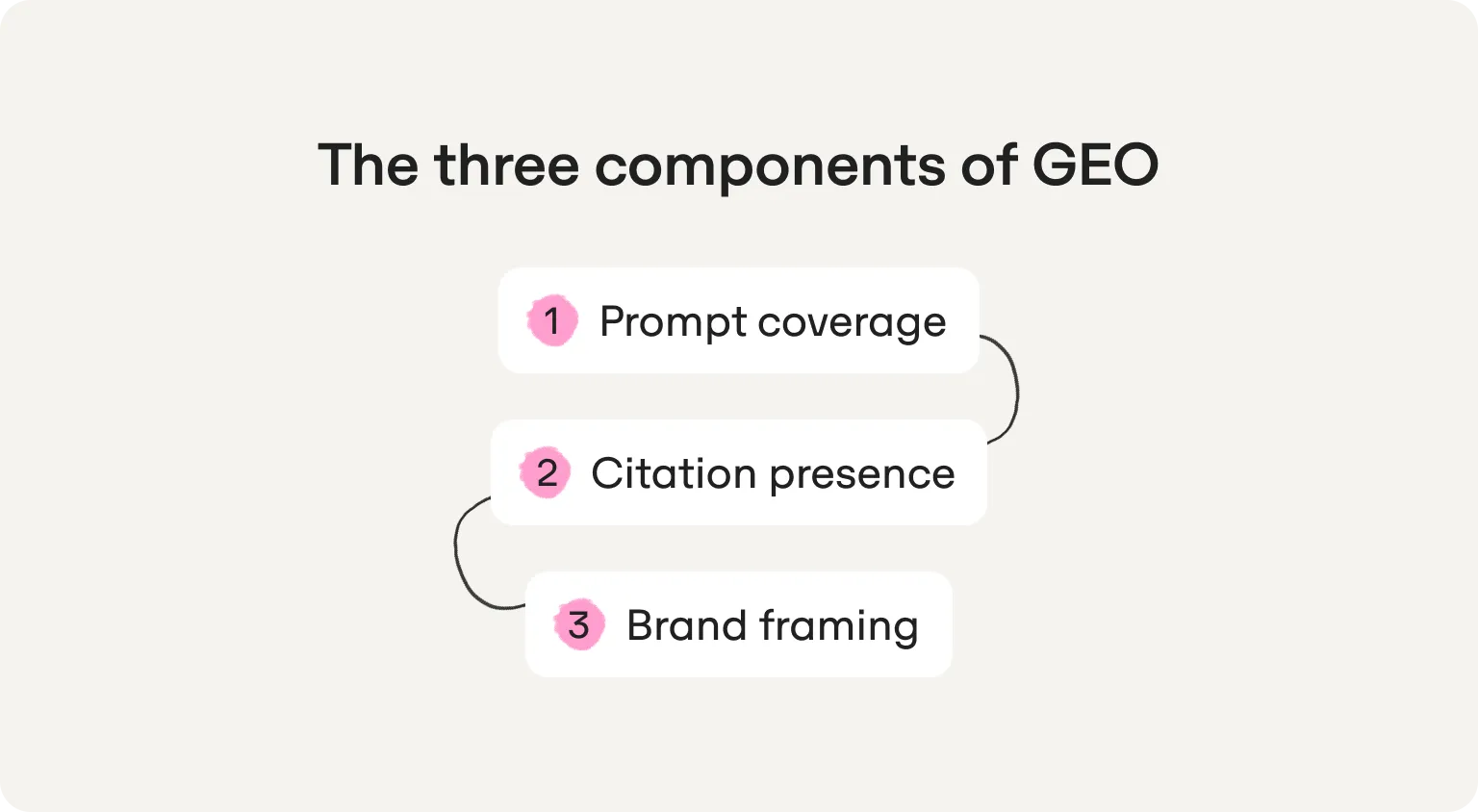
Some GEO strategies address prompt coverage and ignore citation presence and framing entirely. That's why results stay flat.
There's no secret ranking algorithm to hack. AI models don't maintain a "top positions" list the way Google does. They use a pattern-matching system trained on content, citations, and entity relationships across the web.
Three factors reliably influence AI recommendations.
1. Source authority and citation networks
AI engines learn which sources to trust based on how frequently they're cited across authoritative domains: academic papers, established media, industry directories, and peer review platforms. A brand mentioned only on its own website and a handful of low-authority blogs won't appear in AI answers, regardless of how well that content is written.
What makes this harder is that each engine has a different trust hierarchy. Based on Omnia's citation database tracking 42M+ citations, YouTube is the single most cited domain in Google AI Overviews and AI Mode, but registers just 16,000 citations in ChatGPT compared to 446,000 in AI Mode. Wikipedia sits at the other extreme: 200,000 citations in ChatGPT, fewer than 5,000 in AI Overviews. The sources that earn visibility in one engine won't automatically earn it in another.
| Domain | Perplexity | AI Overviews | AI Mode | ChatGPT |
|---|---|---|---|---|
| youtube.com | 193K | 399K | 446K | 16K |
| wikipedia.org | 5K | 5K | 12K | 200K |
The implication: the question isn't whether you're cited on the sources each specific engine trusts. A content strategy built around one engine's citation preferences can leave you invisible everywhere else.
2. Content structure and answer-readiness
Generative models prefer content structured like the answers they give: clear claims, named evidence, concrete specifics, and direct responses to the questions users actually ask. Content that hedges, meanders, or buries its conclusions is harder for models to parse and cite. High-quality content that directly addresses user intent — what the person is actually trying to learn or decide — gets cited more consistently than content written to satisfy a keyword.
In practice, short declarative sentences do more work than long complex ones. Specific figures outperform general statements. Content that directly answers a named question is more citable than content that addresses a topic broadly.
3. Brand entity recognition
AI models build associations between brand names and category definitions. If ChatGPT associates your brand with a specific use case, team size, and problem type, it will surface you for prompts that match. If your brand's entity is undefined or inconsistent across sources, you'll appear randomly, or not at all.
Entity recognition is built through consistent external mentions, structured data, and the language used about your brand across third-party sources — which is why some practitioners frame this work as answer engine optimization rather than generative AI optimization: the goal is to be the answer, not just part of the index.
This is where most GEO advice goes wrong. Tactics borrowed from SEO get repackaged as GEO strategy, and they don't produce results.
This is a system with logical dependencies. Each step requires the prior one to be meaningful. Skipping step one makes step four a guess when it comes to generative engine visibility.
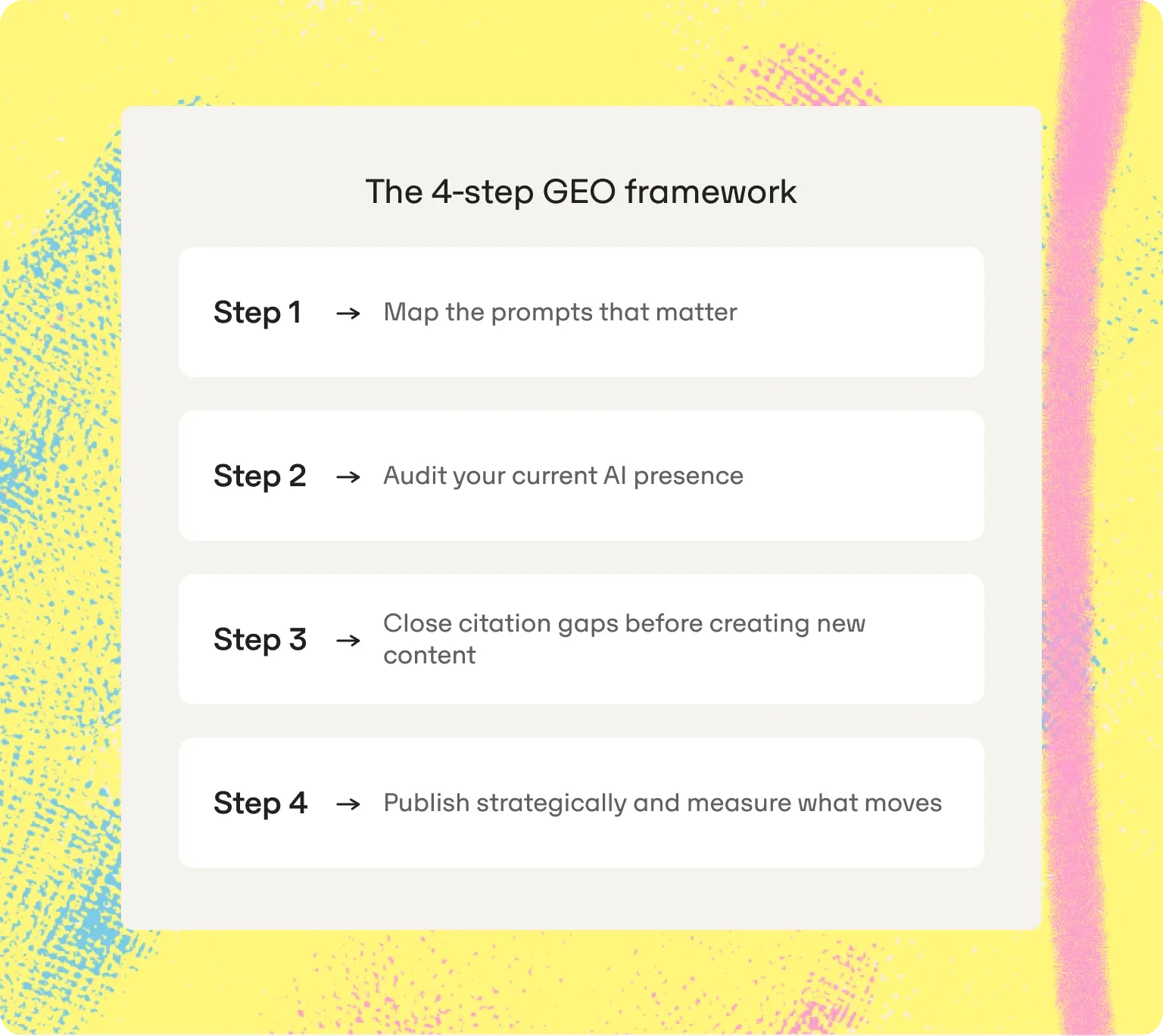
The first mistake in GEO is optimizing content without knowing which prompts drive AI-assisted buying decisions in your category.
GEO prompts are not keywords. A keyword is "AI visibility tool." A prompt is "What's the best tool for a startup with a two-person marketing team to track where they appear in ChatGPT?" The prompt carries context, persona, and intent that a keyword doesn't.
Start by mapping prompts across three categories:
| Prompt type | What it looks like | Why it matters |
|---|---|---|
| Category-level | "Best [category] tools," "top alternatives to [competitor]," "[category] for startups" | High visibility, high competition — your brand either appears or doesn't |
| Problem-level | "How do I increase my brand visibility in AI engines?" "Why am I not showing up in ChatGPT?" | Surfaces buyers earlier; content that answers these gets cited in future category-level answers |
| Comparison | "[Your brand] vs [competitor]," "alternatives to [your brand]" | Highest-intent prompts — buyers already evaluating solutions |
Map 15–20 prompts across all three categories before building a single piece of content. This is your target audience expressed as the questions they're already asking.
Before deciding what to create, know what AI engines currently say about you.
Run your mapped prompts across ChatGPT, Gemini, and Perplexity. For each prompt, record:
That last point is the most valuable. The sources AI cites when recommending competitors are the sources you need to appear on. If G2 reviews, a specific industry blog, or a comparison site consistently appears in AI answers for your category prompts, those are your citation targets.
Manual auditing across 20 prompts and three AI engines is feasible once. It is not a sustainable monitoring system. At scale, this requires tooling. If you want a quick baseline before committing to a full setup, Omnia's free AI ranking checker gives you an immediate read on where your brand stands across AI engines — no account required.
Most GEO strategies start with content creation. The first question should be: are you being cited anywhere? If not, new content won't fix it.
Citation gaps — prompts where competitors appear and you don't — are almost always a source authority problem, not a content quality problem. Fixing them requires a two-track approach.
Get your brand onto the sources AI trusts:
Audit your existing high-potential content and restructure it for citeability:
Don't create new content until you've diagnosed whether a citation gap or a content gap is the actual problem. They require different fixes, and spending a month publishing when you have a citation problem produces nothing.
Once citation foundations are in place, content creation becomes a targeted operation. Each piece should target a specific prompt cluster, be structured to match how AI engines give answers, and be distributed to the sources AI already cites in that cluster.
| Metric | What it tells you | How often to check |
|---|---|---|
| Mention rate | How often your brand appears across your target prompt set | Weekly |
| Citation rate | The subset of mentions where AI references your content directly | Weekly |
| Share of voice | Your mention rate vs. competitors' across the same prompt set | Weekly |
| Prompt convergence | Whether multiple AI engines give similar answers for the same prompt — low convergence means opportunity | Monthly |
If you're a VC-backed startup with a one- or two-person marketing function, the framework above is achievable — but only with ruthless prioritization.
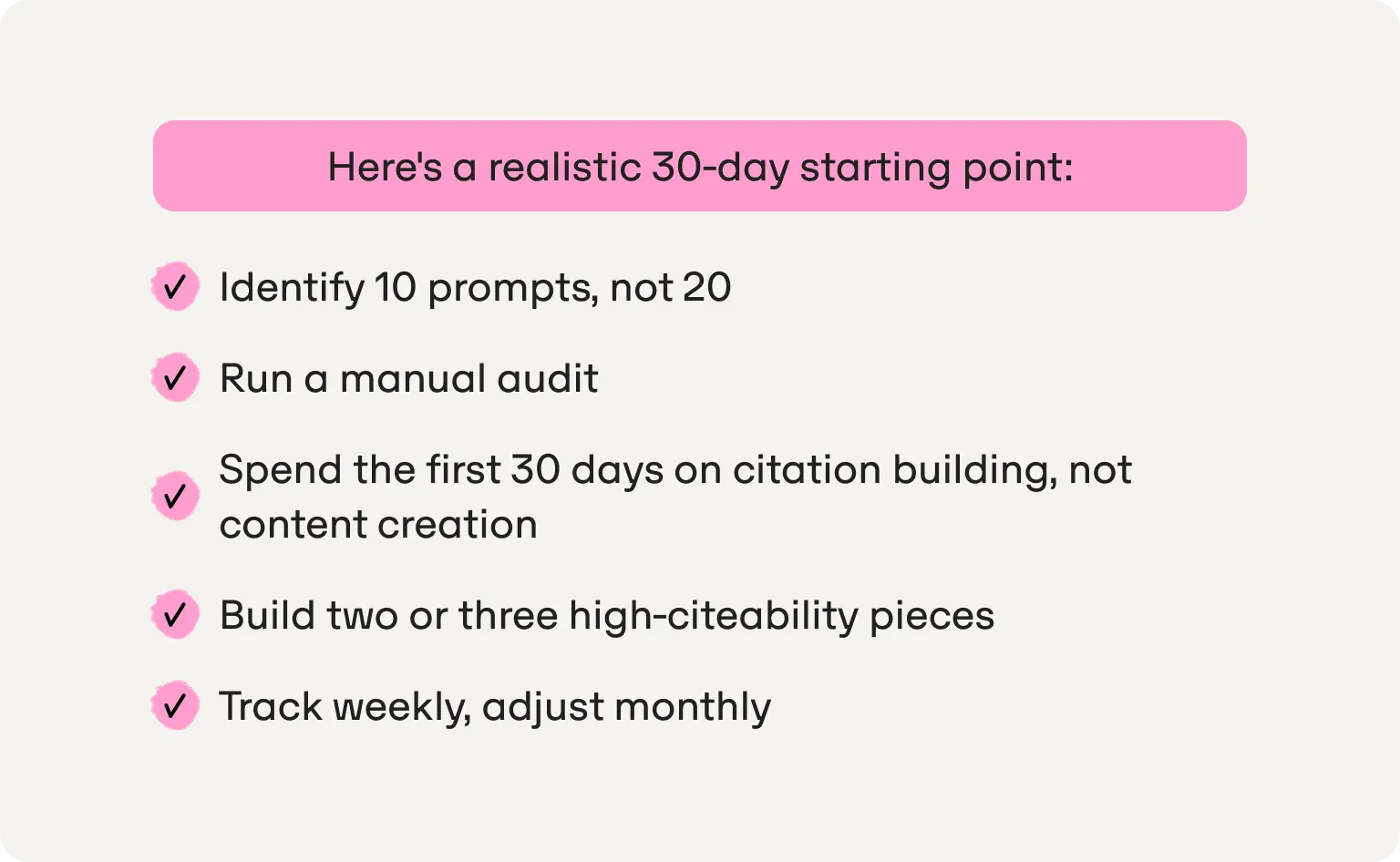
The most common mistake lean teams make is treating GEO like a content volume program. Volume doesn't move AI citations. Focus does.
Here's a realistic 30-day starting point:
The output of this system isn't traffic. It's presence in AI-assisted buying decisions — buyers who ask ChatGPT which tool to choose, and see your name in the answer.

The steps above are executable manually up to a point. At 10 prompts across three AI engines, manual tracking works. At 50 prompts across multiple markets and competitor sets, it becomes a full-time job, and still misses the citation layer entirely.
Omnia closes the gap between visibility data and executed strategy.
INDYA used Omnia to go from 16% to 53% visibility in their main category within 10 days. The gain came from targeted action on citation gaps, not from publishing more content.
Start your 14-day free trial on the Growth plan. No credit card required.
Omnia offers a 14-day free trial on the Growth plan.
No credit card required. See exactly where your brand shows up (or doesn't) across AI engines, then let the platform's recommendations guide your next move.

SEO improves your position in search engine results pages by targeting keywords, earning backlinks, and optimizing technical site structure. GEO improves your presence in AI-generated answers by building citation authority, structuring content for AI parsing, and ensuring your brand entity is consistently associated with specific use cases and problems. Both matter, but they work through different mechanisms and require different tactics. A page that ranks on Google doesn't automatically get cited by ChatGPT.
Faster than SEO, but not instant. AI answer patterns can shift within days of a citation change, which means gains are visible in weeks rather than months. The fastest results come from closing citation gaps on sources AI already trusts (G2, industry media, comparison sites) rather than publishing new content and waiting for it to be indexed. Teams using Omnia's citation intelligence to prioritize source targeting typically see measurable mention rate improvement within two to four weeks.
No. SEO serves buyers who search on Google. GEO serves buyers who ask AI engines. As AI search volume grows, GEO captures demand that SEO doesn't reach, but the underlying content infrastructure (authoritative, structured, well-distributed content) supports both. The question isn't SEO vs GEO. It's whether your current strategy addresses both channels.
ChatGPT, Gemini, and Perplexity account for the large majority of AI search volume. They don't give identical answers — citation patterns differ significantly between engines. A source that appears frequently in ChatGPT answers may not appear in Perplexity answers for the same prompt. Tracking all three gives you an accurate picture of your AI presence; tracking only one systematically skews your view.
Start with the prompts that already drive buying decisions in your category: category-level ("best [tool type] for startups"), problem-level ("how to increase AI brand visibility"), and comparison prompts ("[your brand] vs [competitor]"). Then audit what AI engines currently say in response to each, and identify which sources appear in the answers where your brand doesn't. Those sources are your citation targets. Omnia's prompt discovery surfaces additional prompts you wouldn't identify manually, including emerging long-tail queries where competition is low and opportunity is high.
Yes, if they focus on citation building before content volume. A one- or two-person team can make meaningful GEO progress in 30 days by auditing 10 priority prompts, targeting two or three high-authority external sources, and restructuring existing content for citeability. The limitation isn't capacity — it's monitoring at scale. Tracking 50+ prompts weekly across three engines requires tooling. That's the problem Omnia solves for lean teams that need results without adding headcount.
AI systems rely on a combination of training data, real-time retrieval, and source authority signals to construct a comprehensive answer. Language models learn associations between topics and trusted sources during training, then weight those associations when generating responses. In practice, this means AI assistants tend to pull from multiple sources that are consistently cited across authoritative domains — not just pages that rank well in traditional search. The brands that appear most reliably are those whose content is structured for extractability, whose entities are clearly defined, and whose names appear repeatedly across the sources these models already trust.
The two terms are often used interchangeably, and in practice they describe the same goal: ensuring your brand appears in AI-generated answers rather than just traditional search results. Some practitioners prefer AEO to emphasize the shift away from ranking toward being the answer AI systems serve directly. GEO has become the more widely adopted term, partly because it mirrors the familiar structure of SEO and makes the parallel explicit. For strategic purposes, the distinction doesn't change the work — the same principles of citation authority, content structure, and entity recognition apply regardless of what you call it.
Existing content is often the better starting point. Before building anything new, audit what you already have against your target prompt set — identify which pages address category-level or problem-level questions your buyers are asking AI engines, and restructure those for citeability first. That means adding named sources, sharpening entity statements, and ensuring the page answers a specific question directly rather than covering a topic broadly. A solid SEO foundation — technical SEO, structured data, and high-quality content that already earns organic traffic — gives GEO efforts a meaningful head start, since AI models tend to trust sources that demonstrate authority across multiple signals. New content only becomes the priority once you've confirmed that existing valuable content has been fully optimized and citation gaps remain.
Written By
 JoseGrowthatOmniaJoseGrowthatOmnia
 Miguel FernándezCTO & FounderatOmnia
 JoseGrowthatOmnia
 The Omnia Team
 The Omnia Team
No credit card required · Free for 14 days · See your AI visibility within 3 minutes