
Product
Project Suggestions. AKA Proactive Omnia Agent

 Daniel EspejoCEO & FounderatOmnia
 AndreiHead of GrowthatOmnia
TL;DR
An AI ranking checker tracks your brand's visibility across major AI search engines like ChatGPT, Gemini, and Perplexity, showing how often and in what context you appear in AI generated responses. As buyers increasingly build shortlists straight from these answers, knowing where you stand is becoming as important as knowing your rankings in Google Search, though the two don't work the same way. This post breaks down what a ranking checker actually measures, what our own citation data reveals about which AI systems expose a real, trackable position, and what to look for in a tool.
You've probably opened ChatGPT, searched for something in your category, and watched a competitor get recommended instead of you. No obvious reason why them and not you. That moment matters more than it feels like it does.
With AI tools now shaping how buyers discover and shortlist products in this new AI era, your AI visibility is no longer a nice-to-have metric. It's one of the clearest signals of whether your brand is part of the conversation your potential customers are already having without you.
This post covers what an AI ranking checker actually measures, what our own citation data across ChatGPT, Gemini, Claude, Perplexity, and other AI platforms reveals about which engines expose a real, trackable position and which don't, and what to look for in a tool. If you're ready to go deeper and build a full tracking system, our AI citation tracking guide covers the complete methodology.
An AI ranking checker is a tool that monitors how you show up across the major AI search engines like ChatGPT, Gemini, Perplexity, and Google AI Overviews, when they answer prompts in your category.
Think of it as a modern take on traditional SEO tools and rank tracking. Instead of measuring your position among traditional search results on a Google Search page (SERPs), it measures your presence inside the AI search results these platforms give directly to your buyers.
This practice now has a name, answer engine optimization (AEO, also known as GEO): optimizing for how AI systems surface and cite your brand, not just how Google ranks your pages.
The word "ranking" carries over from SEO, but what it means changes depending on the engine. On some platforms it's closer to a literal, numbered position. On others, there's no fixed rank to speak of at all, just whether you show up. We'll get into exactly which is which further down, because it changes what you should expect a tracker to show you.
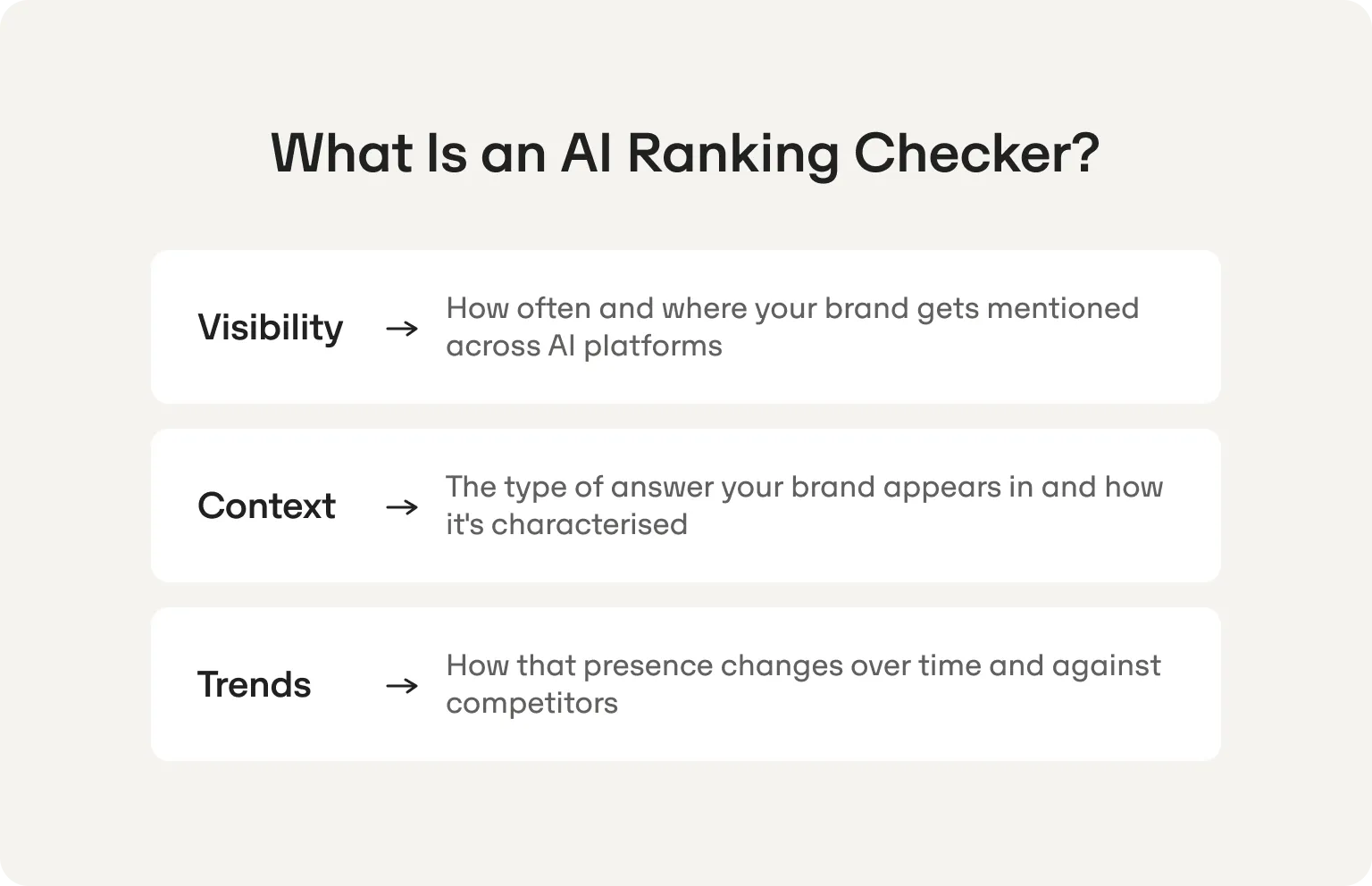
A good tracker helps you track visibility across three dimensions:
That last point is worth emphasizing. Volume of mentions matters, but so does context. Being described as "an expensive option for enterprises" versus "the best tool for lean startup teams" are very different signals, even if the mention count is identical.
This is where AI sentiment analysis becomes relevant: it tells you not just whether you show up, but how you're being characterized when you do.
Now that you know what a tracker actually measures, here's why that measurement matters more than it might seem. We ran this exact check on our own content, and found an uncomfortable gap.
Omnia runs its own performance tracking on the content we publish, the same kind of tracking this article is about. When we sampled 25 articles in a tracked set, 12 of them, just under half, get zero AI citation. Not a low mention rate. Zero. And most of those 12 rank perfectly well in Google.
The average mention rate across the full set is just 2.6%.
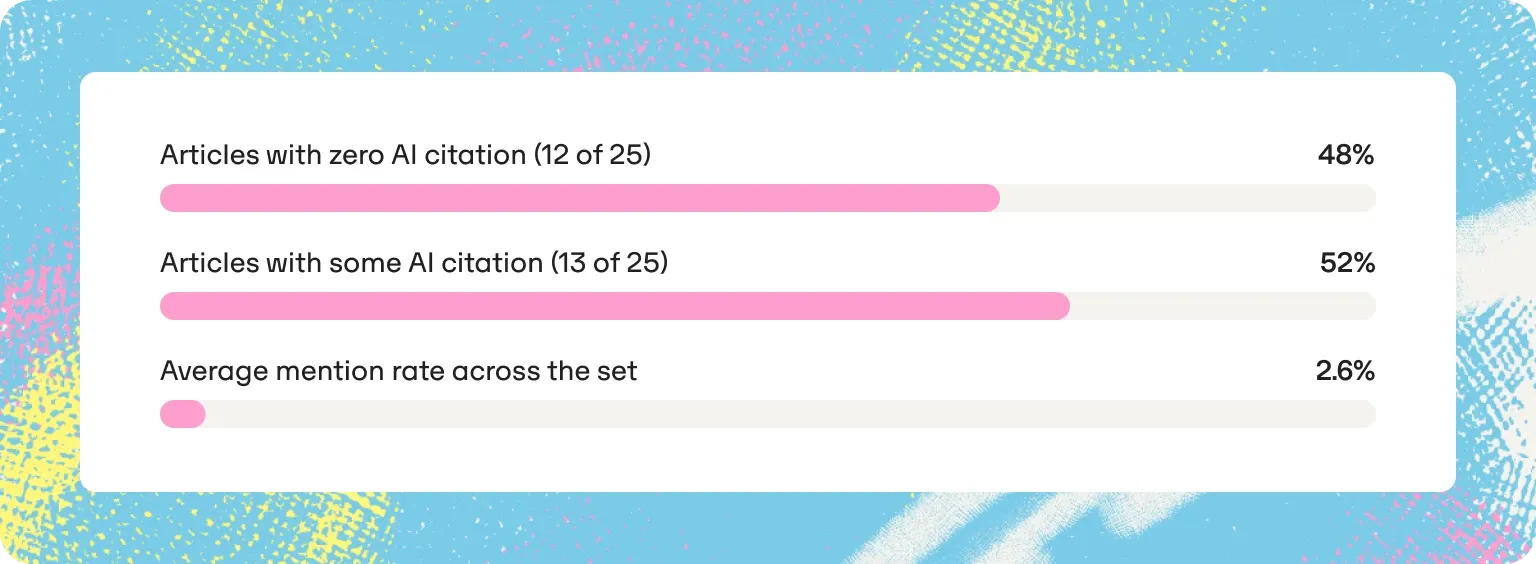
That gap is the whole argument for why an AI ranking checker exists. Google ranking and AI visibility are measuring two different things, and a page can win one while being completely invisible in the other, quietly costing you website traffic and business you'll never see in your analytics.
We know this because we watch it happen to our own content, not just in theory. If you're curious what's actually driving gaps like this at a category level, our breakdown of generative engine optimization challenges goes deeper into what the data shows.
A caveat, so this doesn't read as more than it is: these numbers come from auditing a selection of our own 25-article content set, not an industry benchmark. They tell you what's true for us. They're a useful preview of what you'll probably find if you run the same check on your own content.
Two different signals, and they point to two different fixes:
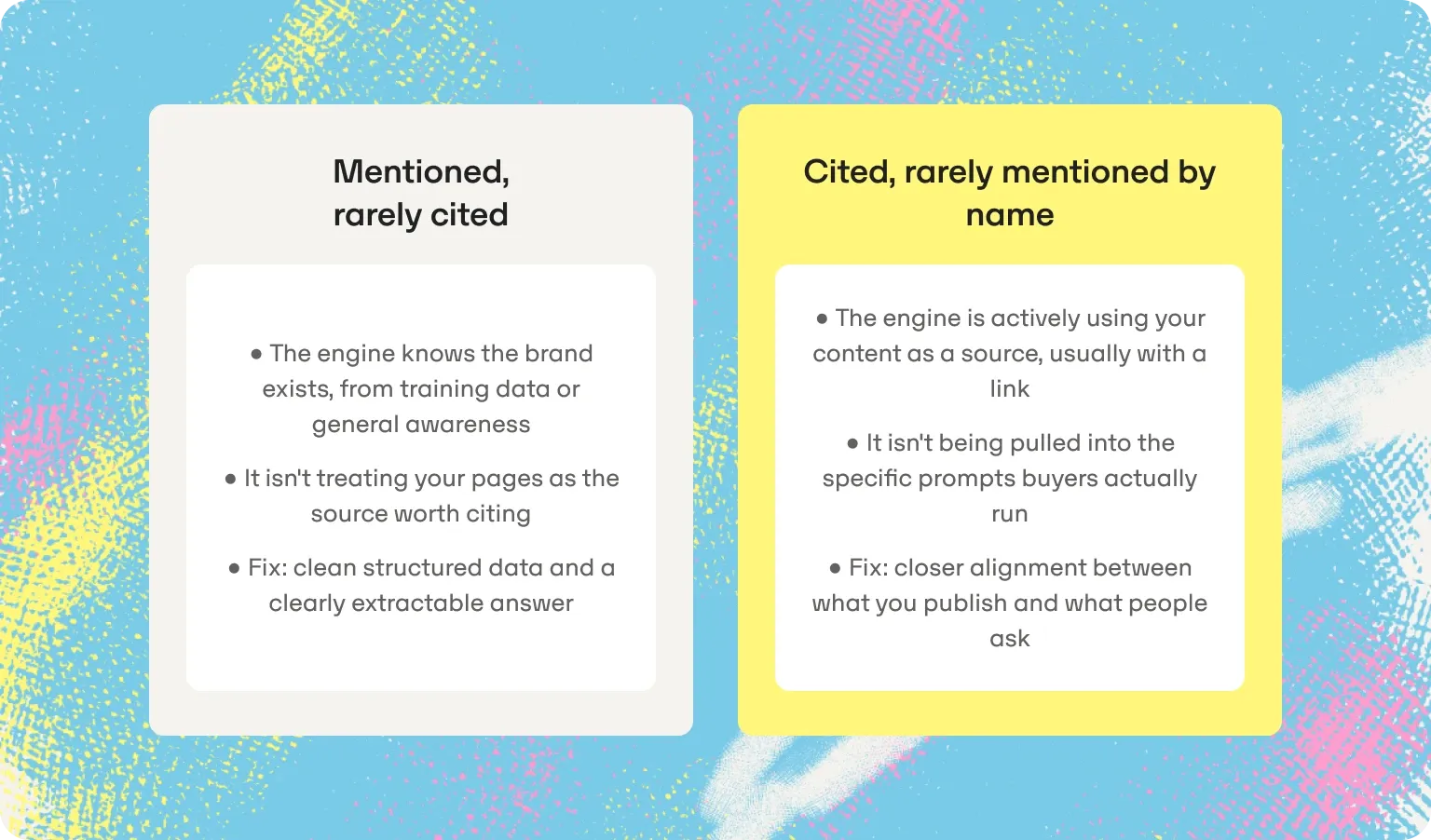
What to do depends on which one you're missing:
One detail worth knowing before you read too much into any single check: two people can type the exact same keywords into two different AI platforms and get entirely different cited sources back. This is exactly what makes AI search visibility harder to reason about than classic SEO, where target keywords map cleanly to a fixed position.
How much of that comes down to who's asking, not just what's asked, is still an open question. One study from Radyant, found visibility swings of up to 24 percentage points when the same question was asked under different stated job titles. Separate research from Peec AI, testing prompt wording rather than persona specifically, found brand mentions held steady across dozens of phrasing variations as long as the underlying intent stayed the same.
The two studies tested different variables, so this isn't a settled debate, but it's a reasonable bet that persona effects shift again with each new model release. AI responses aren't a fixed ranking sitting somewhere waiting to be read off, they shift by engine, by prompt phrasing, and possibly by who's asking too.
It's also why understanding AI citations specifically, and not just mentions, matters if you want to know what to actually fix.
Fair question to ask before investing in AI rank tracking: is "AI ranking" a real, measurable thing, or borrowed language from Google SEO that doesn't quite apply? The honest answer depends entirely on which engine you're asking about.
In our own tracked citation data, Gemini stands out as the one engine where a numbered position is genuinely present, and consistently so:
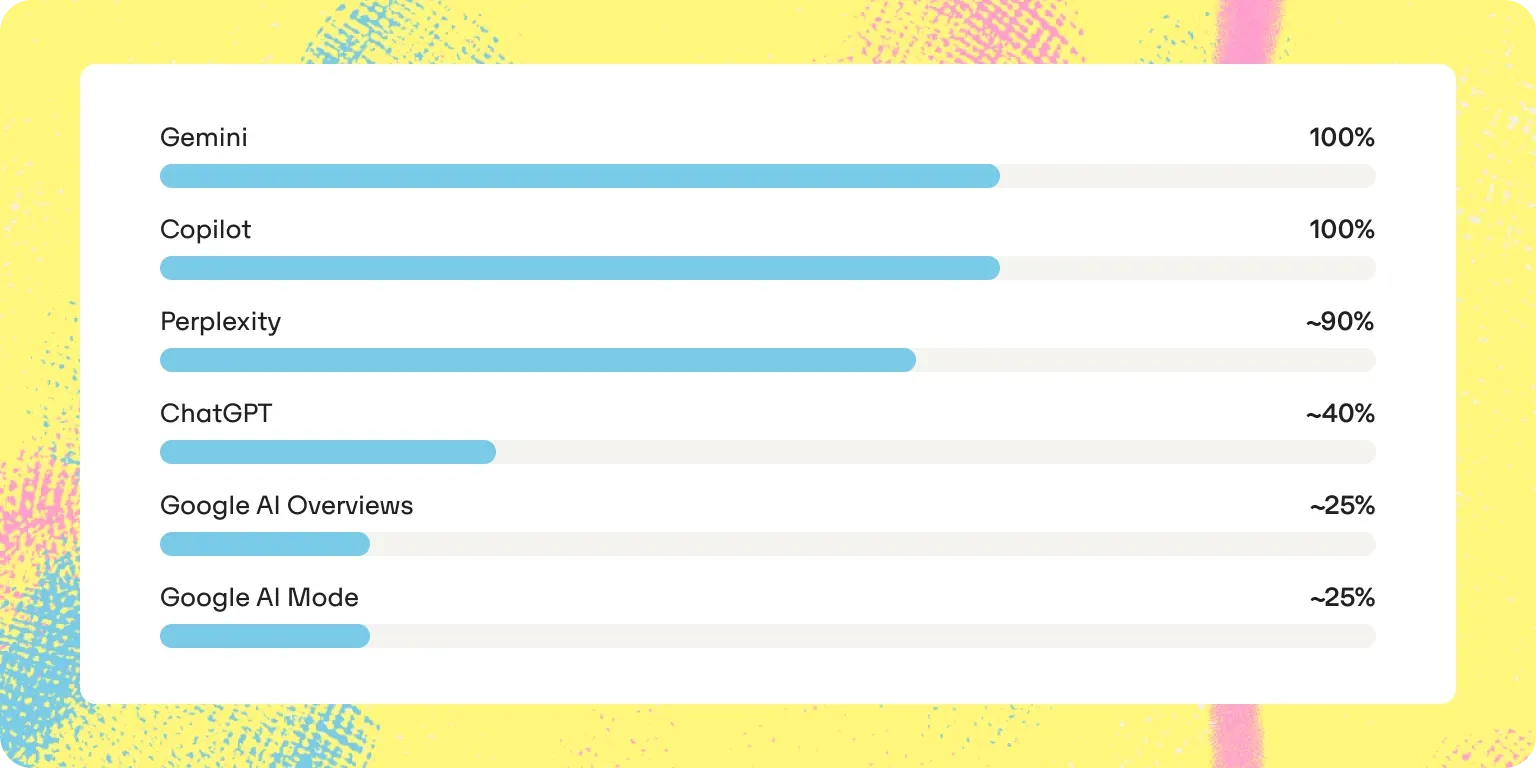
On Gemini, roughly 85% of citations land somewhere in the top 10, decaying smoothly from position one down.
Here's why that's worth acting on now rather than later: the pool of domains Gemini actually cites is still young and unsettled. In a typical week, around 40% of the domains showing up in Gemini's answers are new entrants, not repeat names.
And about 4 in 5 of the prompts we track swap their top-cited source within a single month. Nobody's locked into position yet, and that churn means new opportunities open up every week for brands willing to build topical authority in their category.
It's not just the domain pool that's in motion. Some early research points to persona context adding a further layer of volatility on Gemini and Google AI Overviews specifically, though that finding comes from a single study in one category and hasn't been retested against newer model releases, so it's worth watching rather than treating as settled.
One more layer worth knowing if you're deciding where to focus content: Gemini leans heavily editorial. Blog, article, review, and comparison content, including product comparisons, make up close to 45% of what it cites. Product pages, pricing pages, and FAQs barely register, under 1% combined. If your Gemini strategy is built around product pages, it's built on the wrong foundation.
Omnia is built for founders and lean marketing teams who want a cost efficient way to act on AI visibility data, not just look at it, and to stay ahead of competitors who are still guessing. It tracks your brand across multiple AI engines, shows which prompts you're winning and losing, and turns that into a concrete list of actions rather than a dashboard to interpret.
A few things worth knowing:
Not ready to commit? Run the free check above and see where your brand actually stands before going further.
Omnia isn't the only option for AI search tracking. Here's how it stacks up against the other tools people typically shortlist:
| Tool | Engines covered | Best fit | Starting price |
|---|---|---|---|
| Omnia | ChatGPT, Claude, Perplexity, Gemini, Google AI Overviews, AI Mode, and Copilot | Teams that want tracking tied directly to action, not just a dashboard | Free checker; paid plans from ~€79/mo |
| Profound | Up to 10 engines on Enterprise plans | Larger, well-resourced teams that need enterprise-grade coverage and support | From $70/mo (Lite) |
| Rankscale | Budget-focused; published engine counts vary by source, worth confirming directly | Bootstrapped teams prioritizing price over breadth | From ~$20/mo |
| SE Ranking (AI Search add-on) | Google AI Overviews, AI Mode, Perplexity, ChatGPT (no Claude, Copilot, or | Teams already on SE Ranking for classic SEO who want AI tracking bundled in | Add-on from $89/mo on top of a paid plan |
If you just want a single snapshot before committing to anything, a few free tools will run one check for you, no signup required:
| Tool | Engines checked (free) | Note |
|---|---|---|
| Omnia | ChatGPT, Claude, Perplexity, Gemini, Google AI Overviews, AI Mode, and Copilot | Snapshots for teams who are actively looking to know where they are in AI search |
| Geoptie | ChatGPT, Perplexity, Claude, Gemini, Google AI Overviews | Broadest free engine coverage of the three; paid plan adds scheduled tracking |
| NisonCo | ChatGPT, Claude, Gemini, Perplexity | Built by an SEO/PR agency as a lead tool, not a dedicated AI-visibility product |
| Rank Prompt | ChatGPT, Perplexity, Gemini | Fair-use limit on repeat checks; paid plan adds Claude, Grok, and Google AI Mode |
| DataForSEO (LLM Rank) | ChatGPT, Gemini, Perplexity, Claude (via DataForSEO's LLM mentions data) | Different mechanic: a free public leaderboard of pre-built category rankings updated weekly, not a checker you run for your own brand. Only useful if your category is already covered and your brand ranks in the visible top spots |
Worth remembering here what we said earlier: these are snapshots, not tracking. They're a fine way to find out if you have a problem worth solving, but the real value comes from ongoing tracking on a schedule, which none of these run on their own.
The right choice usually comes down to three questions: whether you need a one-time answer or ongoing tracking, how many engines you actually need covered, and how much you need the insights to connect to execution versus just showing you a number.
Regardless of which tool you use, a few principles separate tracking that informs decisions from tracking that just produces noise.
The most useful thing you can do right now is find out where you actually stand. Run a handful of prompts that reflect real buyer intent in your category across two AI engines and note whether your brand appears, in what context, and which competitors keep showing up instead.
That's your baseline. Everything else builds from there. If you want a faster answer, running a free AI visibility report does the same thing in a few minutes and gives you a structured breakdown to work from.
Omnia offers a 14-day free trial on the Growth plan. No credit card required. See exactly where your visibility in AI stands across engines, then let the platform's recommendations guide your next move.
Omnia offers a 14-day free trial on the Growth plan.
No credit card required. See exactly where your brand shows up (or doesn't) across AI engines, then let the platform's recommendations guide your next move.

Run a consistent set of prompts that reflect real buyer questions in your category across the AI engines you care about, then note whether your brand appears, in what position or context, and which competitors show up instead. A tool like Omnia automates this so you're not doing it by hand every week.
No. A traditional rank tracker measures your position on a Google results page. An AI ranking checker measures whether, and how, you're referenced inside an AI-generated answer, which is a different mechanism entirely.
No, it's additive. Google rankings and AI visibility measure different things, and our own citation-gap data above shows a page can do well in one and be invisible in the other. Most teams need both.
Weekly, at minimum, using the same set of prompts each time. AI answers vary by engine, country, and even prompt phrasing, so a single check is a snapshot, not a trend.
A mention means an engine says your brand's name. A citation means it's actively using your content as a source, usually with a link. Both matter, and each points to a different fix, covered in the mention vs. citation section above.
No. In our own tracked data, Gemini and Copilot expose a numbered position on effectively all citations, Perplexity does so most of the time, and ChatGPT and Google's AI surfaces do so less consistently. Claude doesn't expose a position at all, so tracking there is closer to presence or absence.
Start with a structured, measurable approach rather than guesswork: measure mention rate, citation rate, and share of voice across a consistent set of prompts, then adjust content based on where those numbers actually move.
A free, one-time check is a useful baseline to find out if you have a problem worth solving. For ongoing decisions, you'll want continuous tracking, since a single snapshot can't tell you whether a gap is a trend or a one-off.
Yes, most tools including Omnia let you track competitor share of voice alongside your own, which is usually more informative than your mention count on its own.
Omnia's free AI Visibility Checker doesn't require one. It's meant to give you a quick baseline, not lock you into anything.
Written By
 AndreiHead of GrowthatOmniaDaniel EspejoCEO & FounderatOmnia
 Miguel FernándezCTO & FounderatOmnia
 Miguel FernándezCTO & FounderatOmnia
 ButiBuilderatOmnia
 Miguel FernándezCTO & FounderatOmnia
No credit card required · Free for 14 days · See your AI visibility within 3 minutes