
AI Search Visibility
How To Turn AI Visibility Data Into a GEO Roadmap in 2026

 JoseGrowthatOmnia
 The Omnia Team
TL;DR
Most agentic AI marketing content describes a category that does not exist in production yet. The Omnia Agent, Omnia's own AEO agent, already runs the full loop: research, drafting, publishing, and reporting, with approval required only where it counts. This is what a working AEO agent looks like right now, drawn from three workflows already shipping inside real accounts.
Most "AI agents for marketing" content lists what an agent could theoretically do. None of it names which agent is actually doing it, for a real brand, right now. That gap is why the same question keeps coming back from marketing ops leads evaluating this space: is agentic AI something to put to work this quarter, or a new label for automation tools that already existed.
The Omnia Agent is one direct answer. It reads a brand's citation gaps and drafts outreach emails to the sites AI engines already cite instead. It audits a live website, ranks the fixes by priority, and can apply some of them directly through a connected CMS. It pulls Google Analytics data on request and builds the chart. All three run inside one workspace, and a person still approves anything that publishes, sends, or writes back to a connected tool. That is not a description of an agent platform. It is what the Omnia Agent does today, and the rest of this article walks through exactly how.
Most confusion in this space comes from three different things getting called the same name.
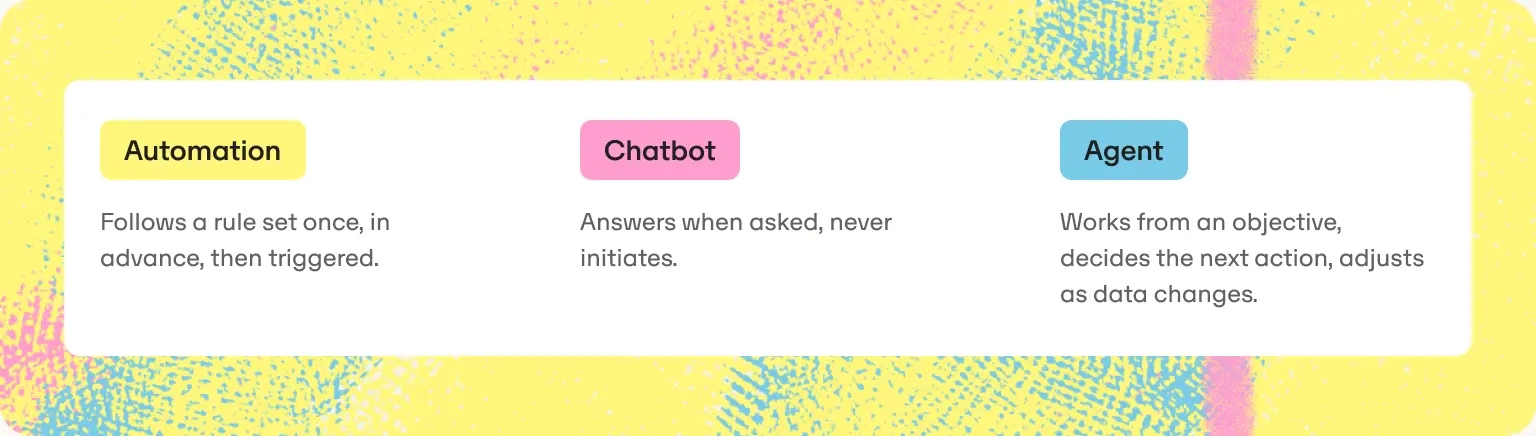
The decisive difference sits in that middle column. An agent does not wait to be asked and does not just follow a rule someone wrote last quarter. It decides, against real data, what happens next. The same principle that lets an AI engine answer from retrieved facts instead of a guess, what search practitioners call AI grounding, is what makes an agent's decision reliable rather than a hunch dressed up as automation.
Two more terms get merged that shouldn't be:
One is a tool doing the work. The other is a target those tools crawl. Worth naming directly, since the two get confused often enough in this space to cause real mix-ups in vendor conversations.
Two patterns repeat across almost everything published on this topic.
It reads like a real estate listing for a neighborhood: true in general, and silent on the actual property.
None of it is verifiable against a real output. It's the opposite of what AI observability is supposed to provide: the ability to check exactly what an agent did against what actually happened, not an aggregate number nobody can trace to a real account.
Most of the challenges that make GEO hard come down to exactly this gap, between a general capability and a working system built for one brand's actual position in AI answers. The next section is what closing that gap looks like.
Three workflows below are not hypothetical. Each one is a shipped Omnia Agent skill, already running inside real accounts, with a video walkthrough behind the link.
Starting point: a single monitored prompt, and the Citations tab showing which third-party URLs AI engines currently pull from to answer it.
Nothing sends automatically. A person reviews the drafts, adjusts if needed, and clicks send. The same flow runs across every monitored prompt with a citation gap, not just the one in the demo, so a single review session can cover outreach for an entire prompt set at once.
Starting point: a live domain, handed to your Omnia Agent with no further instruction.
This is the clearest example of the difference between an agent and a dashboard. A dashboard would stop at the ranked list. Your Omnia Agent hands over the list and, where authorized, starts closing items on it.
Starting point: a GA4 connection, added once through Settings.
This is the reporting half of the loop, closing it back to the start: not just producing content or fixing pages, but showing what happened after.
Research and outreach, audit and fix, measurement: three different jobs, one workspace, each a skill that exists today rather than a capability described in the abstract.
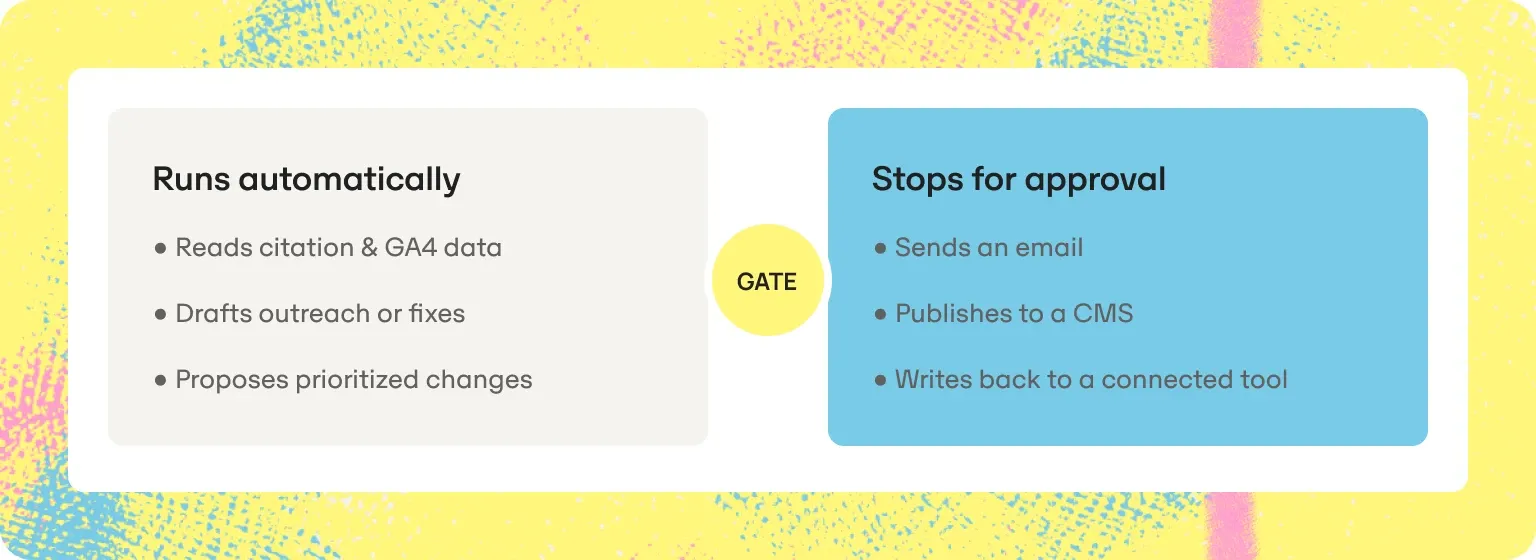
None of the three workflows above run unsupervised in the way "autonomous agent" tends to imply. Every connection your Omnia Agent uses, Gmail, a CMS, GA4, is authorized through OAuth, scoped to what that specific integration needs, and revocable at any time. Connecting GA4 for reporting does not give your Omnia Agent write access to a CMS; each tool carries its own permission boundary, set by whoever connects it.
The approval gate sits at the point of consequence, not at every step. Your Omnia Agent can read data, draft an email, or propose a fix freely, since none of that leaves the workspace or changes anything external. The moment an action would publish, send, or write back to a connected tool, it stops for explicit approval. The AEO audit example makes this concrete: your Omnia Agent drafts the fix and ranks it by priority, but a human still authorizes the CMS write that makes it live. Reading and proposing are automatic. Publishing is not.
The three workflows above are not staged demos of a future product. They are what customer accounts are already running against.
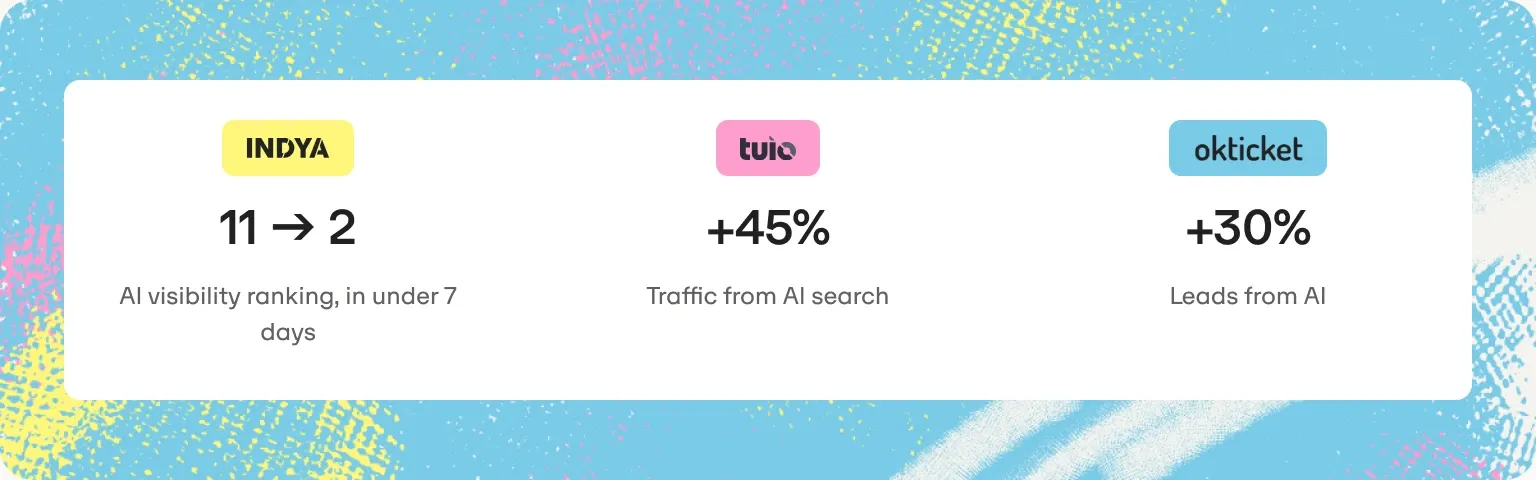
None of these numbers come from an industry average or a projected estimate. Each is a single account's before-and-after, the same kind of traceable result the earlier section pointed out was missing from most agentic AI marketing content. A citation gap closed through outreach, a site audit that fixed real pages, a GA4 connection that showed which channel actually moved: the three workflows are not separate from these outcomes. They are how the outcomes happened.
The pattern worth noticing across all three is speed relative to team size. None of these are enterprise accounts running a dedicated AI visibility team; they're the kind of lean marketing operation this article opened with; and the outcomes on the customer stories page reflect what one or two people, plus their Omnia Agent, produced in days rather than quarters.
A capable marketer can build a version of this manually. Connect Claude to Omnia's data through Omnia MCP, ask it for citation gaps, draft against them, check GA4 separately, draft outreach by hand. Every piece of data your Omnia Agent uses is available that way too.
The difference is who runs the loop.
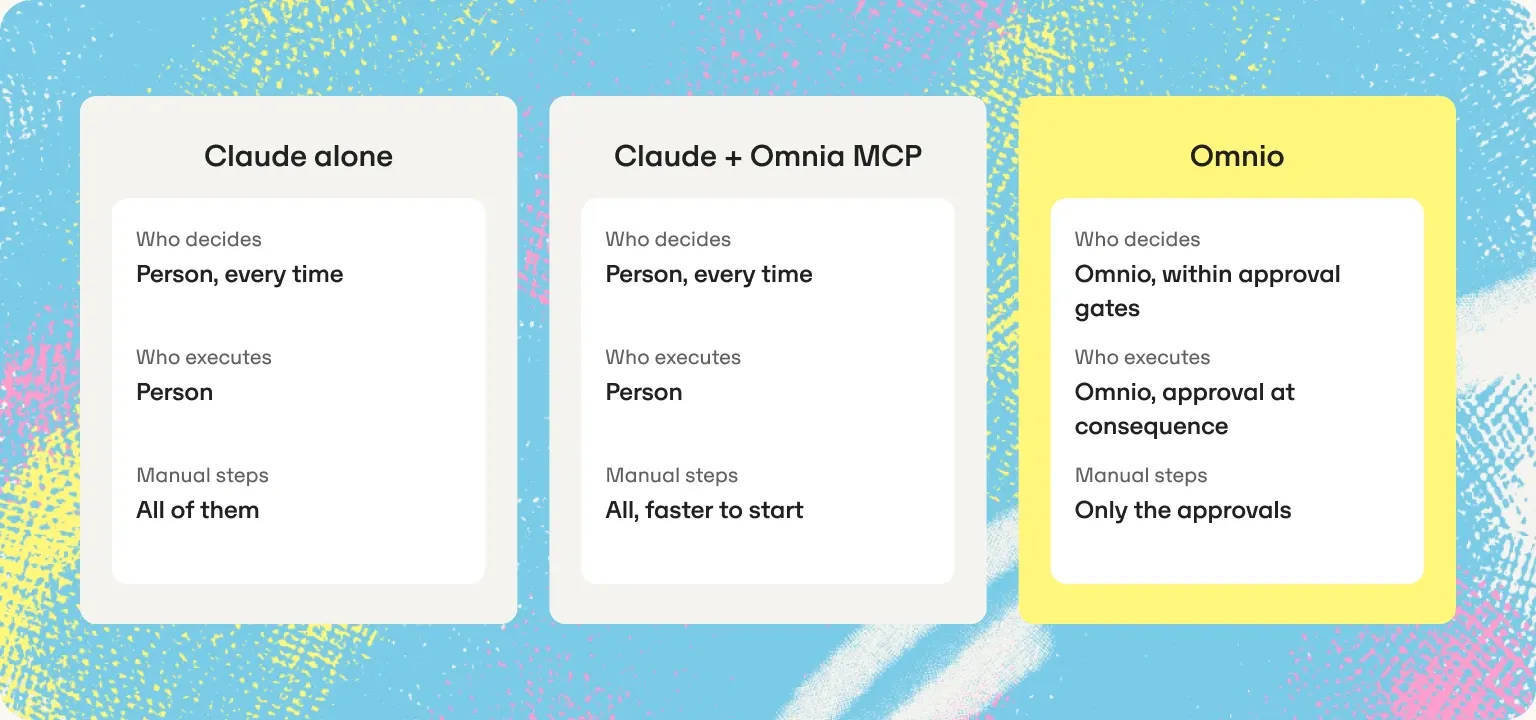
Omnia MCP closes the data gap: Claude gets access to real citation and visibility numbers instead of general knowledge. It does not close the execution gap. Every decision, every draft, every check-in still runs through a person, one step at a time, every cycle. The full comparison against Claude goes deeper on this distinction.
However, the fastest way to see it firsthand is to hire the Omnia Agent directly: 14 days free, no credit card, running against a brand's real citation data from the first session rather than a demo account built to look good.
Omnia offers a 14-day free trial on the Growth plan.
No credit card required. See exactly where your brand shows up (or doesn't) across AI engines, then let the platform's recommendations guide your next move.

Both exist right now. Most published content on the topic describes a category, agent types, blueprints, projected statistics, without naming a specific tool doing a specific job. A working agent looks different: a defined skill, connected to a brand's own data, producing an output someone can check against a real result. The Omnia Agent's listicle outreach, AEO audit, and GA4 reporting workflows are examples of the second kind, already running in customer accounts.
Research and drafting run without a pause: reading citation data, scoping a website, pulling GA4 numbers, drafting outreach emails or a prioritized fix list. Anything that publishes, sends, or writes back to a connected tool, sending an email, pushing a CMS fix, stops for approval first. The agent decides and prepares; a person authorizes anything that leaves the workspace.
Automation follows a rule someone set in advance: a trigger fires, a fixed action runs. An agent works from an objective instead of a rule, deciding in the moment which action gets there, then adjusting as data changes. A scheduled report is automation. Your Omnia Agent deciding that a citation gap needs outreach rather than content, then drafting that outreach itself, is agentic.
Every connected tool, Gmail, a CMS, GA4, runs through OAuth, scoped to what that integration needs and revocable at any time. Reading data and drafting content happen freely, since neither changes anything outside the workspace. The moment an action would publish, send, or write back to a connected system, it pauses for explicit approval. Nothing goes live without a person confirming it first.
No. The customer outcomes behind the Omnia Agent's workflows come from lean teams, often one or two marketers, not dedicated AI visibility departments. That is the actual use case: a small team gets the research, drafting, and reporting work of a larger one, while still approving everything that ships.
Written By
 The Omnia TeamJoseGrowthatOmnia
 Miguel FernándezCTO & FounderatOmnia
 JoseGrowthatOmnia
 The Omnia Team
 JoseGrowthatOmnia
No credit card required · Free for 14 days · See your AI visibility within 3 minutes