
AI Search Visibility
How To Turn AI Visibility Data Into a GEO Roadmap in 2026

 JoseGrowthatOmnia
 Miguel FernándezCTO & FounderatOmnia
TL;DR
International SEO tools for AI search should show you what AI engines say about your brand in each market, the way a local buyer sees it. Many tools report one blended score instead, and very few document whether they run prompts from inside the country. Base plans range from a single region to unlimited markets, so the real price of a tool is the price of covering your markets. Omnia is the best overall pick, with unlimited countries and languages on every tier and an agent that acts on each gap. BrightEdge suits enterprises, and LLMrefs is the budget pick with 50+ countries. Per-market data only pays off when someone acts on it per market.
Your brand shows up in ChatGPT answers in the US. Then you launch in Spain and Germany, open your AI visibility dashboard, and see one global score. That number can't tell you whether a buyer in Madrid, asking the same question in Spanish, ever hears your name.
Most international SEO tools were built for a different job. The roundups ranking for this topic cover hreflang testers, crawlers and keyword databases, which check how your site is set up for other markets. Few of them check what AI engines actually say about you in each country.
This guide compares 10 international SEO tools for AI search on six things a multi-market team needs:
Classic international SEO tools check how your site is built for other markets. They validate hreflang tags, pull keyword volumes per country and track rankings in each Google database. That work still matters, because AI engines retrieve from the same localized pages.
International SEO tools for AI search answer a different question: what do ChatGPT, Perplexity, Google AI Overviews and Google AI Mode actually say about your brand in each market? They are a subset of AI visibility platforms, filtered for one requirement: every answer, citation and competitor is captured country by country. A multi-market team needs both kinds of tools, and this guide covers the second.
The gap shows up fast after an expansion. A SaaS brand that leads ChatGPT answers in the US opens offices in Madrid and Munich. Its dashboard still shows one global visibility score, and nobody on the team can say whether Spanish or German buyers see the brand at all.
AI engines shape answers around where a question comes from and the language it's asked in. A prompt run from Madrid in Spanish draws on Spanish publishers, local review sites and the brands those sources mention. The same prompt run from New York pulls a different set of sources, and often a different shortlist of vendors.
That means every market needs its own record: its own answers, its own citations and its own competitor set. Averaging them into one score hides the market where you're losing.
Tracking is only half the job. Deciding what to change in each market is a strategy question, and it's covered in our guide to building an AEO strategy across languages.
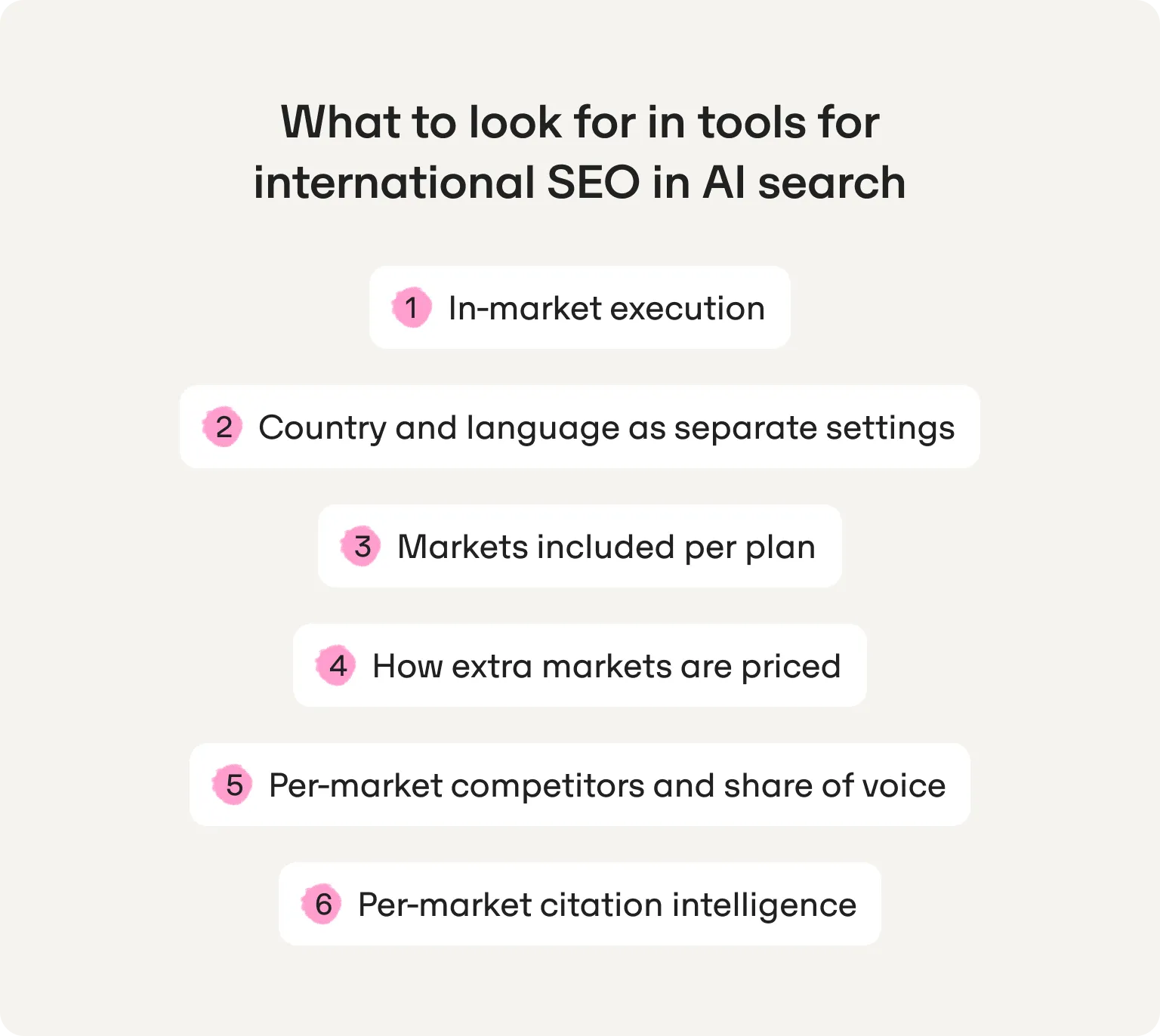
Six criteria separate a tool that measures each market from one that reports an average. Take them into every demo.
Some tools set a language and locale parameter, then send the prompt from wherever their servers sit. Others run the prompt from a browser located in the target country. Only the second approach reliably shows the answer a local buyer sees, because engines weigh location as well as language. Few vendors say which method they use, so ask before you trust any per-country number.
Ask the vendor: "Where is this prompt physically run from when I select Spain?"
Multi-market buyers don't always search in the local language. A procurement lead in Berlin may ask ChatGPT in English, and a buyer in Miami may ask in Spanish. A tool that ties one language to one country misses both. Look for country and language as two independent settings on every prompt.
Ask the vendor: "Can I track English prompts in Germany?"
Base plans in this category range from a single region to unlimited countries and languages. Several tools gate a second market behind an enterprise contract, which turns the advertised entry price into the opening bid of a negotiation. Check the market count on the exact plan you would buy.
Ask the vendor: "How many countries does my plan include, and which tier removes the cap?"
Prompt-based plans hide a multiplier. If each market counts as a separate prompt, a 50-prompt plan spread across four markets tracks about 12 prompts per market. That's a fair model, but it changes your budget, so get the counting rule in writing before you sign.
Ask the vendor: "Does one prompt tracked in three countries count as one or three?"
Your main competitor in Spain is often a local player you never meet in the US. A tool that applies one competitor list everywhere gives you a share of voice for the wrong fight. You need a separate competitor set per market, with share of voice reported market by market.
Ask the vendor: "Can I set a different competitor list for each market?"
Local publishers, directories and review sites shape AI answers in each country. Seeing which domains get cited in Spanish answers, separately from US answers, tells you exactly where to earn mentions. This is the actionable half of the data, and our guide to tracking AI citations explains why the source list matters more than the score.
Ask the vendor: "Can I see the domains cited in Spanish answers separately from US answers?"
This ranking starts with the reader it's written for. If you're an SEO or marketing lead at a brand that sells in more than one country, you probably landed here because the usual "best AI visibility tools" lists skipped your real question. Which of these tools actually handle multiple countries and languages, and what does it cost to cover all of your markets? We ranked on that question, with the criteria weighted in this order.
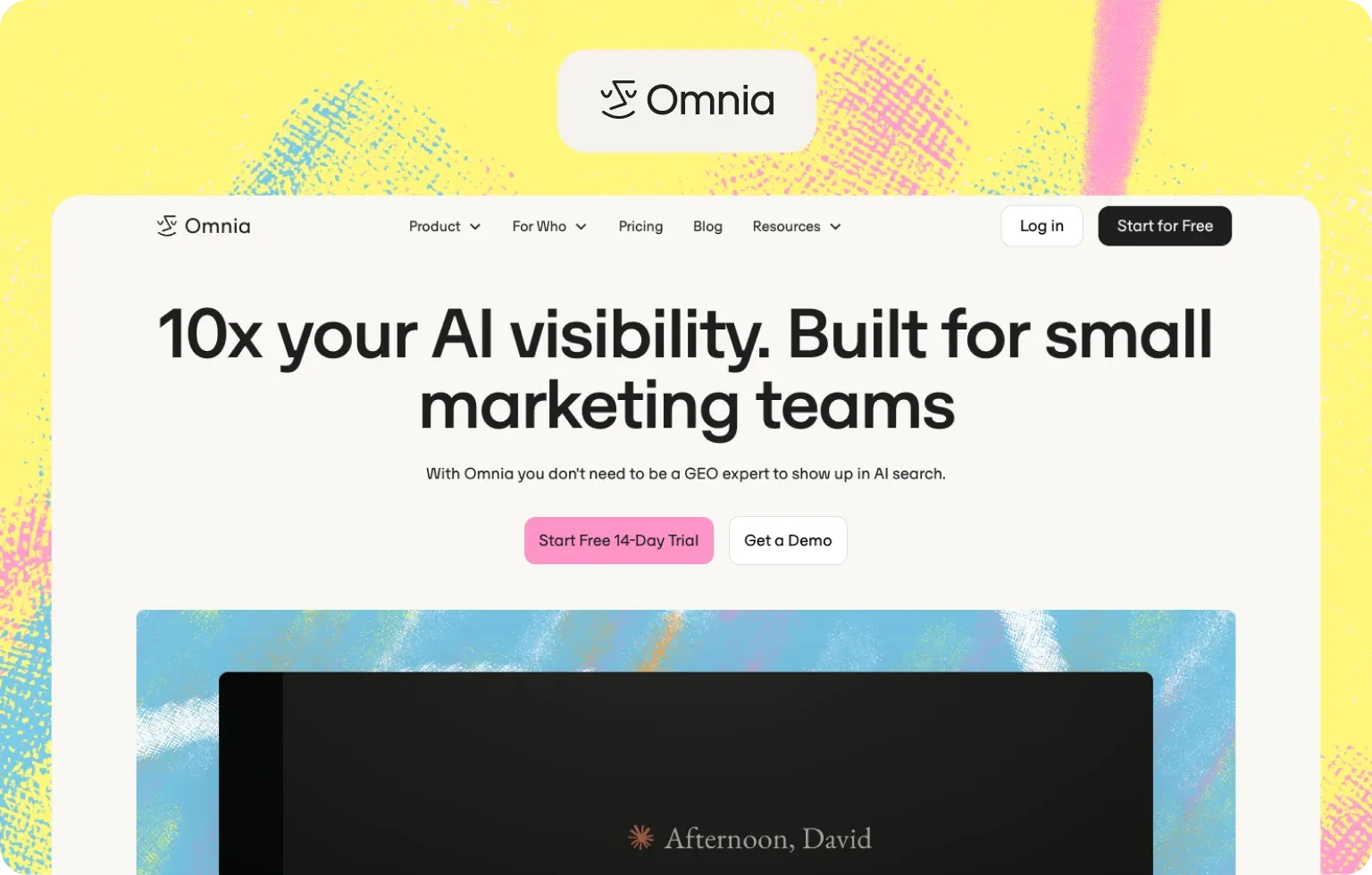
Omnia is an AI visibility and answer engine optimization (AEO) platform built for brands that sell across several countries and languages. It tracks how AI engines answer questions about your brand, market by market, and pairs that tracking with the Omnia Agent, which turns the gaps it finds into shipped work.
Best for: SEO and marketing leads covering several countries who need per-market data and a way to act on it.
Market coverage: Unlimited countries and languages on every tier, with no market caps and no enterprise gate. Omnia opens browsers in real locations to capture what users actually see in each country and language, which makes it one of the few tools here that documents how it runs prompts in each market.
How markets are priced: There's no fee per country or language. Each market counts as a separate prompt, so the Growth plan's 25 prompts could cover 8 prompts across 3 markets.
What it does well for multi-market teams:
Proof from a new market: PuntoSeguro became the #1 life insurance brand in Spain across AI engines, entering a new market in three months and generating 25 leads from ChatGPT in one month.
Watch-outs: Because each market counts as its own prompt, a team tracking many markets will use up the Growth plan's 25 prompts quickly and should look at Pro.
Pricing: Omnia's plans start at €79/mo for Growth (€63/mo billed annually). Pro is €279/mo (€223 annually), and Enterprise starts at €499/mo (€399 annually). Every plan comes with a 14-day free trial, no credit card required.
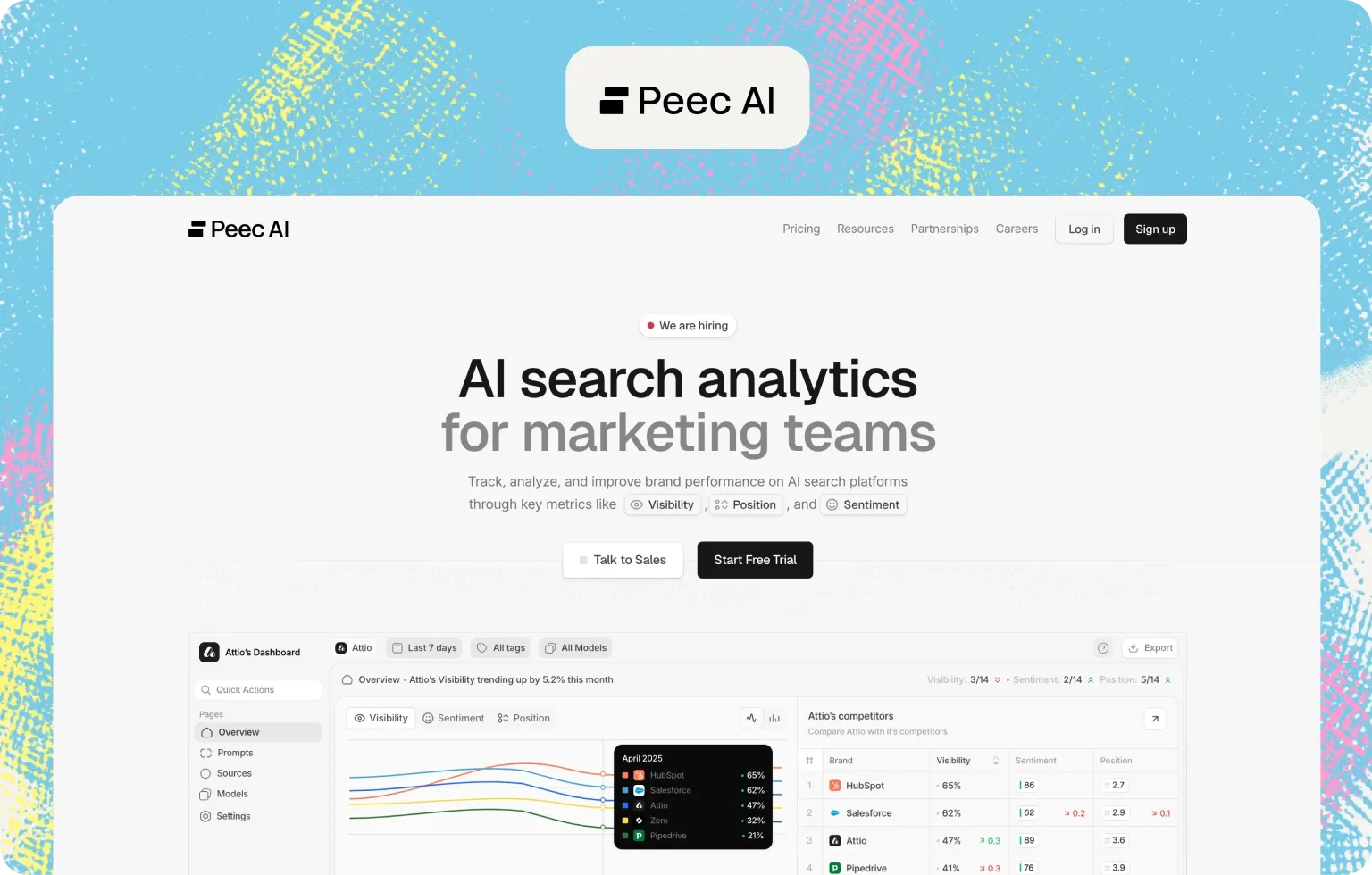
Peec AI is a Berlin-based AI search analytics platform that tracks how often brands appear in answers from ChatGPT, Perplexity, Google AI Overviews and other engines. Its pricing is built around prompts, which makes costs easy to forecast as a prompt set grows.
Best for: Teams that want wide market coverage without an enterprise contract.
Market coverage: Unlimited regions and 115+ languages on the base plan. [Pending verification on Peec's pricing page.]
What it does well for multi-market teams: Seven engines, daily tracking, unlimited seats and a Looker Studio connector for building per-market reports.
Watch-outs: There's no action layer, so every per-market gap still needs someone on your team to act on it. Teams weighing that trade-off can compare the Peec AI competitor tools that include one.
Pricing: Starter $95/mo, Pro $245/mo, Advanced $495/mo, Enterprise custom.
BrightEdge is one of the longest-established enterprise SEO platforms, used by large organizations to manage search performance and content at scale. It has since extended into AI search, so teams can report on AI visibility inside the platform they already use for SEO.
Best for: Large organizations already running SEO in BrightEdge that want AI visibility in the same platform.
Market coverage: 145 country and language combinations, the broadest stated footprint in this list.
What it does well for multi-market teams: Citation volatility analysis, persona and intent mapping, and an action layer.
Watch-outs: BrightEdge tracks three engines and publishes no pricing. Teams that need wider engine coverage or transparent pricing usually shortlist BrightEdge alternatives before a sales call.
Pricing: Not published.
SISTRIX is a German SEO toolbox best known for its Visibility Index, a long-standing benchmark for organic search performance across European markets. Its AI tracking module adds AI Overviews and AI engine monitoring to the country-level data SISTRIX users already rely on.
Best for: Teams whose classic international SEO already runs in SISTRIX.
Market coverage: 50 countries, with AI Overviews tracked across all of them.
What it does well for multi-market teams: Custom AI tracking by engine, region and persona, plus dashboards split by country, language and domain. It's the most natural bridge in this list from classic international SEO to AI search.
Watch-outs: AI tracking covers four engines and is still in beta. There's no action layer.
Pricing: Start €119/mo, Plus €239/mo, Professional €419/mo, Premium €799/mo.
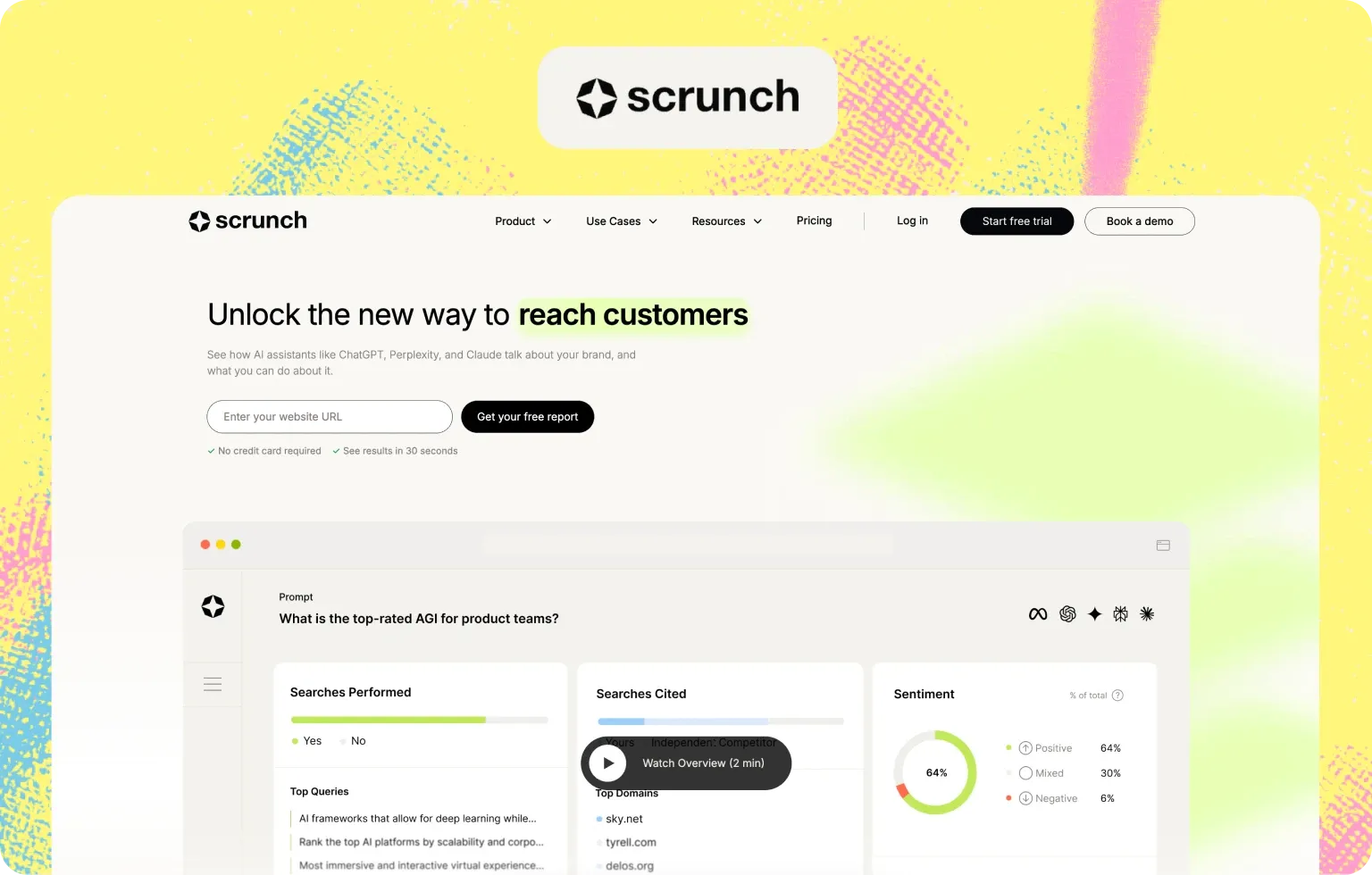
Scrunch AI is an AI search visibility platform aimed at enterprise marketing teams. It monitors how AI engines describe a brand and segments the results by persona, topic and geography.
Best for: Teams that need competitor analysis cut by audience and market.
Market coverage: Multi-region, though the number of regions on the base plan isn't specified.
What it does well for multi-market teams: Competitor analysis by persona, topic and geography, nine engines, real-time refresh, SOC 2 compliance and an action layer.
Watch-outs: Without a published market count, you'll need to confirm your markets on a demo. Teams that want that number upfront can compare Scrunch AI alternatives.
Pricing: Core $250/mo, Enterprise custom.
LLMrefs is an AI search analytics tool that tracks brand mentions and citations across a wide range of large language models. It's designed to be accessible to smaller teams, with a free tier and a single paid plan.
Best for: Small teams that need many markets on a tight budget.
Market coverage: 50+ countries and 20+ languages.
What it does well for multi-market teams: Eleven engines, the widest engine coverage in this list, with a free tier and a single paid plan.
Watch-outs: Refresh is weekly, which can miss a short drop in one market. There's no action layer.
Pricing: Free tier; All-in-one plan €79/mo.
Rankscale AI is an AEO platform that tracks brand visibility and citations across AI engines, with a focus on page-level analysis. It serves smaller teams and agencies, including white-label reporting for client work.
Best for: Smaller teams and agencies that need many regions and client-ready reports.
Market coverage: Unlimited regions.
What it does well for multi-market teams: Eight engines, daily tracking, citation tracking with cross-model overlap scores and white-label reporting.
Watch-outs: There's no action layer, so reporting is where the tool stops. Teams that need execution too can compare Rankscale AI alternatives.
Pricing: Pro €99/mo, Growth €385/mo, Enterprise €780/mo.
SE Visible is the AI visibility product from SE Ranking, the SEO platform. It brings AI answer tracking and competitor benchmarking to mid-market teams, with a fixed list of supported countries and languages.
Best for: Teams whose markets fall within a defined list.
Market coverage: 7 countries and 5 languages.
What it does well for multi-market teams: Multi-country competitor benchmarking, five engines and unlimited seats.
Watch-outs: The country list is fixed, so check that every market you sell in is on it before buying. There's no action layer.
Pricing: Basic $99/mo, Core $189/mo, Plus $355/mo.
Semrush is one of the most widely used SEO and digital marketing platforms, covering keyword research, rank tracking and competitive analysis across many country databases. Its AI visibility tracking now sits alongside that classic toolkit, with Semrush One bundling SEO and AI search together.
Best for: Teams that want classic multi-country SEO and AI visibility in one platform.
Market coverage: Base-plan geography for AI tracking isn't specified.
What it does well for multi-market teams: Citation tracking at domain and URL level, daily tracking of up to 300 queries, four engines, and an action layer through the Content Toolkit.
Watch-outs: Ask for the exact market list on a demo before committing, since it isn't published.
Pricing: Semrush One Starter $199/mo, Pro+ $299/mo, Advanced $549/mo.
Profound is an enterprise-focused AI visibility platform that monitors how brands appear across a broad set of AI engines. It's built for large marketing organizations and offers tools such as Conversation Explorer for analyzing what users ask AI engines.
Best for: Enterprise teams with the budget to negotiate a custom contract.
Market coverage: One country and one language on the base plan.
What it does well for multi-market teams: Ten engines, Conversation Explorer, Agent Analytics and an action layer.
Watch-outs: Any second market means moving to Enterprise, which makes Profound a hard fit for teams expanding market by market. Most teams in that position end up comparing Profound alternatives with multi-region support.
Pricing: Starter $99/mo, Growth $399/mo, Enterprise custom.
Advertised prices assume one market. Once you add a second, each tool's plan logic takes over, and that logic varies more than the headline prices do. Take a team tracking 50 prompts across four markets:
Two pricing models stand out. Some tools cap markets and push you to an enterprise contract. Others include every market but count each one against your prompt allowance. Omnia uses the second model, and it scales linearly. Twenty-five prompts in four markets needs 100 monitored prompts, which is the Pro plan at €279/mo. If you need a little more headroom, 25 extra prompts cost €89/mo.
The second model is easier to budget, because a new market's cost is visible upfront. It also makes choosing which prompts are worth tracking in each market the real constraint. Before you sign with any vendor, get two things in writing: how many markets your plan includes, and how a prompt is counted in each one.
If you sell in one country, in one language, and have no plans to expand in the next 12 months, the international filter in this guide isn't for you. Any of the tools above will cover a single market, and several cost less when you only need one. What matters more for you is monitoring AI search visibility consistently in the market you have, so you can see changes as they happen.
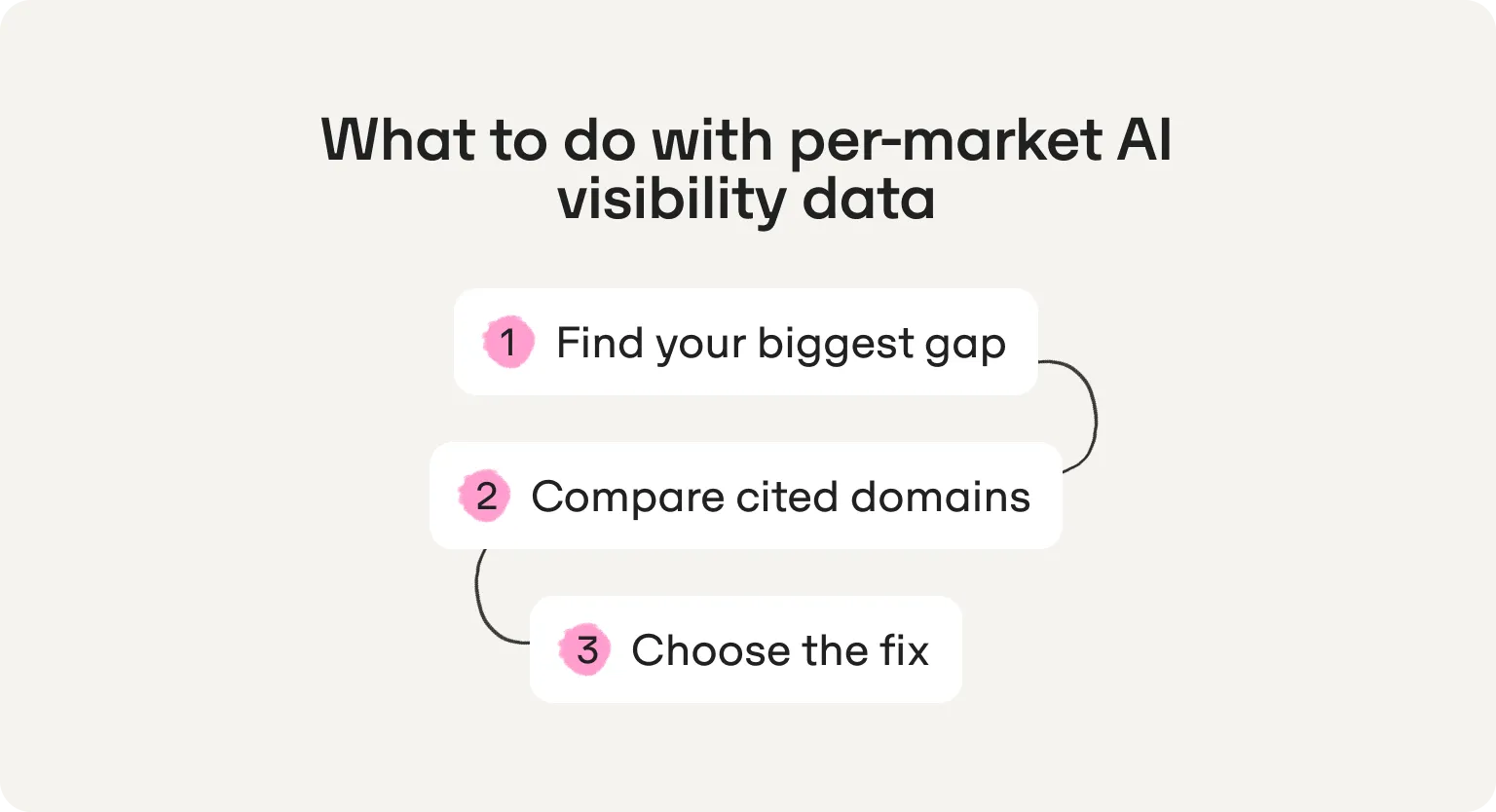
Per-market data earns its keep when it changes what you do next in a specific country. Three moves turn it into a plan:
Then measure the same prompts in the same market, so you can see whether the fix moved the answer.
Most tools in this list will tell you that you're missing from AI answers in Spain. Fewer will tell you why, and none of the others will draft the Spanish page for you. That last step is where multi-market teams get stuck, because the number of markets grows faster than the team.
Omnia positions itself as the AEO specialist you don't need to hire, and the multi-market case is where that promise is easiest to test. One specialist can only check so many markets by hand. Omnia tracks every monitored prompt daily through real browser simulations, with unlimited brands, countries and languages on every plan. Omnia's own pricing page sets the two side by side:
Every plan also includes API access and MCP access with read and write permissions inside Claude and ChatGPT, so per-market data sits where your team already works. The piece that changes the math for a lean team is the Omnia Agent.
A tracking tool shows you the gap in each market. Your Omnia Agent works to close it. It sits inside Omnia and works from your live visibility data every day:
Adding a market works the same way. Ask your Omnia Agent to start monitoring France, and it proposes a parallel French prompt set written the way French buyers actually ask, with France set as the market location. It adds the French and international competitors relevant to that market, keeps the same intent coverage as your existing set, and reports each market separately. It doesn't translate your existing prompts, because a French buyer asks different questions and weighs different local players.
Two properties matter most to a team handing over real work. Your Omnia Agent never publishes without your sign-off, so every change waits for your approval. And every recommendation is grounded in your own Omnia data, which is the difference between a generic assistant and how agentic workflows are changing AEO for teams that use them well.
Your Omnia Agent's work runs on insight credits. Each insight or action costs 30 credits. Growth includes 150 credits a month, Pro includes 600 and Enterprise includes 1,500, and top-ups cost €10 for 150 credits. A team acting on several markets at once will get more out of Pro or Enterprise. In Omnia's words, a marketer plus the Omnia Agent beats either one alone.
Project Suggestions is where your Omnia Agent's work starts each day. It reads your prompts, AI answers, citations and sentiment, along with your site, your competitors' sites and your connected tools. It then returns up to three scoped projects, and only when the evidence supports them. Each suggestion carries its evidence, its confidence level and what it still doesn't know.
Accepting a suggestion opens a conversation that's already underway, with the context, the evidence and often a first draft attached. Your Omnia Agent also checks 60 days of history, so projects you declined or finished don't come back. Project Suggestions is available on Growth, Pro and Enterprise.
For a multi-market team, that might look like a suggestion to close a competitor's lead in ChatGPT answers in Spain. It would arrive with the Spanish domains AI engines cite for that prompt and a drafted Spanish page ready for your review.
Omnia customers have reported results from this approach. TUIO saw 45% more traffic from AI search, and OkTicket reported 30% more leads from AI.
Omnia offers a 14-day free trial on the Growth plan.
No credit card required. See exactly where your brand shows up (or doesn't) across AI engines, then let the platform's recommendations guide your next move.

The best international SEO tools for AI search measure AI answers separately in each country and language. Omnia leads for multi-market teams because it includes unlimited countries and languages on every plan and acts on the gaps it finds. BrightEdge suits large enterprises, and LLMrefs is a strong budget option with 50+ countries.
Yes. AI engines shape answers around where a question is asked from and the language it's asked in, so the cited sources and recommended brands can change from one market to the next. That's why a single global visibility score can hide the market where you're losing.
Translation alone often isn't enough. A translated prompt may not match how local buyers phrase the question, and a prompt sent from outside the country may not return the answer they see. A better approach is a prompt set written natively for each market, with its own local competitors and separate reporting.
It varies. Some tools cap the number of countries per plan and move additional markets to an enterprise contract. Others include every market but count each one as a separate prompt against your allowance. Ask each vendor how many markets your plan includes and how prompts are counted per market.
With some tools, yes. The ability depends on whether a tool treats country and language as separate settings. This matters for B2B brands, since many buyers outside English-speaking countries search in English.
Yes. AI engines retrieve from your localized pages, so a broken hreflang setup can weaken your AI visibility in a market as well as your rankings there. Classic international SEO and AI search optimization work best together.
A classic international SEO tool checks how your site is built for other markets, including hreflang, localized keywords and rankings per country. An AI visibility tool checks what AI engines actually say about your brand. International SEO tools for AI search combine the two by measuring AI answers market by market.
No. Omnia charges per monitored prompt, and brands, countries and languages are unlimited on every plan. Each market counts as a separate monitored prompt, so a prompt tracked in three countries uses three prompts from your allowance.
Written By
 Miguel FernándezCTO & FounderatOmniaJoseGrowthatOmnia
 JoseGrowthatOmnia
 The Omnia Team
 The Omnia Team
 JoseGrowthatOmnia
No credit card required · Free for 14 days · See your AI visibility within 3 minutes