
AI Search Visibility
How To Turn AI Visibility Data Into a GEO Roadmap in 2026

 JoseGrowthatOmnia
 The Omnia Team
TL;DR
Readiness isn't a feeling, it's answerable with four concrete checks: whether a brand appears in AI answers at all, where it appears relative to competitors, whether what gets said about it is accurate, and whether any of that is improving or eroding over time. Most brands asked to assess their readiness reach for a framework built for a different question entirely, whether the organization has adopted AI internally, when the real question is whether AI engines already talk about the brand.
Leadership asks the same question in almost the same words every time: are we ready for AI search. What usually comes back is an opinion dressed up as an answer, a gut feeling from whoever got asked, or a framework borrowed from AI adoption consulting that scores data infrastructure, governance, and employee training. None of that touches the actual question. A brand can have excellent AI governance internally and be completely invisible when a customer asks ChatGPT about its category, and a brand with no AI strategy at all can already be cited constantly. Readiness for AI search is a separate, measurable thing, and it doesn't require a consulting engagement to check.
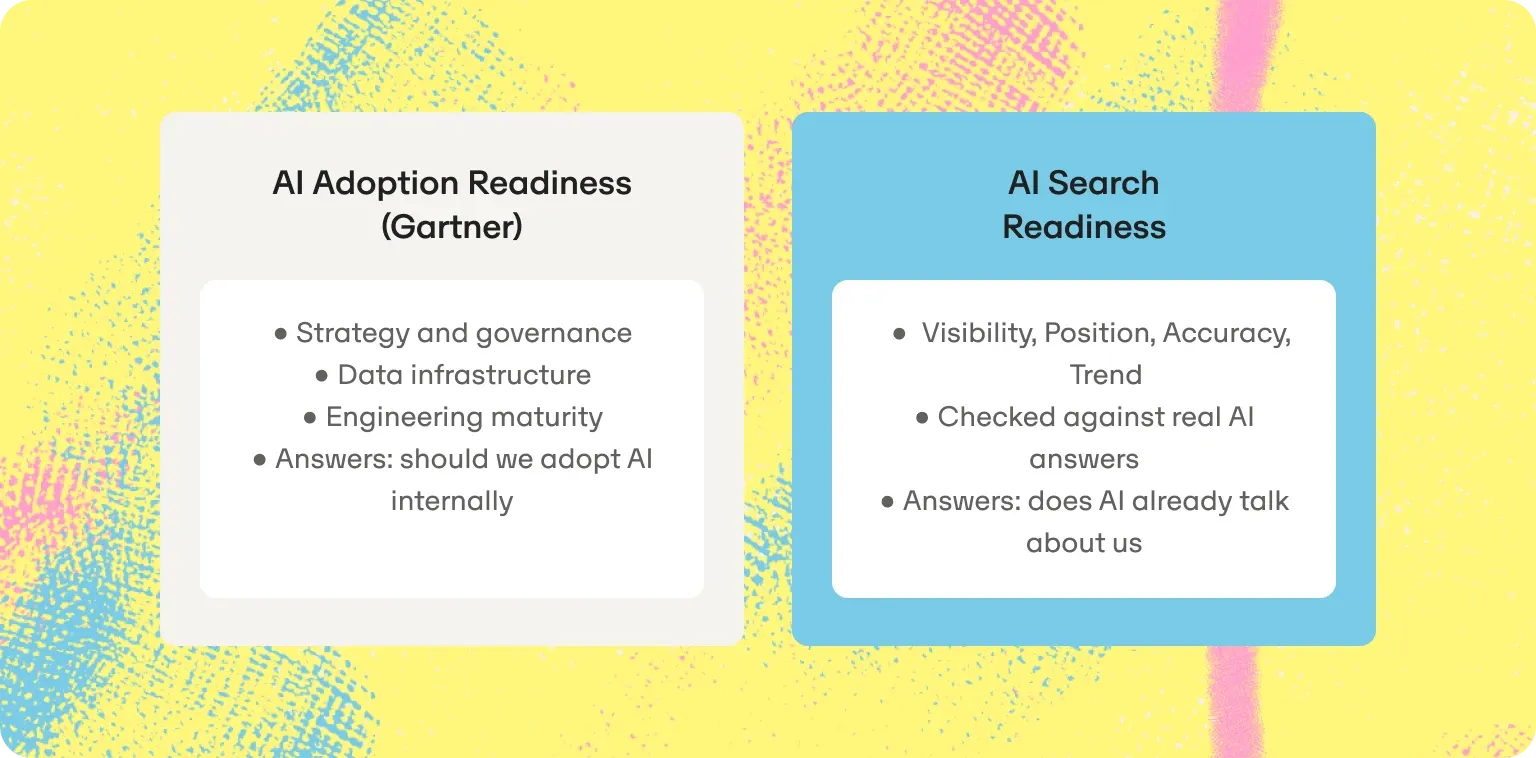
Pull up the most widely used AI maturity framework and the mismatch becomes obvious fast. Gartner's own AI maturity model, the most cited version of this exercise, scores an organization across seven pillars:
Every one of those is a real, worthwhile thing to measure. None of them asks whether a customer typing a question into ChatGPT ever encounters the brand. A company can score at the top of Gartner's five maturity stages, AI embedded across every process, strong governance, mature data pipelines, and still be a name that never comes up when an AI engine answers a question about its own category. The framework was built to answer "should we adopt AI," not "does AI already talk about us."
The practitioners actually measuring AI search visibility for a living have been saying this directly. Mike King, CEO of the SEO firm iPullRank, put it plainly: classic search measurement was about performance, but AI search channels behave more like branding channels, which means the old KPIs and the internal-readiness scorecards built for a different era don't transfer cleanly. Lily Ray, one of the most cited voices on AI Overviews and answer engine optimization, has been equally direct in the other direction, warning that plenty of people entering this space with little real experience are making lofty promises about GEO without evidence behind them. Between those two positions sits the actual requirement: a framework specific to AI search visibility, checkable against real data, not borrowed from a different discipline and not sold as hype.
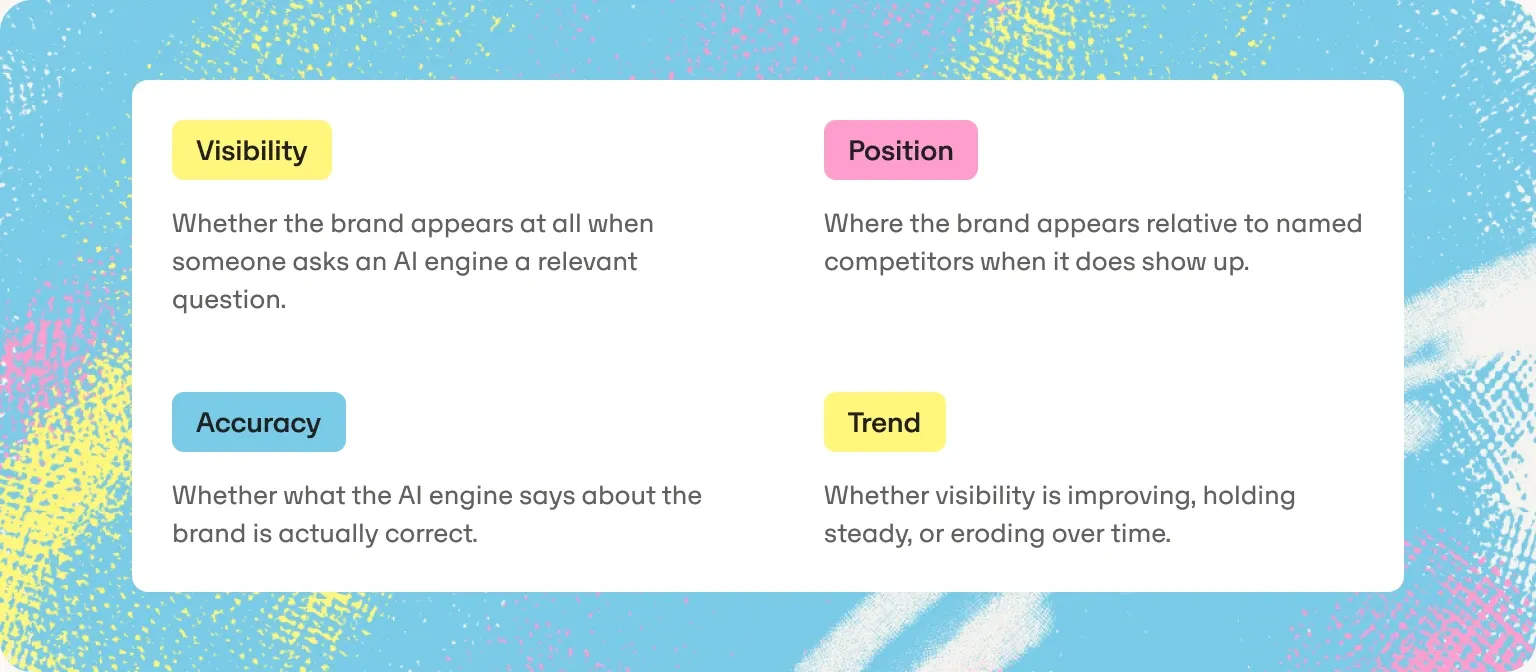
Four questions actually determine whether a brand is ready for AI search, and each one has a concrete way to check it, not a survey to fill out.
| Dimension | What it measures | How to check it yourself |
|---|---|---|
| Visibility | Whether the brand appears at all when someone asks an AI engine a relevant question | Ask ChatGPT, Perplexity, or Google AI Overviews the actual questions a customer would ask, and see if the brand comes up |
| Position | Where the brand appears relative to named competitors when it does show up | Ask the same question with "compared to" a known competitor and see who gets recommended first |
| Accuracy | Whether what the AI engine says about the brand is actually correct | Compare the AI's description against the brand's own facts, checking especially for outdated pricing, discontinued products, or old positioning |
| Trend | Whether visibility is improving, holding steady, or eroding over time | Repeat the same prompts on a schedule and track whether the answer changes, since a single check only shows one moment |
This structure isn't invented for this article. It mirrors what iPullRank itself tracks for clients: share of voice, citation rate, citation quality, and citation sentiment, the same four ideas under different names. Two of these dimensions map directly onto terms worth knowing by name: visibility is what most people mean by an AI visibility score, and position is closely tied to inclusion rate, how often a brand gets included at all once a relevant prompt is asked.
Accuracy matters more than it might first appear, Mike King has pointed out that a brand's Wikipedia page, structured product data, and press coverage now shape how AI engines describe it more than the brand's own website copy does, which means inaccurate or outdated entity data anywhere in that chain can quietly poison the Accuracy dimension even when Visibility looks fine.
The trend dimension is worth taking seriously for a specific reason: not everyone agrees that single-query AI visibility checks mean much. Rand Fishkin has been openly skeptical of AI visibility tracking at the individual query level, calling it unreliable given how much a single answer can vary between one ask and the next. That's a fair critique of a one-time snapshot, and it's exactly why this framework treats a single check as a starting point, not a verdict. A pattern held across repeated checks over weeks answers a question that one lucky or unlucky prompt cannot.
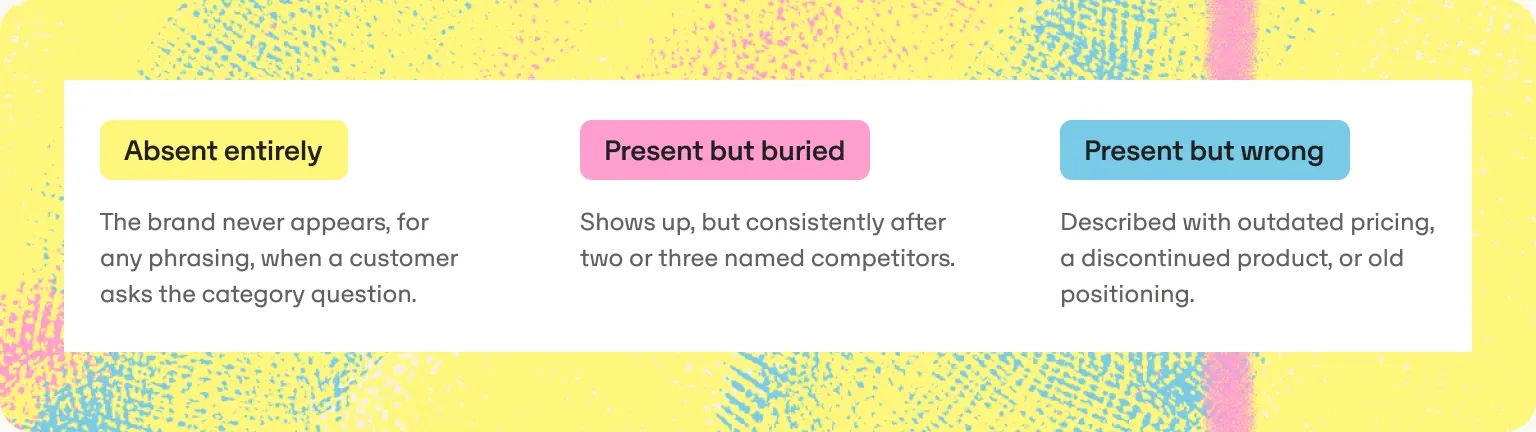
"Not ready" isn't one condition, it's three distinct failure states, and they call for different responses.
Most brands that assume they're "probably fine" on AI search have never actually run a proper citation check to see which of these three states, if any, applies to them. Several of the structural reasons this keeps happening sit underneath all three failure states at once, not because the brand did anything wrong, but because nobody built the checking habit in the first place.
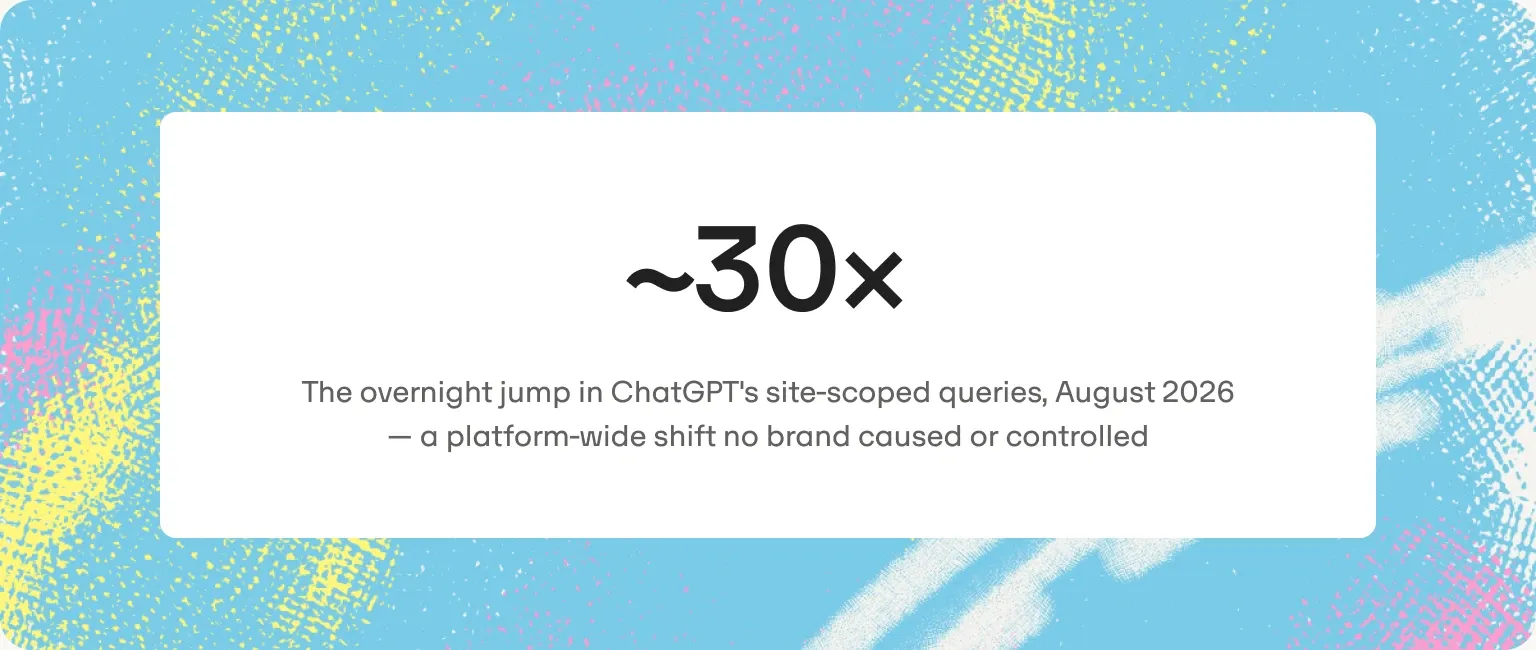
A readiness answer from six months ago is not a readiness answer today, and the gap isn't the brand's fault. AI engines update their own retrieval behavior on a schedule nobody outside the company can see or influence. In August 2026, ChatGPT's search behavior shifted overnight: the share of queries scoped directly to individual domains jumped roughly thirtyfold in a single day, a platform-wide change that had nothing to do with any brand's content and everything to do with how the underlying model decided to search. A readiness check run in July would have missed it entirely, not because the check was wrong, but because the ground moved after it ran.
This is the actual argument for treating AI visibility as something to observe continuously rather than something to confirm once and file away. The same logic that makes generative engine optimization an ongoing practice rather than a one-time project applies directly here: competitors publish new content on their own schedule, AI engines change retrieval behavior on theirs, and a brand's own citation patterns shift in response to both without anyone at the company doing anything differently. A readiness assessment answers the question for right now. Whether that answer still holds next quarter is a separate question, and it only has an answer if someone keeps checking.
Running the four checks above by hand, one prompt at a time across ChatGPT, Perplexity, and Google AI Overviews, works, but it's slow to do properly and easy to do inconsistently. The free AI visibility checker runs the same four dimensions automatically, against real prompts, in minutes instead of an afternoon:
No account required, no sales call, no waiting on an internal audit. A leadership team gets the same answer the framework above describes, automated instead of manually assembled prompt by prompt.
A result showing the brand absent, buried, or misdescribed answers the readiness question. It doesn't close the gap on its own, and closing that gap through the same manual, one-prompt-at-a-time process only compounds the bandwidth problem most lean marketing teams already have.
This is where the Omnia Agent, Omnia's own AEO agent, picks up where the checker leaves off:
None of this requires a specialist hire or a quarter-long project to get started. The same team that just ran the free checker can go from seeing the gap to having something already underway to close it, without adding headcount to do it.
Leadership doesn't need another framework to debate. It needs the actual number. Run the free AI visibility checker now and get a direct answer to the question that started this: is the brand actually ready for AI search, or has nobody checked yet.
Omnia offers a 14-day free trial on the Growth plan.
No credit card required. See exactly where your brand shows up (or doesn't) across AI engines, then let the platform's recommendations guide your next move.

It means whether a brand shows up, accurately and competitively, when someone asks an AI engine a question about its category. It has nothing to do with whether the organization has adopted AI internally, that's a separate question measured by a separate, unrelated framework.
A general AI adoption framework, like Gartner's, scores internal capability: strategy, governance, data infrastructure, engineering maturity. None of those pillars touch whether a customer encounters the brand in an AI-generated answer. A brand can score perfectly on one and fail completely on the other.
At minimum monthly, since AI engines update retrieval behavior on their own schedule and competitors publish new content continuously. A single check only confirms the answer for the moment it ran; treating that answer as permanent is how brands get blindsided by a shift they had no way to see coming.
Yes, more realistically than in traditional search rankings. AI citation depends heavily on structured, accurate, well-sourced information about a brand, not primarily on domain age or backlink volume, which narrows the gap between a smaller brand doing this well and a larger one that hasn't paid attention to it yet.
Run the Free AI Visibility Checker against a set of real prompts a customer would actually ask. It answers the visibility, position, and accuracy questions directly, in minutes, without requiring an internal audit or a consulting engagement first.
Written By
 The Omnia TeamJoseGrowthatOmnia
 Miguel FernándezCTO & FounderatOmnia
 JoseGrowthatOmnia
 The Omnia Team
 JoseGrowthatOmnia
No credit card required · Free for 14 days · See your AI visibility within 3 minutes