
AI Search Visibility
How To Turn AI Visibility Data Into a GEO Roadmap in 2026

 JoseGrowthatOmniaJoseGrowthatOmnia
TL;DR
The best answer engine optimization tools do four things. They track whether your brand appears in AI generated answers, show which sources AI engines cite instead of you, measure that visibility by country and prompt, and turn the findings into content you can actually ship. Most tools on this list do two or three of those things well. Omnia does all four, with URL-level AI citations tracking, prompt tracking across 7 engines, unlimited country coverage on every plan, and the Omnia Agent, a built-in AI agent. If you’re shortlisting, start with the comparison table below, then read the reviews for the three tools that fit your team.
If you’re evaluating answer engine optimization tools, you’re already past the question of whether AI search matters. You know it does. Now you need to figure out which platform will help you become the cited answer, not just another brand that gets mentioned in passing.
The market is crowded, and it’s getting busier every day. Traditional SEO platforms are bolting on AI visibility features and calling themselves AEO tracking software. PR tools are adding LLM monitoring and labeling it AEO. Purpose-built platforms are racing to add execution layers on top of dashboards. The result is a category where every tool claims to do the same thing, when very few really do.
This article covers 13 platforms and evaluates each one on AEO-specific capability: engine coverage, citation tracking depth, country-level visibility, and whether the tool stops at monitoring or includes an action layer.
For SEO and marketing leads working with a budget and a deadline, the goal is to help you identify which tool fits your team, where each one has gaps, and which one gives you the data and execution you need to improve how your brand shows up in AI answers.
Answer engine optimization (AEO) platforms are built to track, measure, and improve how your brand shows up in AI generated responses from AI answer engines like ChatGPT, Perplexity, Google AI Overviews, and Google AI Mode. They’re narrower than generative engine optimization tools, which cover the broader discipline of influencing what gets generated. AEO focuses specifically on being the cited source, the recommended brand, and the named answer.
There’s no blue links or traditional ranking positions to worry about.
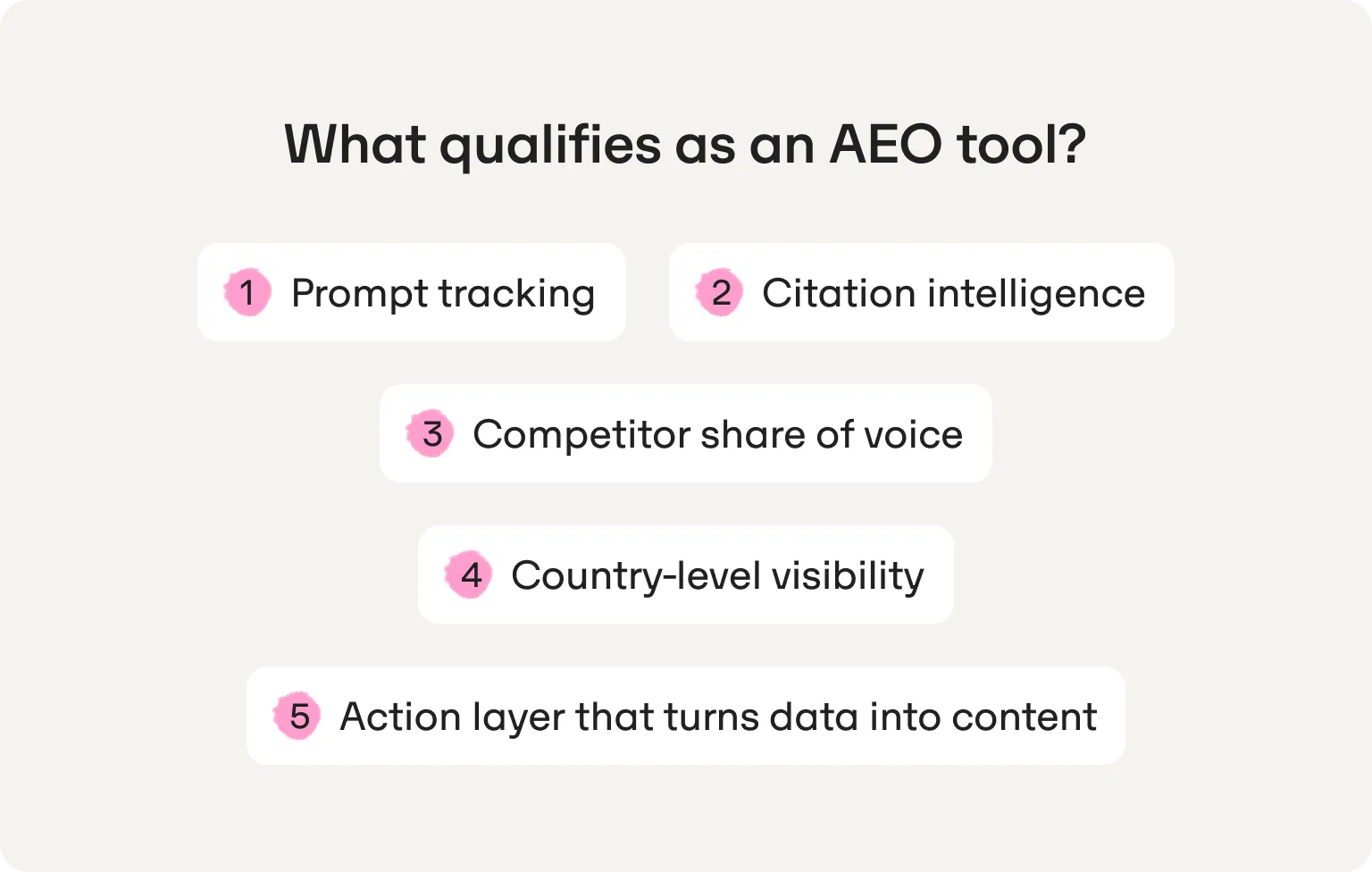
A real AEO tool needs five things to earn the label:
If a tool only shows brand mentions without citation context, it’s a monitoring dashboard, not an AEO platform. If it tracks engine visibility but can’t tell you what to publish next, you’re really paying for only half a solution.
The distinction matters because the actions you take are different depending on what you’re measuring. A mention count tells you something happened. A citation with URL-level detail tells you what to fix. A share of voice trend tells you whether a competitor is gaining ground across your topic cluster. The AI visibility platforms worth your budget give you all three layers, not just the top one.
Every AEO platform follows the same basic loop. It sends prompts to AI search engines, captures the responses, analyzes them for brand mentions and citations, and presents the results in a dashboard. What separates good tools from bad ones is what happens after the dashboard loads. The best platforms show you why the score moved, which competitors are gaining, and what content you need to publish to close the gap.
Prompt discovery is the foundation of any AEO program. If you’re only tracking prompts you guessed, you’re missing out on the ones your buyers use. A good prompt discovery tool surfaces real questions from real users, clusters them by intent, and maps them to answer types so you know whether the prompt is looking for a comparison, a definition, a recommendation, or a how-to. It should also cover other AI platforms beyond ChatGPT, so you’re not oblivious to engines your buyers might use.
The AI prompt discovery process should also show you which prompts are winnable. A head term like “best CRM” is nearly impossible to win in AI answers if you’re not already a category leader. A long-tail prompt like “best CRM for B2B SaaS teams under 50 people” is winnable, and it’s where most brands should start. Tools that only surface high-volume prompts without competitive context set you up to chase terms you can’t win.
AI search tracking means monitoring how your brand shows up across major AI engines like ChatGPT, Perplexity, Google AI Overviews, Google AI Mode, Gemini, Copilot, and Claude. The same prompt can return different answers on different engines in different countries. That’s why country-level tracking isn’t optional if you’re interested in more than one market.
A brand might rank #1 in ChatGPT AI responses in the US but be invisible in the UK. A competitor might dominate Perplexity citations in Germany but not in France. Omnia’s proprietary data shows that engine overlap is lower than most teams assume. AI Overviews and ChatGPT share only 52% of cited domains, and Perplexity and ChatGPT share just 49.5%. If your tool only checks one locale or one engine, you’re missing the full picture in every market that matters.
There’s a difference between a brand mention, a brand recommendation, and a brand citation:
AI citations are the most defensible signal because they’re tied to a specific URL, and they tell you exactly which page earned the citation. Citation intelligence should show you cited domains, cited URLs, citation frequency, and how those metrics change over time. It should also show you which sources AI engines cite when they don’t cite you.
If a competitor is getting cited because they have a stronger backlink profile on a specific page, you need to know that page, not just the competitor’s domain. The AI citation tracking layer is what distinguishes a reporting dashboard from a platform that hands you a to-do list.
Sentiment analysis in AEO tells you whether AI systems are describing your brand accurately. A brand can be visible and cited but described in terms that don’t match its positioning. If an AI engine recommends your product but calls it “budget-friendly” when you’re positioned as premium, that’s a sentiment gap. If the AI describes a competitor as “the industry standard” and describes you as “an alternative,” that’s a positioning problem that sentiment tracking surfaces.
The AI sentiment analysis layer should track sentiment across engines, over time, and by prompt cluster. A single sentiment score isn’t useful. Sentiment by prompt, by engine, and by competitor is. It tells you where your brand narrative is strong and where it’s being shaped by someone else.
This is where some AEO tracking tools start to fall behind. They show you a dashboard or present you with an AI visibility score. But they don’t tell you what to publish, which page to update, or which offsite placement to pursue. An action layer means the tool outputs prioritized recommendations, content briefs, outlines, and technical fix lists. It turns “you have a low visibility score” into “here’s the page that will improve it.”
The strongest action layers go further. They connect to your CMS, push changes live, and measure whether the content you shipped truly moved your citation rate. Marketing teams that use these tools ship faster because the platform handles the gap between insight and execution.
If you can’t show AEO data in a leadership meeting next week, the tool won’t survive stakeholder scrutiny. Look for scheduled reports, exportable dashboards, API access, and integrations with google search console, GA4, and your CMS. Role-based access matters if multiple teams need visibility.
AEO metrics only matter if they connect to business outcomes. So, here’s how each one maps:
14 tools is a lot, and not every one is going to fit your use case. Scan this comparison table and identify 3 or 4, then read the detailed review below.
| Tool | Best for | Engines | Country tracking | Competitor SOV | Citation tracking | Pricing from |
|---|---|---|---|---|---|---|
| Omnia | Mid-market B2B SaaS teams needing execution | 7 | Unlimited on all plans |  |
Domain & URL | €79/mo |
| AirOps | Enterprise content ops teams with governance | 4 | Custom on enterprise only | |
Domain & URL | $200/mo |
| Scrunch AI | Enterprise SEO and digital PR teams | 9 | Multi-region on enterprise only | |
Domain & URL | $250/mo |
| Peec AI | Agencies managing multiple clients | 7 | Unlimited regions on enterprise only | |
Domain & URL | $95/mo |
| Semrush | SEO managers already on Semrush One | 4 | Not specified | |
Domain & URL | $199/mo |
| Ahrefs | SEO teams using Ahrefs for backlinks | 6 | Not specified | |
Domain & URL | $199/mo |
| BrightEdge | Enterprise SEO directors at large brands | 4 | 145 countries | |
Domain only | Custom |
| Moz | Small business owners and junior SEOs | 3 | Not specified | |
Domain & URL | $179/mo |
| HubSpot | Inbound teams on HubSpot CMS | 3 | Not specified | |
Domain & URL | Free / $50/mo |
| Meltwater | PR directors at enterprise brands | 9 | Advertises "worldwide" | |
Domain & URL | Custom |
| Profound | Regulated industries needing compliance | 10 | Custom on enterprise only | |
Domain & URL | $99/mo |
| Conductor | Enterprise SEO at large publishers | 7 | Not specified | |
Domain & URL | Custom |
| AthenaHQ | Early-stage teams wanting free AEO | 8 | 90+ countries on enterprise only | |
Domain & URL | $295/mo |
These reviews cover what each tool does well, where it falls short, and which team it fits best.
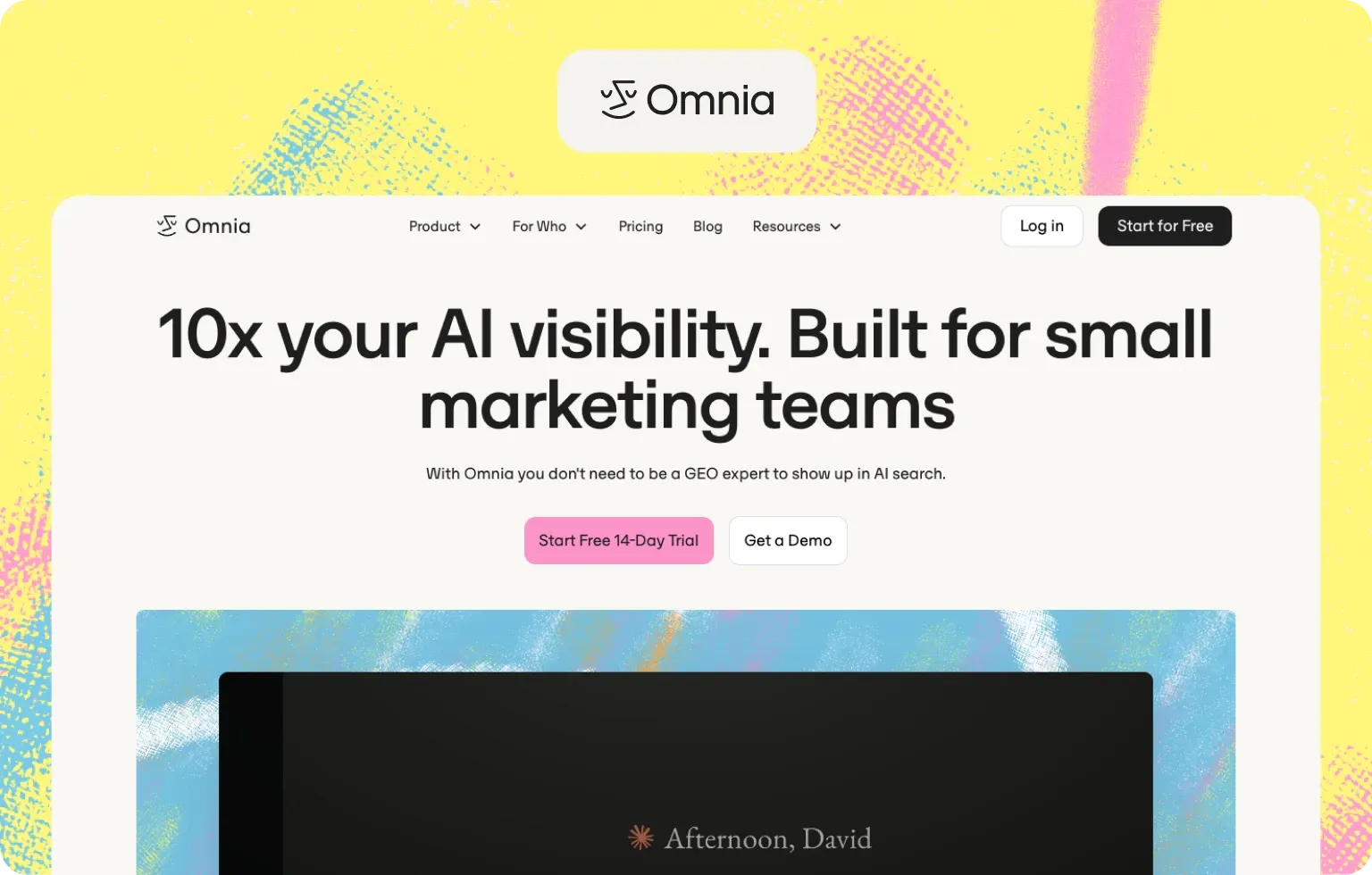
Omnia is a purpose-built AI visibility platform designed specifically for answer engine optimization. Every plan includes tracking across seven AI answer engines, unlimited country and language coverage, MCP and API access, and the Omnia Agent, an AI agent that does the work most tools leave to you.
Best for
SEO and marketing leads who need to go from “we have a visibility gap” to “here’s the content we’re publishing this week” without stitching together three separate tools.
What it does well
Omnia’s AEO architecture starts with prompt discovery that surfaces winnable prompts, not just high-volume head terms. Citation data drills down to the individual page, so you know precisely which URLs earned citations and which ones you need to outperform.
The action layer is what pushes Omnia past dashboard-only tools to actually make a difference in improving your AI visibility. When the platform identifies a prompt cluster where a competitor is gaining, it drafts a content brief targeting the specific prompt cluster where you’re losing ground. Your Omnia Agent reads your share of voice, citations, and sentiment across every engine, finds the gaps where AI engines cite competitors instead of you, drafts the content built to earn citations, and pushes changes live through your CMS.
Key features
Watch-outs
Omnia is purpose-built for AEO, so teams looking for a full traditional SEO suite (backlink analysis, technical site audits, keyword research) will need to pair it with an existing SEO platform. It’s not trying to replace your SEO stack, it’s trying to win your AI visibility.
Good fit if
Not a fit if
Pricing
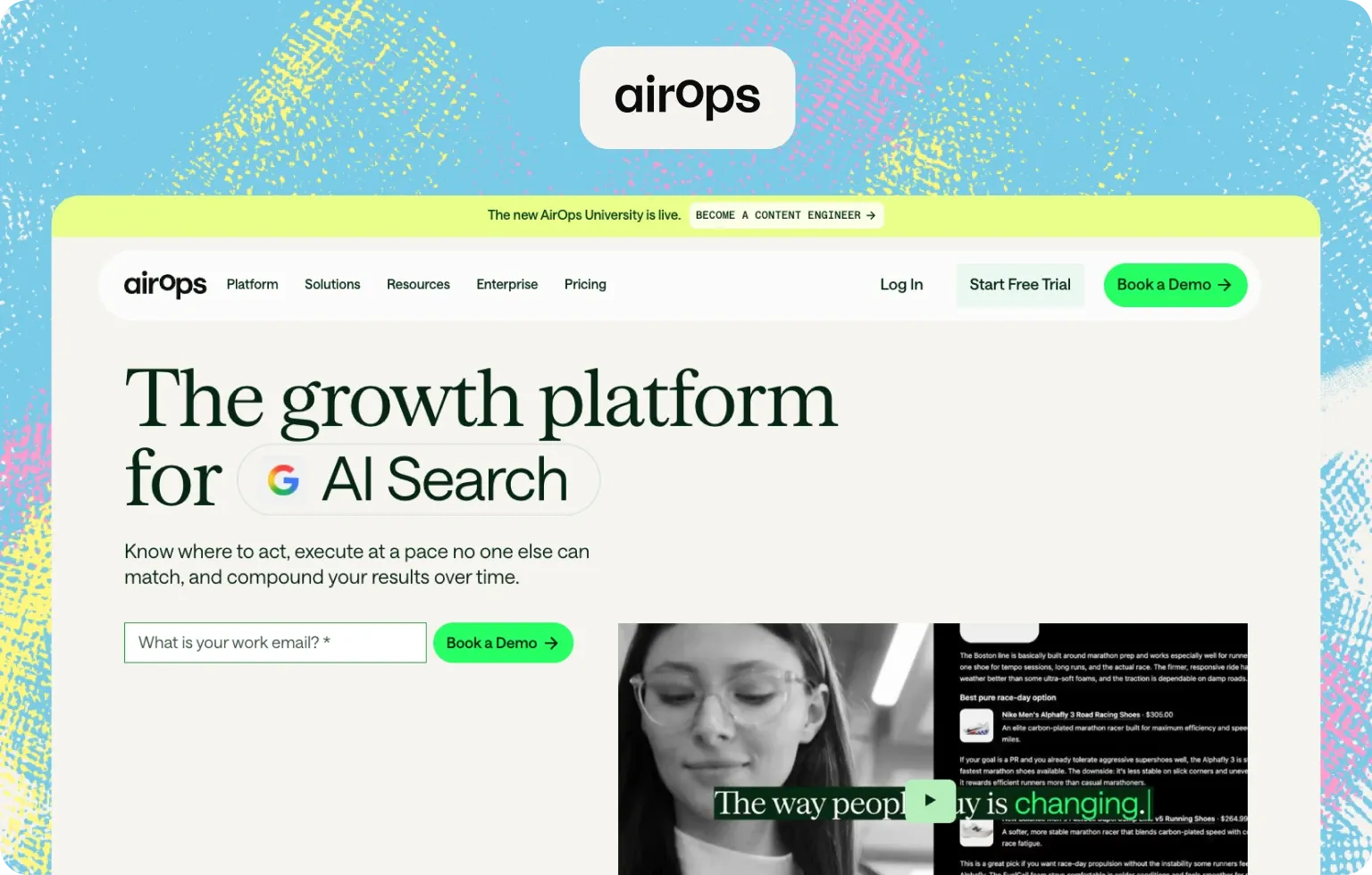
AirOps is an enterprise AEO platform that connects AI search visibility data to content execution and measurement in a single system. It has one of the strongest action layers on this list, taking teams from knowing where they stand to knowing what to do next.
Best for
Enterprise content and SEO teams that need automated content workflows tied to AEO insights.
What it does well
AirOps tracks visibility across 4 AI models. Its Page360 feature unifies Google Search Console, GA4, and AI visibility data into a single page-level view, so you can see organic clicks, AI citations, and referral traffic for every URL in one place. Teams transitioning from SEO platforms will find AirOps’ content workflow capabilities a step up from monitoring-only tools.
Key features
Watch-outs
The platform is more than smaller teams need if they only want lightweight monitoring. Engine coverage is limited to four, and multi-region tracking is only available on the enterprise plan.
Pricing
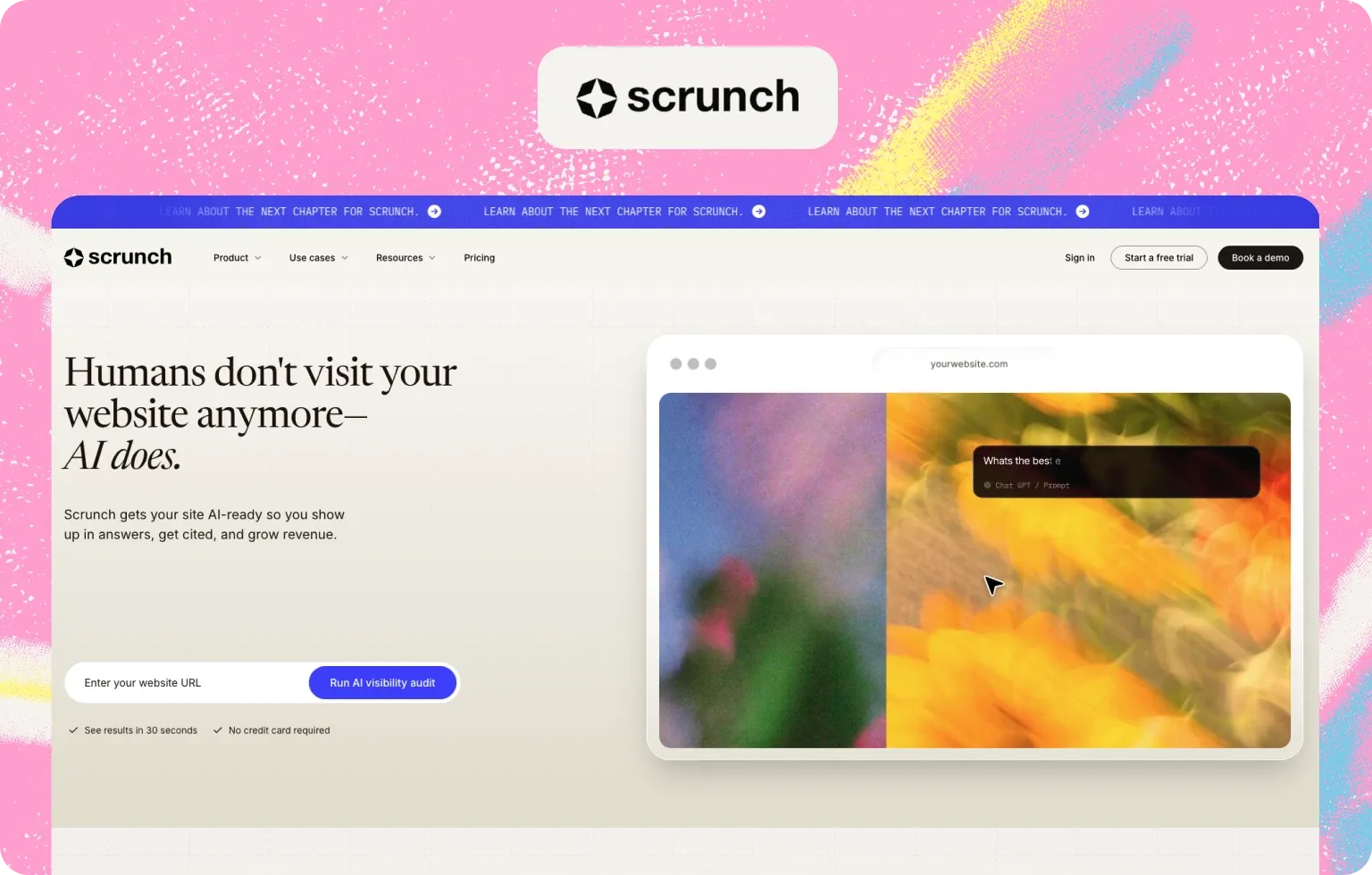
Scrunch is an enterprise-focused AI monitoring platform with strong competitive benchmarking and AI crawler analytics. It tracks how brands appear across AI powered search engines and adds an Agent Experience Platform for deeper execution workflows.
Best for
Enterprise teams that need competitive share of voice analysis and AI crawler traffic data alongside visibility monitoring.
What it does well
Scrunch tracks 4 LLMs on its Core plan and 9 on Enterprise. Its competitive share of voice analysis is one of the stronger implementations in the category. The platform now includes a content gaps feature that finds and fixes AI blind spots, and the Agent Experience Platform adds structured execution workflows. For teams evaluating Scrunch alternatives, the crawler analytics and agent traffic tracking are genuine differentiators.
Key features
Watch-outs
Pricing starts at $250/month, which puts it out of reach for smaller teams. Geographic coverage beyond a single region requires the enterprise tier, as well as the full 9-engine coverage and MCP connector.
Pricing
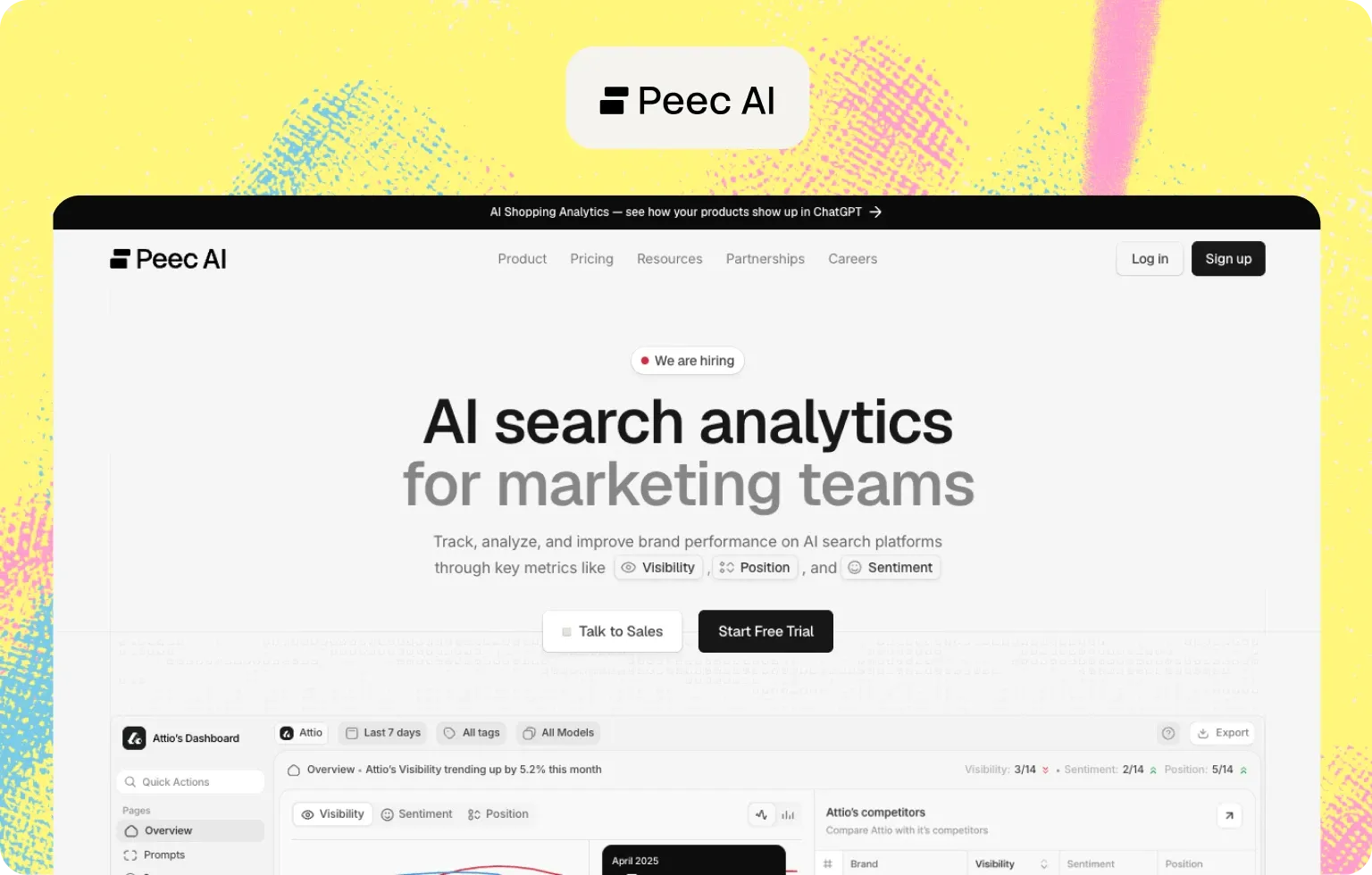
Peec AI is a mid-market AEO tracking tool focused on citation and answer tracking across multiple AI platforms. It offers unlimited seats on every plan, which makes it attractive for agencies managing multiple brands.
Best for
Agencies and mid-market teams that need multi-engine citation tracking with unlimited seats.
What it does well
Peec covers seven engines, but you choose three of seven on self-serve plans. Its citation graph visualization is a big strength, and the platform includes sentiment analysis and content gap detection. The GEO URL audit feature evaluates pages for citation readiness. For marketing teams comparing Peec AI competitors, the unlimited seats policy is a real advantage for multi-brand teams.
Key features
Watch-outs
You can’t access data from before your signup date, which limits historical benchmarking. The platform deliberately doesn’t generate content, though its Actions feature provides opportunity-scored recommendations on what to create or optimize next.
Pricing
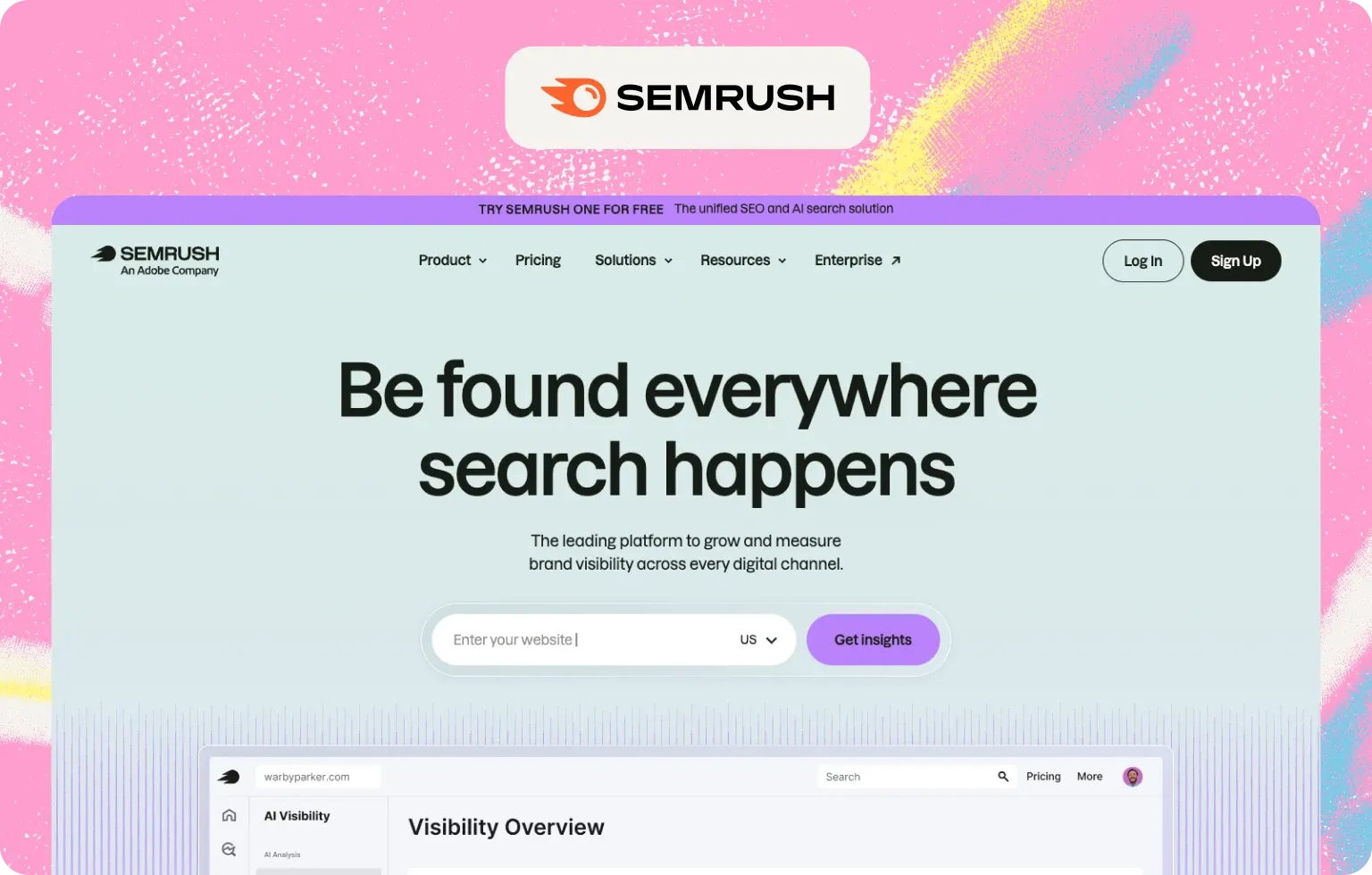
Semrush folded AI visibility into its Semrush One package, layering answer engine tracking on top of its existing SEO suite. The pitch here is continuity. If your team already runs keyword research and site audits inside Semrush, you can add AI search tracking without adopting a separate platform.
Best for
SEO teams entrenched in the Semrush ecosystem who want AEO monitoring without leaving their existing dashboard.
What it does well
Semrush One bundles SEO and AI visibility into a single subscription, leveraging years of search intelligence data. The AI Visibility toolkit covers 289M+ LLM prompts, and the AI Visibility Index gives teams a scoring framework for benchmarking AI search presence. An AI Search Operating System links SEO and AEO workflows within one interface. The full traditional SEO toolkit (keyword research, backlinks, site audits, rank tracking) makes it a legitimate all-in-one for teams that need both disciplines.
Key features
Watch-outs
Engine coverage caps at 4, well below purpose-built AEO platforms. The AI visibility features sit on top of a platform designed for traditional seo, so the AEO depth trails dedicated tools.
Pricing
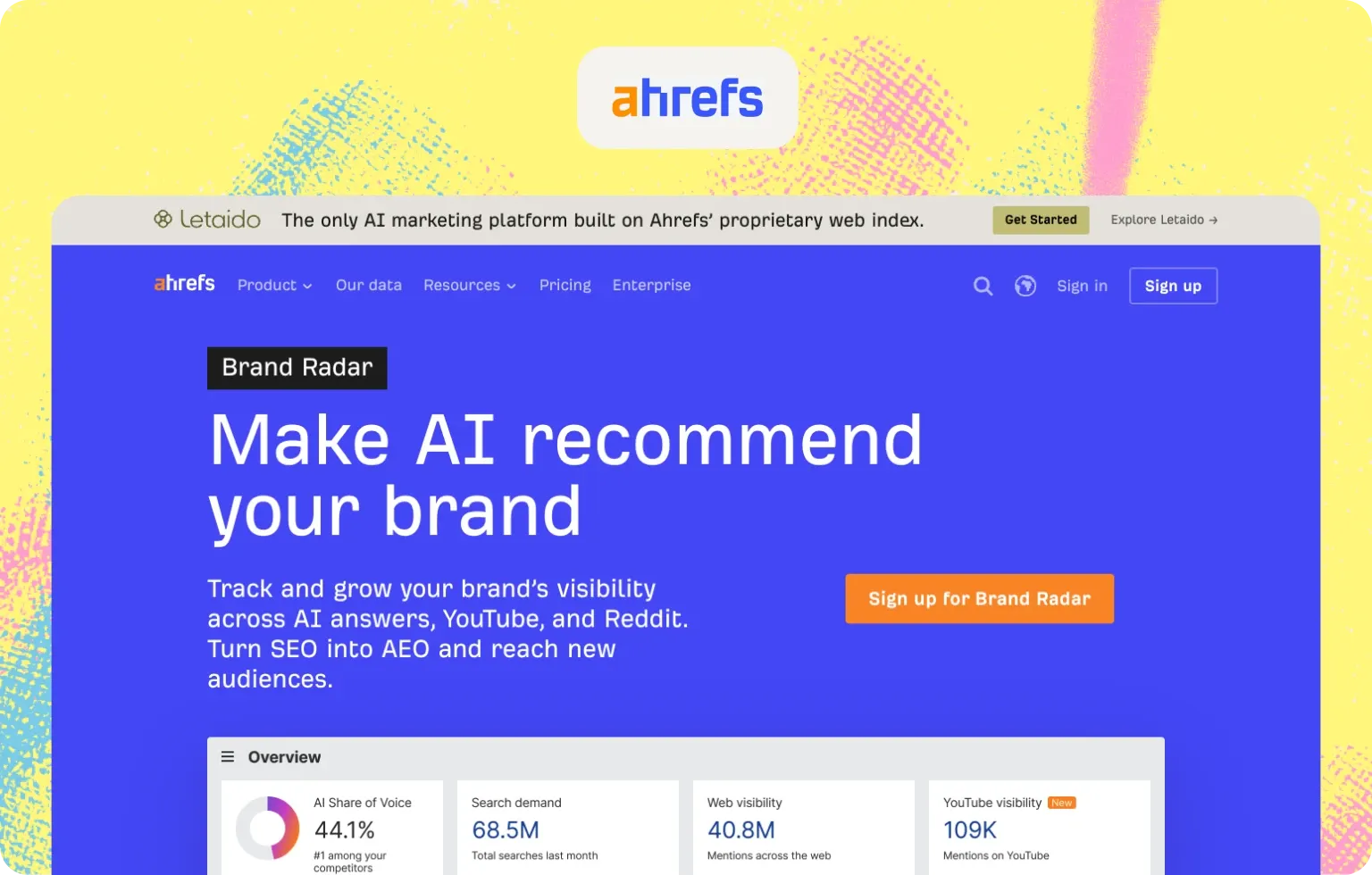
Ahrefs’ Brand Radar is a separate AI visibility product that sits alongside its core SEO toolkit, drawing on the same backlink index and query data that powers Site Explorer. Ahrefs’ advantage is scale: The underlying data pool is among the biggest in the category, fueled by actual user searches instead of synthetic queries.
Best for
SEO teams already using Ahrefs who want to correlate backlink data with AI citation wins.
What it does well
The 391M+ search-backed prompt database is Brand Radar’s biggest strength, giving teams one of the deepest pools of real-query data available. 6 AI engines are covered and citation data connects to Ahrefs’ backlink index, letting you cross-reference domain ratings and referring domains with your AEO presence. For teams exploring Ahrefs alternatives, the sheer data volume is the main draw.
Key features
Watch-outs
Brand Radar is a separate product from core Ahrefs, so the two datasets live in different products. The citation data operates at the domain level, not the URL level, so you can’t see which specific pages won citations.
Pricing
BrightEdge is an enterprise SEO platform that added AI search capabilities through AI Catalyst and AI Hyper Cube. It’s built for large organizations that need SEO performance, organic traffic growth, and AI tracking under the same governance layer.
Best for
Enterprise teams already using BrightEdge for SEO who want to add AI visibility without learning a new tool.
What it does well
BrightEdge’s AI Catalyst tracks brand mentions, citations, and sentiment across ChatGPT, Google AI Overviews, and Perplexity. The AI Hyper Cube reveals AI search conversations mentioning your brand, tracks competitive brands weighted by real search volume, and maps your brand’s presence through the AI-assisted customer journey. Content briefs and recommendations are available through AI Catalyst and Content Advisor. For teams comparing Ahrefs vs BrightEdge, the unified data layer is a genuine strength.
Key features
Watch-outs
Citation data operates at the domain level, not the URL level. Cross-engine coverage is narrower than purpose-built AEO tools at three engines. And pricing is enterprise-only and not published.
Pricing
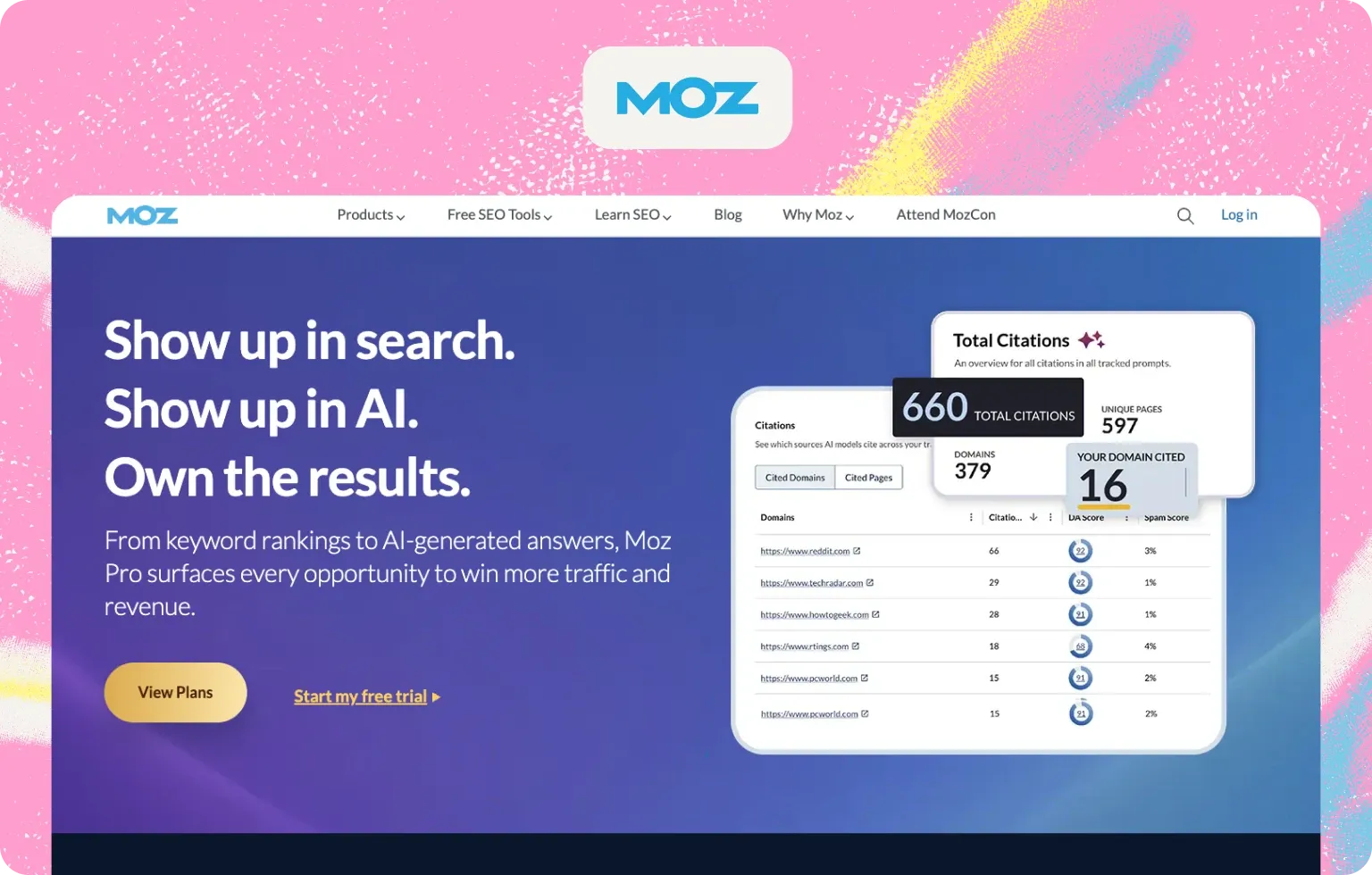
Moz is a reputable SEO suite that has added AI/AEO features through its AI Visibility Dashboards and tracked prompts. It pairs traditional Domain Authority and link data with new AI mention tracking and prompt suggestions.
Best for
SMBs and teams wanting an approachable all-rounder that covers both traditional SEO and entry-level AEO.
What it does well
Moz’s AI Visibility Dashboard shows when your brand and competitors appear in AI-generated responses, and where in each response your brand appears. The Prompt Suggestions feature generates a curated list of prompts based on any topic or brand term. SEO metrics like search volume, intent, and difficulty appear alongside AI prompt tracking suggestions.
Key features
Watch-outs
Moz only tracks 2 engines on the Standard plan. There’s limited AI-specific diagnosis compared to modern AEO tools, and the AI features are layered on top of SEO rather than purpose-built.
Pricing
HubSpot offers a free one-time AEO diagnostic called the AEO Grader, plus a paid ongoing monitoring tool called HubSpot AEO. The free grader scores your brand across five dimensions, and the paid tool extends that into continuous tracking with CRM-powered prompt suggestions.
Best for
Teams already in the HubSpot ecosystem who want AEO monitoring connected to their CRM and content tools.
What it does well
The AEO Grader is free, requires no account, and scores your brand across five dimensions: sentiment, presence quality, brand recognition, share of voice, and market position. The paid HubSpot AEO tool tracks visibility across ChatGPT, Gemini, and Perplexity with a brand visibility score, prompt tracking, citation analysis, and prioritized recommendations.
Key features
Watch-outs
Hubspot’s AEO tooling is limited to three AI engines (ChatGPT, Gemini, Perplexity). You can only track URLs the tool recommends, not custom URLs you want to monitor independently. The deepest value is reserved for existing Marketing Hub users.
Pricing
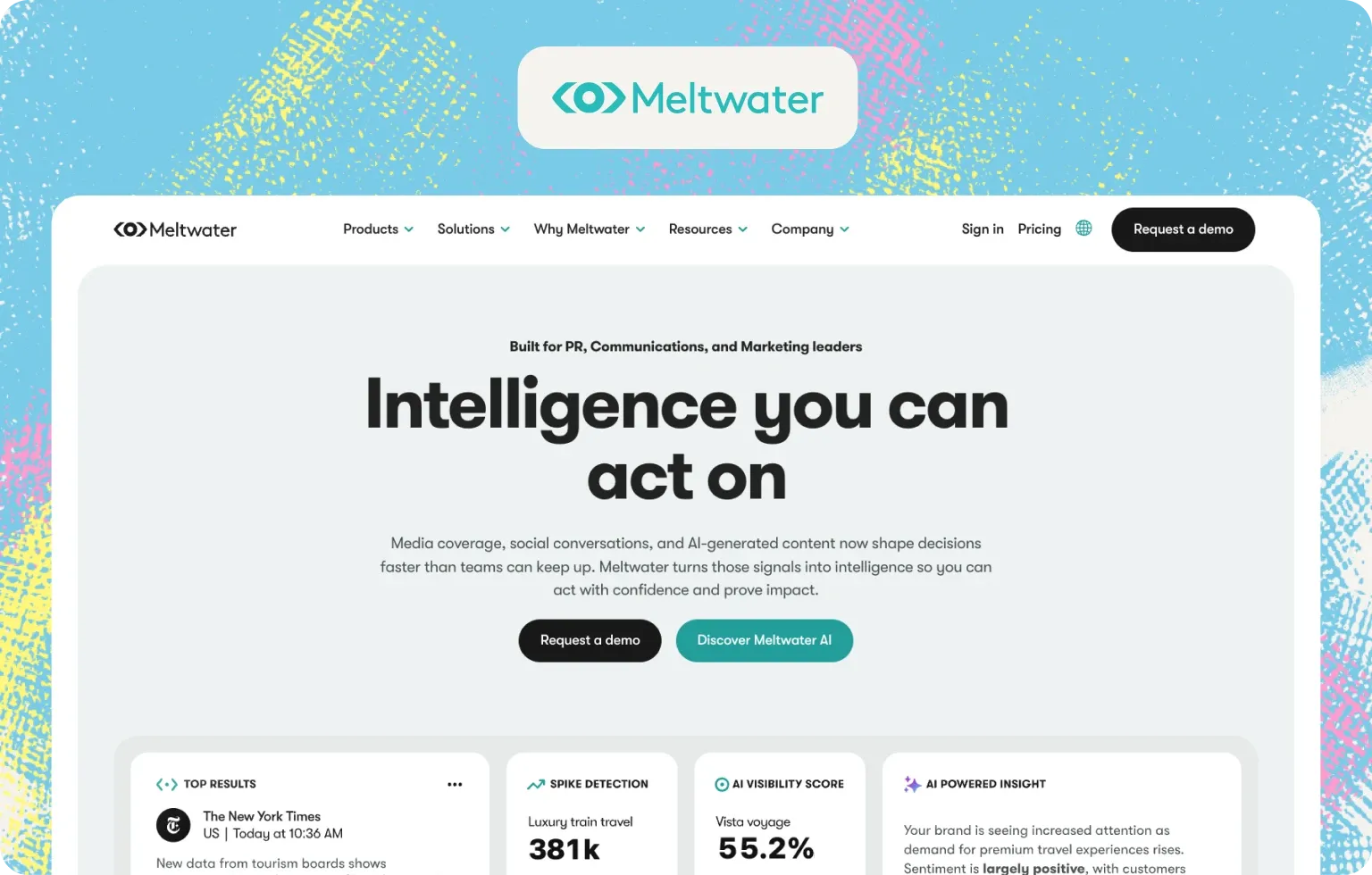
Meltwater’s GenAI Lens is an AI brand monitoring solution built into the Meltwater platform alongside media monitoring, social listening, and consumer intelligence. It’s designed for PR and marketing professionals who need to track how their brand appears across AI platforms.
Best for
PR and communications teams already using Meltwater who need AI visibility alongside traditional media monitoring.
What it does well
GenAI Lens has some of the broadest engine coverage, tracking 9 engines. It covers brand mention frequency, sentiment analysis with emotion detection, prevalence scores, competitive share of voice, and source attribution showing which websites and journalists LLMs cite. AI-generated weekly recommendations help improve AI visibility, and LLM-Generated Reports turn AI insights into executive-ready decks.
Key features
Watch-outs
There’s no published pricing, and the platform lacks a content execution layer. Meltwater’s platform is PR-first with AEO as an add-on, so teams focused purely on AEO may find the broader media monitoring features unnecessary.
Pricing
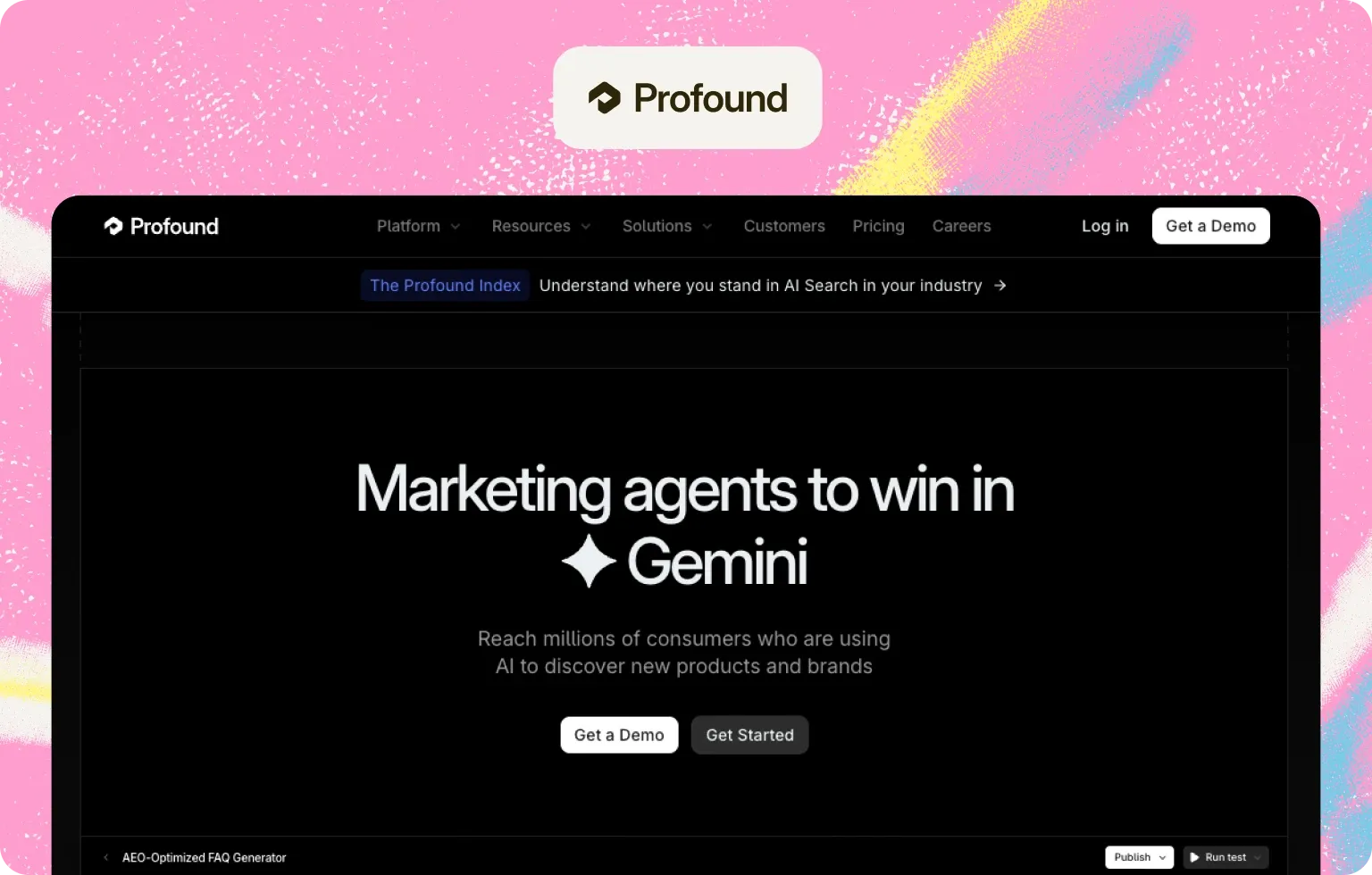
Profound is an enterprise AEO platform with some of the deepest data infrastructure in the category. It tracks visibility across 10 AI engines and includes a proprietary database of 1.5B+ real user prompts sourced from consent-based panels.
Best for
Enterprise brands and regulated industries needing broad multi-engine reporting with compliance certifications.
What it does well
Profound tracks visibility across up to 10 AI engines on its Enterprise tier. Its 1.5B+ user prompt database is one of the largest in the category. AI citation attribution and bulk prompt analysis (100+) are available, along with a Prompt Volumes dataset, content creation and content optimization features.
Key features
Watch-outs
At $99/month, the entry-level plan is limited to ChatGPT alone. The real entry point for multi-engine tracking is the Growth plan at $399/month. The platform’s depth comes with a steep learning curve, causing non-technical teams to consider Profound alternatives.
Pricing:
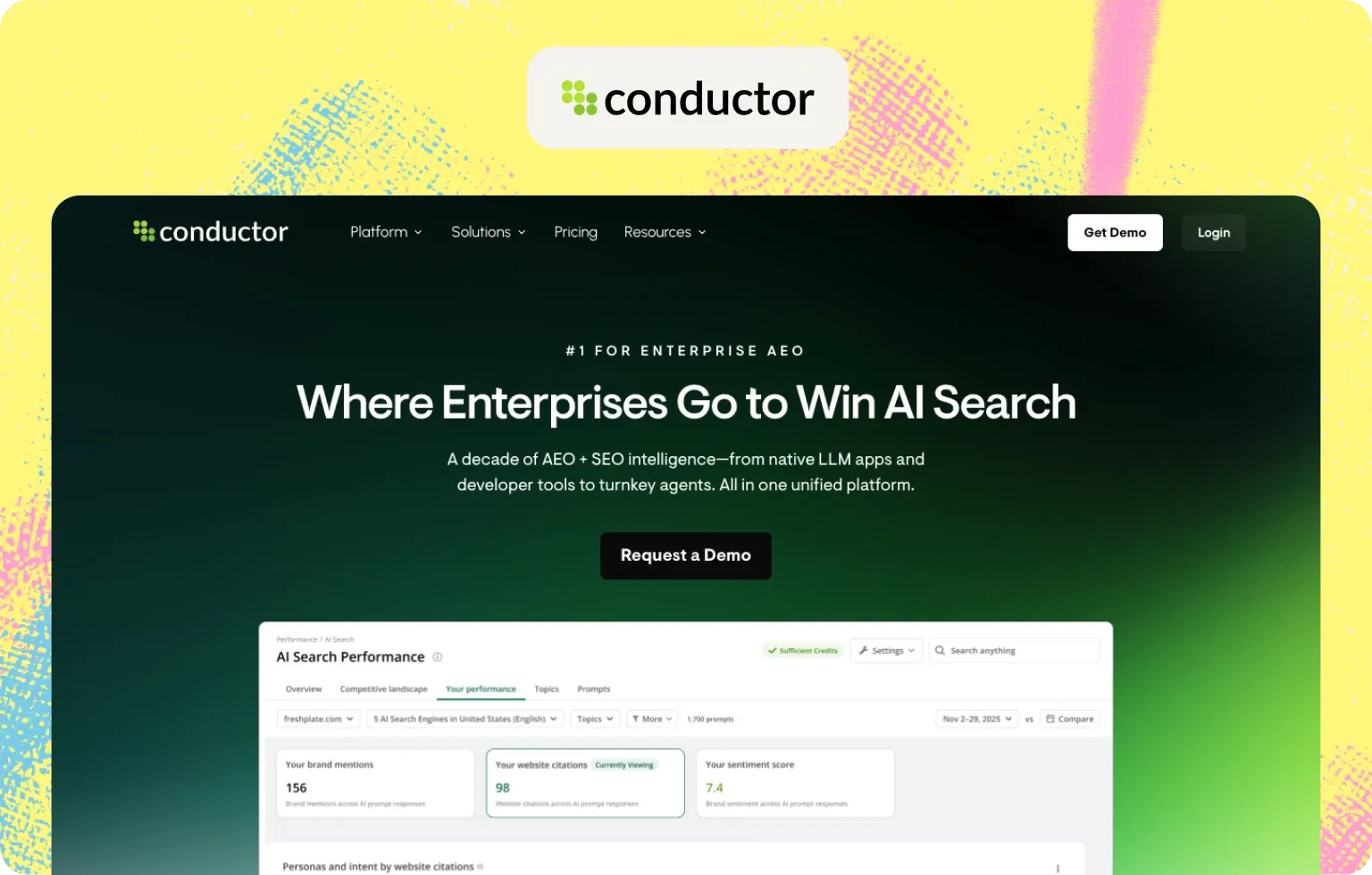
Conductor is an enterprise AEO and SEO platform that positions itself as “the only end-to-end enterprise AEO platform” with a “system of record for AEO.“ It unifies AI visibility with web analytics, search rankings, and technical site health.
Best for
Enterprise teams that need to connect AI visibility to web analytics, conversions, and revenue.
What it does well
Conductor’s AI Search Performance report monitors brand presence across 7 AI answer engines. Sentiment analysis is tied directly to cited sources. The Intelligent Prompt Generation feature auto-generates up to 100 prompts per topic, configurable by persona and intent.
Key features
Watch-outs
Enterprise pricing is not published and is estimated at $2,000+/month. Full enterprise procurement is required. AEO is part of a broader SEO platform, not a standalone tool. The platform is built for large organizations with dedicated SEO teams.
Pricing
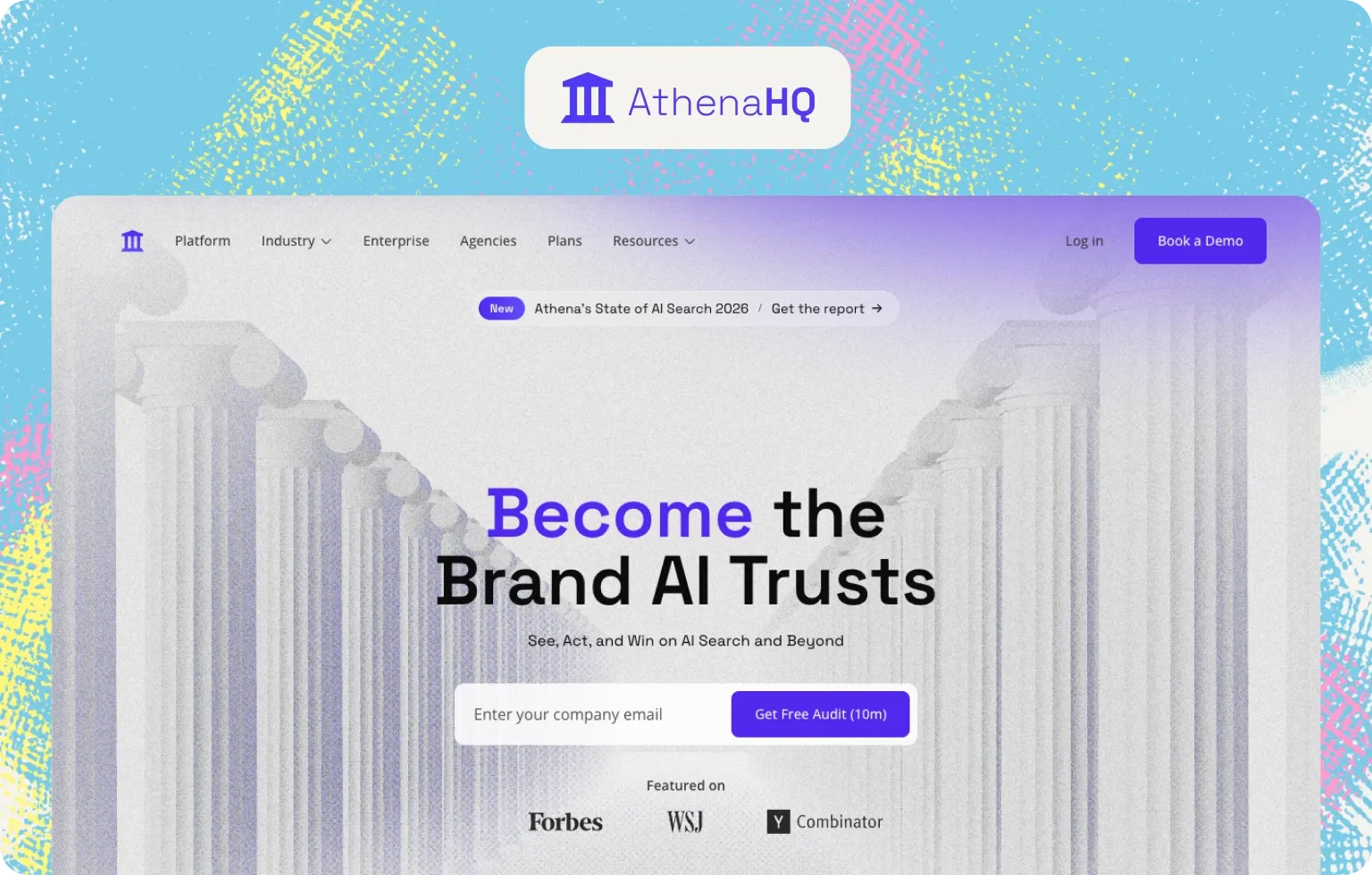
AthenaHQ is an AEO monitoring platform that combines multi-engine tracking with brand integrity monitoring and content agents. Founded by former Google Search and DeepMind leaders, it offers a free Essential tier for teams testing the waters before committing.
Best for
Marketing and brand teams that want a no-cost entry point for AEO monitoring with built-in content agents.
What it does well
AthenaHQ tracks 8 AI engines and covers 90+ countries and multiple languages. The Athena Citation Engine (ACE) provides citation source analysis, showing which specific websites AI platforms cite for queries in your category. Content agents add a content generation and execution layer that goes beyond pure monitoring.
Key features
Watch-outs
The credit-based system makes it difficult to budget. The most differentiated capabilities, including ACE, multi-region tracking, SSO, and API access, are gated to the custom-priced Enterprise tier. The $295/month Starter plan is limited to a single region and language.
Pricing
Red flags to watch out for: No published pricing, no action layer, no free trial, gated API access, or per-engine pricing that inflates the real cost. If you see two or more, keep looking.
This plan is tool-agnostic and aligned to where AEO platforms add the most value. Each phase answers one question: Do we show up today? Why are competitors cited? What are we shipping next?
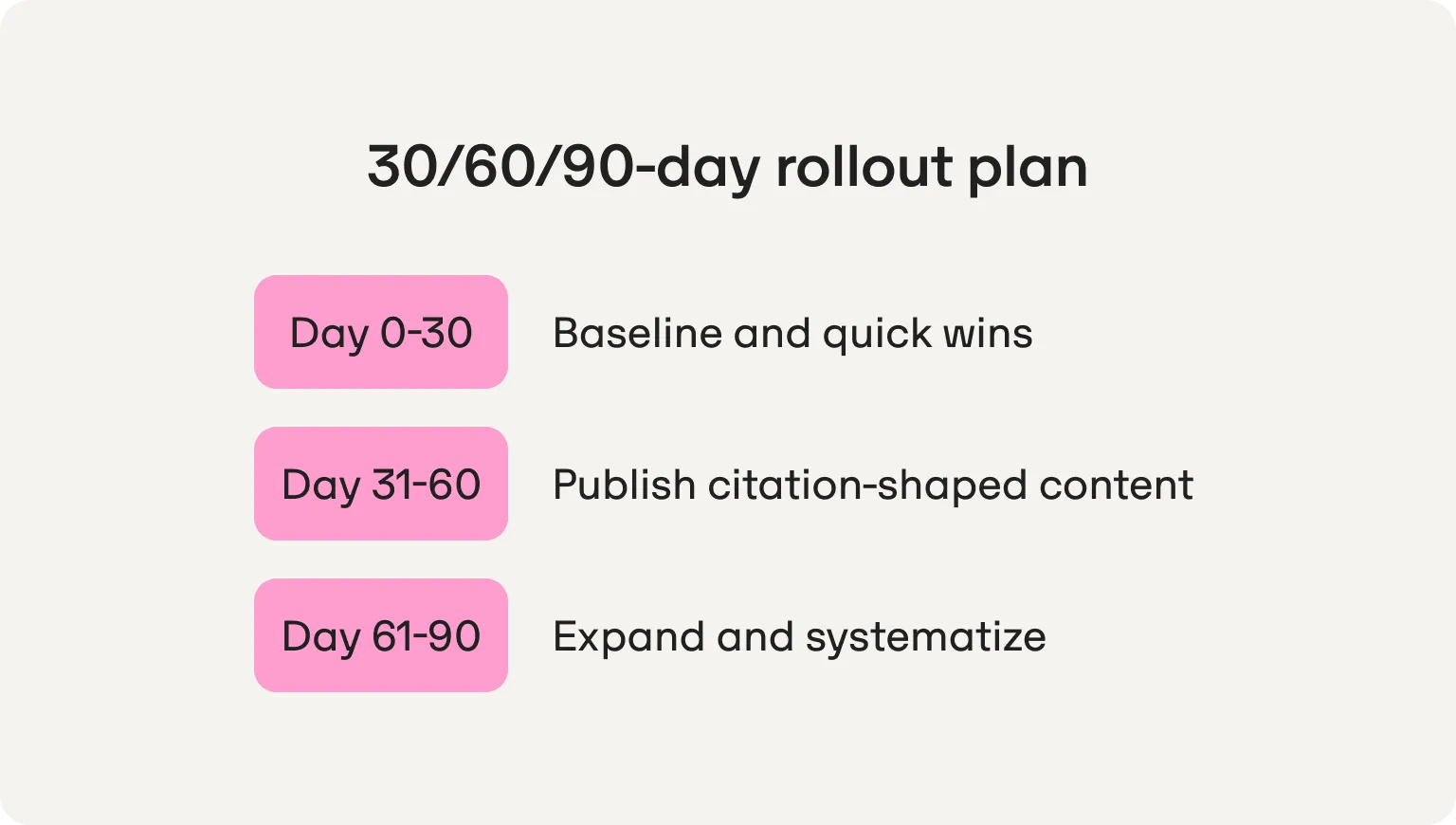
Baseline your current AI visibility across the engines your buyers use. Set up prompt tracking for 20-30 high-intent prompts, define your competitor set, and run a citation audit to see which domains and URLs AI engines cite when they don’t cite you. Identify quick-win edits like pages close to earning citations that need better structured data or updated schema markup. This is where a good AI visibility platform pays for itself.
Publish 5–10 answer-first pages designed to earn AI citations. These have direct answers in the first paragraph, FAQ schema at the page level, and structured data that makes content easy for AI models to extract. Target prompt clusters where competitors are cited but you’re absent, and pursue offsite placements on the publications AI already cites.
Your Omnia Agent can accelerate this phase by drafting briefs and pushing pages live through your CMS.
Expand your prompt clusters from 30 to 100+. Measure whether your citation rate and share of voice shifted, and compare your current AI visibility score against your Day 0 baseline. Systematize reporting with scheduled exports, and connect your tool’s API or MCP integration to your analytics stack so AI search tracking becomes part of your regular cadence. By Day 90, you should answer all three questions with data: where you show up, why competitors win, and what you shipped to change it.

If you’re an SEO or marketing lead with 90 days to show AEO results, the tool you pick matters less than what it lets you ship. Omnia was designed around that constraint:
The reason Omnia ranks first here isn’t the tracking capabilities, though. It's the Omnia Agent. When the platform finds a citation gap, your Omnia Agent doesn't display it on a chart and wait. It reads the data, identifies where competitors are winning, drafts the content meant to close the gap, and pushes it live through your CMS. For SEO and content leads who can’t hire a bigger team but still need to move AI visibility metrics, your Omnia Agent is the layer that turns a static dashboard into a helpful teammate.
Transparency extends to the buying experience. A free AI visibility checker lets you baseline before committing. Pricing is public, with a free 14-day trial and no credit card required.
Book a demo if you want guidance, or skip it and get started right away with the free checker. Many tools in this category still hide behind a sales call. Omnia doesn't.
Omnia offers a 14-day free trial on the Growth plan.
No credit card required. See exactly where your brand shows up (or doesn't) across AI engines, then let the platform's recommendations guide your next move.

Start by baselining your current AI visibility across the AI search engines your buyers use. Find the prompts where rivals earn citations and your brand doesn’t. Publish answer-first content with clear structured data and schema markup. Pursue offsite placements on the domains AI already cites. Track whether your AI citations improve over 60-90 days, and adjust based on what moved.
The best AEO tools combine prompt tracking, URL-level AI citations tracking, competitor share of voice, country-level visibility, and an action layer that turns data into content. Omnia offers all five with 7 engines on every plan and the Omnia Agent, an AI agent that can draft and publish citation-shaped content.
Most teams see measurable shifts in AI visibility within 60-90 days of publishing citation-shaped content. The first 30 days are about baselining and quick wins. Days 31-60 are about publishing content designed to earn citations. By Day 90, you should see whether your citation rate and share of voice moved. AI search results shift faster than traditional search engines, but sustained visibility requires ongoing content optimization and monitoring.
Written By
 JoseGrowthatOmniaJoseGrowthatOmnia
 Miguel FernándezCTO & FounderatOmnia
 JoseGrowthatOmnia
 The Omnia Team
 The Omnia Team
No credit card required · Free for 14 days · See your AI visibility within 3 minutes