
AI Search Visibility
How To Turn AI Visibility Data Into a GEO Roadmap in 2026

 JoseGrowthatOmnia
 Daniel EspejoCEO & FounderatOmnia
TL;DR
AI engines typically mention only 3–5 brands per response, making Brand Share of Voice the critical new metric for any category. A real case study shows how a small sunscreen brand surpassed major global competitors in AI visibility within 8 weeks by identifying and targeting the sources AI models actually cite.
Most brands are disappearing and they don’t even know it. Engines such as ChatGPT, Gemini, and Perplexity do not display links: they generate responses. And in those responses, only a few brands have a voice. The rest have disappeared.
Until now, we talked about Share of Voice as the percentage of impressions, clicks, or mentions that a brand had compared to its competitors. But that was before.
Today, we are discussing Share of Voice in generative environments, which is divided into two fundamental metrics:
Both metrics are important, but they capture different aspects of your visibility. You can have Brand Share of Voice without Domain Share of Voice if models mention your brand but cite other sites as sources. And you can have Domain Share of Voice without Brand Share of Voice if your website is used for its answer but the model does not explicitly mention your brand.
Example: A media outlet may use your site as a source without mentioning your brand. Or your brand may appear as a recommended option, but the source that validates that recommendation will be another domain.
If you don't know these two metrics, you're blindly managing your presence on the fastest-growing channels. And if you don't know what sources are feeding those responses, you can't do anything to change it.
Omnia gives you just that: total visibility into how, where, and when your brand (and your website) appears in AI-generated responses. And what is happening with your competition.
In this article, we explain why this is critical and how an emerging brand, From Sun With Love, went from not existing in AI to surpassing Columbia, Decathlon, and Patagonia in mentions.
Historically, Share of Voice (SoV) measured what percentage of visibility a brand had compared to its competitors. In traditional advertising, it was a question of media investment. In SEO, it was about Google rankings. In social media, it was about mentions or interactions.
However, the rise of generative models has forced us to redefine this metric. Visibility today depends not just on where you publish or what you say, but on what the models read, trust, and use.
We now talk about Brand Share of Voice and Domain Share of Voice. Both are important, but neither are useful if you do not understand where those responses are coming from — and how to influence them.
Knowing how many times your brand appears in AI responses is just the starting point. What really matters is knowing what is influencing those responses. It is not enough to appear once: you need to understand the dynamics that keep you in or out of the responses.
Some reasons why Share of Voice in AI belongs on your dashboard:
Measuring SoV gives you visibility, but also urgency: if you do nothing, someone else will take that place.
A common mistake is to think that having your own well-positioned content is enough. Many brands write hundreds of articles and wonder, ‘Why don't I appear in the results?’
But language models don't just consume content from your website. In fact, in many cases they prefer:
If you do not understand which sources the model is reading, you cannot influence its response.
With Omnia, you can identify:
From Sun With Love is an emerging sun-protection clothing brand. When they began analysing their presence on AI engines with Omnia, the reality was that it did not appear in any relevant responses within their category.
Not because it was irrelevant, but because they were not present in the sources that the models considered reliable.
In less than 8 weeks, its Domain Share of Voice increased to 4.7%, competing with high-volume media sources.
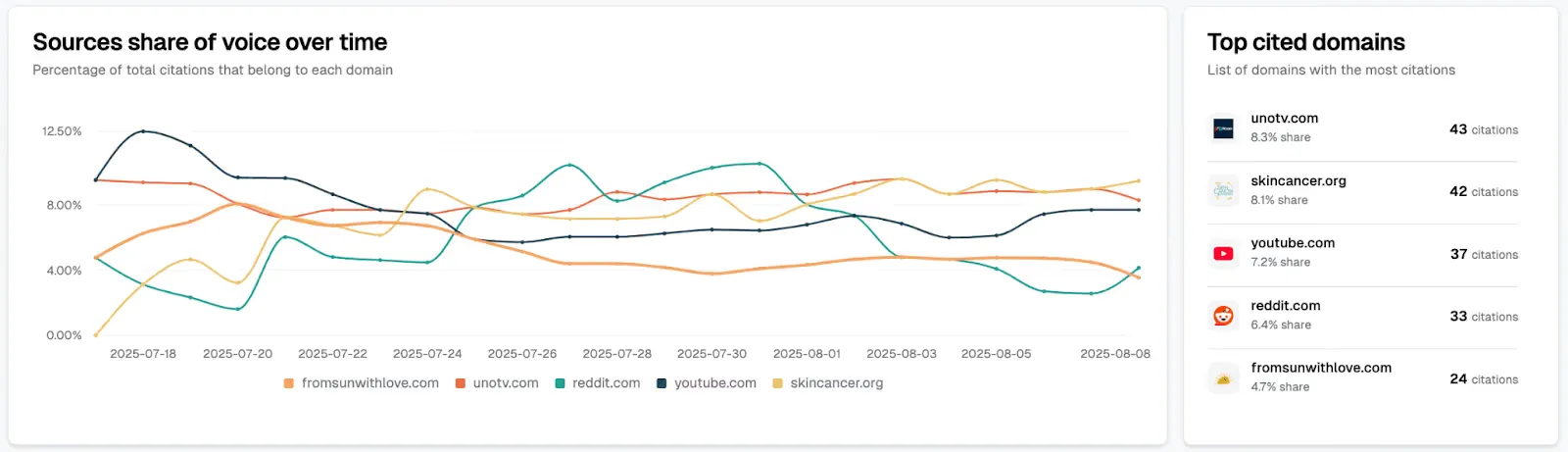
But matters most: Their Brand Share of Voice reached 12.1%, overtaking giants such as Columbia, Decathlon, and Patagonia.
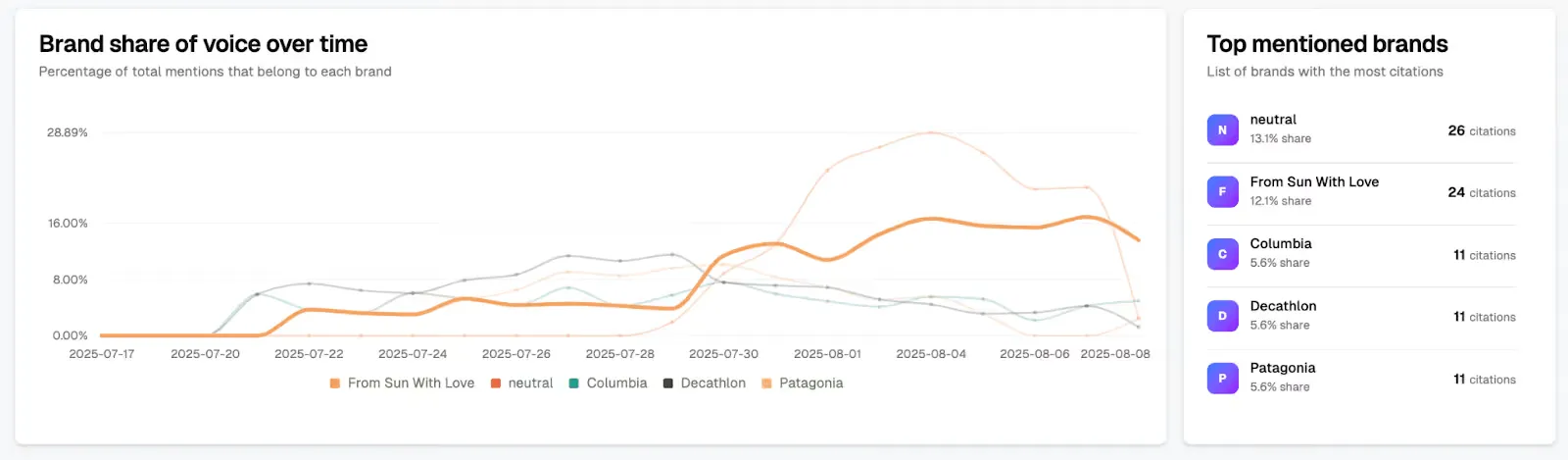
Today, they appear in AI-generated responses when a user searches for products in this category.
This case proves that visibility is not a matter of budget, but of information. If you know what to look for, you can take action.
Waiting for AI to magically recognise you does not work. There are specific actions you can take today:
Do you appear in your sector’s key prompts?
Which brands are dominating the responses?
Which models (ChatGPT, Gemini, Perplexity) recognise you?
How much does your domain matter?
What other sites are influencing the answers?
Where does your competition publish, and where are you missing?
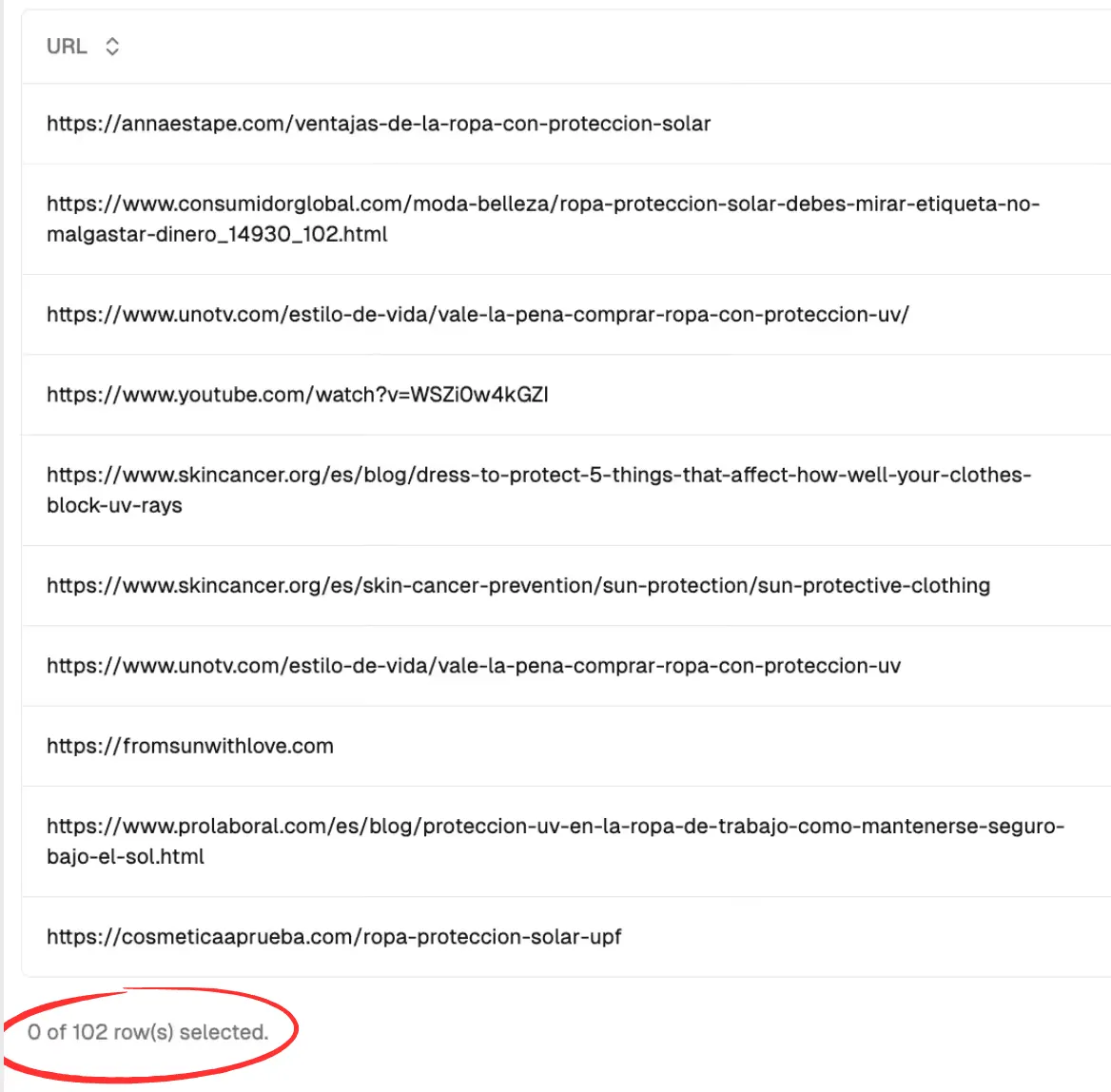
Create specific content for decision prompts.
Publish in media outlets that are already being cited.
Optimise your content so that it is quotable, concise, and easy to summarise.
Measure your progress week by week with Omnia.
Adjust your strategy based on the results.
Generative SEO is not an extension of traditional SEO. It is a whole new field, with its own rules and sources of influence.
Visibility is not only for big brands with big budgets, every brand can be visible with the right information and the right strategy.
If you want to be in AI responses, you need to understand which prompts matter, who dominates them, what sources feed the system, and what your actual position is.
Request a demo and see how Omnia can show you where you are, where you should be, and how to get there.
Omnia offers a 14-day free trial on the Growth plan.
No credit card required. See exactly where your brand shows up (or doesn't) across AI engines, then let the platform's recommendations guide your next move.
Written By
 Daniel EspejoCEO & FounderatOmniaJoseGrowthatOmnia
 Miguel FernándezCTO & FounderatOmnia
 JoseGrowthatOmnia
 The Omnia Team
 The Omnia Team
No credit card required · Free for 14 days · See your AI visibility within 3 minutes