
AI Search Visibility
How To Turn AI Visibility Data Into a GEO Roadmap in 2026

 JoseGrowthatOmnia
 Daniel EspejoCEO & FounderatOmnia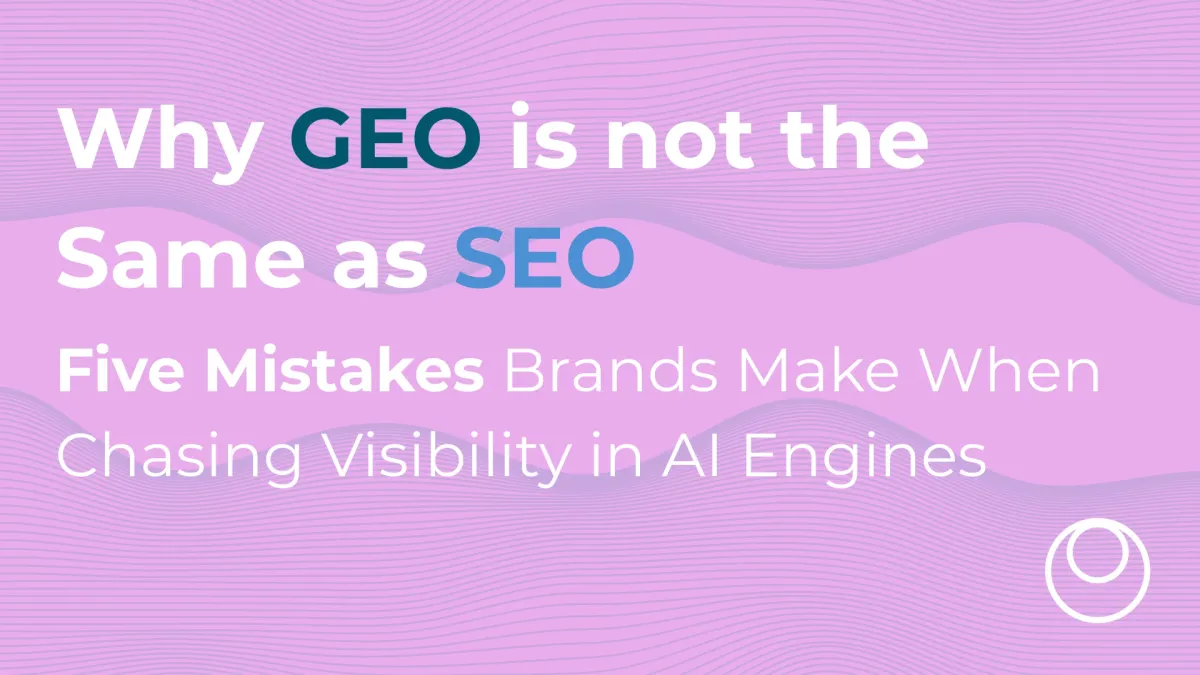
TL;DR
Most brands fail at AI visibility by applying traditional SEO logic — assuming backlinks, keyword density, and static content will carry over. The real path forward is writing answer-focused content, structuring pages for how AI models actually read, and refreshing material regularly as competitors reposition.
In this article:
Many teams still treat AI engines as if they were another search channel. They are not. These systems do not rank ten blue links, they read across multiple sources, synthesise and answer. They only cite a small number of pages and those pages often look very different from a classic search results page.
In the audits we run with brands, the same patterns keep appearing. Good SEO performance does not always translate into visibility in AI answers. For a lot of queries, only a small share of the URLs cited by ChatGPT, Gemini or Perplexity overlap with Google’s top results. The exact number changes by engine and category, but the message is the same: ranking well does not guarantee you will be cited.
Below are the five mistakes we see most often, why they matter, and a practical way to fix them. The steps you will read are essentially the spine of how we approach AEO work inside Omnia.
The first mistake is assuming Answer Engine Optimisation is just SEO with new branding. Teams reuse the same keyword sets, templates and on page tactics. That sometimes helps, but it ignores how AI engines actually construct answers.
AI engines do not build a ranked list. They compose a response and choose which sources to quote to justify it. They care about clarity, internal consistency and how well a page answers the question, not just about backlinks or technical SEO. The overlap with organic rankings is not even stable across engines. Perplexity, for example, often feels closer to traditional search. Others lean much harder on a small set of “safe” sources.
AEO is engine specific work. Treating it as “SEO but for AI” is a shortcut that hides important differences.
The second mistake is publishing content around broad topics and hoping it will fit what people need. AI engines respond to explicit questions. If a page does not clearly solve a specific query, it is less likely to be used as evidence.
Most brand content is written from the inside out. “These are the things we want to talk about.” AEO forces you to flip that. If you do not start from the exact questions people are asking, you are optimising for yourself, not for the user or the model.
The third mistake is writing for old SEO instincts. Keyword variations, light paragraphs, surface level coverage. That might have been enough when the goal was to trigger a match on a search term. It does not work when the model is trying to understand a concept and respond in natural language.
Language models look for:
If your page cannot handle the next question a user would reasonably ask, the model often prefers another source that can. Authority here is rarely a single factor. It is the combination of clarity, evidence and coherence across your site and the wider web.
Even when the substance is strong, unstructured pages make life harder for the model. Headings, summaries, lists and sensible internal links help the assistant parse the page quickly and place each fact in the right context.
When you look at pages that appear often in AI citations, they tend to be easy to scan. Clear headings, focused paragraphs, occasional tables or Q&A blocks. Structure is not decoration, it is a signal. It helps users read, and it helps models extract.
Ignoring structure means forced ambiguity. The model has to work harder to understand what the page is about, and often chooses a clearer alternative.
The fifth mistake is treating content as “done”. Questions evolve. Product details change. Competitors reposition. A page that was the right answer last year can be misleading today.
AI engines are constantly training on new data and crawling fresh content. If your key pages do not reflect the current reality of your product and your category, the model will lean towards more up to date sources.
If you do not revisit your assumptions and refresh key content, your visibility decays quietly. Most teams only notice when someone finally checks a prompt and realises the brand is no longer there.
Each mistake has a practical starting point. The idea is simple: connect one fix to each mistake and turn it into a repeatable habit. This is roughly the sequence we follow when we run AI visibility audits.
Fixing Mistake 1: Treating AEO like SEO
Instead of asking “where do we rank”, ask “what answer does the model give, and which brands and sources does it use to build that answer?”.
Pick a handful of decision prompts in your category, the kind of questions people ask when they are close to choosing. For each one:
You now have a first view of the “answer space” for that question. It moves you out of the ranking mindset and into a visibility mindset: are we present at all, and if so, how?
A tool like Omnia simply does this at scale, across many prompts and engines at once, but the logic is the same.
Fixing Mistake 2: Creating content without a clear question
Take what you learned from those answers and map the questions behind them. Then add what you see in support tickets, sales calls, community threads… You will end up with a list of actual prompts your users care about.
Group them into three main buckets:
For each important question, check whether you have at least one asset that truly answers it, clearly and directly. In many cases that will be a page on your site, in others it might be a detailed guide, a comparison page or a third party profile where people already find you. If there is no good answer anywhere, you have found a real gap.
Fixing Mistake 3: Writing for Google, not for language models
Now focus on the assets that should carry these questions. For some prompts, that will be a page on your site. For others, it might be a comparison site, a marketplace profile or a review page the model already trusts. Your goal is to turn a small set of owned pages into canonical answers and to strengthen the external sources that are already shaping the model’s view of your category.
For each page:
Then make sure the wording is aligned across your site and your external profiles. If you use different names for the same thing, or conflicting numbers for the same metric, you create doubt. From the model’s perspective, that weakens your authority.
Once you update these pages, you want to see if anything changed and how AI engines talk about you.
Fixing Mistake 4: Ignoring how AI reads structure
Take those same priority pages and make them easier to parse. You do not need fancy design. You need clear structure.
For each page, ask:
Use headings to signal shifts in topic, not just for style. Use bullets where you are listing things. Use small Q&A blocks where it mirrors how people ask. All of this helps the model decide “this is the part that answers the question”.
When we look at citation data, the same pattern shows up again and again: structured, scannable pages are much easier for models to use.
Fixing Mistake 5: Never updating
Finally, you need a loop. One off fixes are not enough in a moving environment.
Define a small set of prompts to monitor regularly. For each one, track:
When something important changes, for example a competitor appears more often, your description shifts, or a new source starts being cited, update the page that should own that question and the related sources around it. Then check again.
Doing this manually for a couple of prompts is fine. Doing it across markets, languages and engines is where you feel the need for a dedicated layer like Omnia that keeps that visibility view up to date.
Over time this becomes a simple wheel: observe, adjust, observe. That is the practical side of AEO, not tricks, just structured feedback applied to the way AI engines already behave.
If you are starting from zero, think of this as a first pass, not a full strategy.
Choose a small set of decision prompts where it really hurts not to be there.
Things like:
These are the prompts that sit closest to a real buying moment.
Run those prompts in ChatGPT, Gemini and Perplexity.
For each prompt, note:
This gives you a concrete view of who the model is listening to and how it frames your category.
Once you know the prompts and the sources, you have two levers.
Your own content
External sources
The goal is simple. You want the model to see the same clear, consistent story about your brand wherever it looks.
After you have improved your own content and key external sources, wait a short period, then run the same prompts again.
Look for:
Doing this manually for a few prompts is fine. Once you want to follow dozens of prompts across several engines, you will feel why a visibility layer like Omnia exists, it keeps that whole picture updated for you.
The point is not to create pages for every question. It is to know which questions matter, see which sources shape the answers, and then make sure you show up in those sources with the right story.
AI engines are not just another traffic source. They are becoming the place where decisions start and end. They reward precise answers, clear structure and consistent facts. The five mistakes above are easy to make, especially if you apply old SEO to a new environment.
By shifting your focus to answers, building from real questions, turning key pages into canonical responses, adding structure that helps models and humans, and running a simple review loop, you give yourself a better chance of being cited and recommended where it matters.
That is the work. Omnia sits next to this, giving you the visibility layer you need to see whether your efforts are actually changing how AI engines talk about your brand.
Omnia offers a 14-day free trial on the Growth plan.
No credit card required. See exactly where your brand shows up (or doesn't) across AI engines, then let the platform's recommendations guide your next move.
Written By
 Daniel EspejoCEO & FounderatOmniaJoseGrowthatOmnia
 Miguel FernándezCTO & FounderatOmnia
 JoseGrowthatOmnia
 The Omnia Team
 The Omnia Team
No credit card required · Free for 14 days · See your AI visibility within 3 minutes