
Citation Analysis
Multilingual SEO Best Practices: A Practical Guide

 AndreiHead of GrowthatOmniaAndreiHead of GrowthatOmnia
TL;DR
MCP is the connection layer that lets Claude read your actual tools and data, like Google Search Console or your CRM, instead of answering from general training knowledge alone. For a marketing team, that means two real options: connect Claude to your data yourself and drive every question, or use a tool built on top of that same connection to actually execute the work. Neither one requires understanding the protocol itself.
You don't need to know how MCP works to know whether it matters for your team. You need to know what it changes about working with Claude, and where that change stops.
Most explanations of MCP start with the protocol, servers, clients, standardized connections, and lose a marketing lead before the second paragraph. That's backwards. What actually matters here isn't the plumbing, it's what Claude can do once that plumbing exists that it couldn't do before, and what still doesn't happen automatically once it's set up.
Here's the short version: without MCP, Claude answers your questions from general knowledge, a reasonable guess about SEO or marketing best practice. With MCP, Claude can read your real numbers, your Search Console data, your analytics, your CRM, and answer from what's actually happening in your business. That's a meaningful shift. It's also not the whole story, because someone still has to be the one asking, connecting, and acting on what comes back.
This guide walks through what MCP actually is, what it changes for a marketing team day to day, what it doesn't do, and how to think about it alongside the tools built specifically for AI visibility work.
Think about what happens when you ask Claude a question about your own marketing data today. It answers from what it was trained on, general knowledge about SEO, about AI visibility, about what tends to work. It doesn't know your actual Search Console numbers. It doesn't know what your CRM says about last month's leads. It's giving you an educated guess dressed up as an answer.
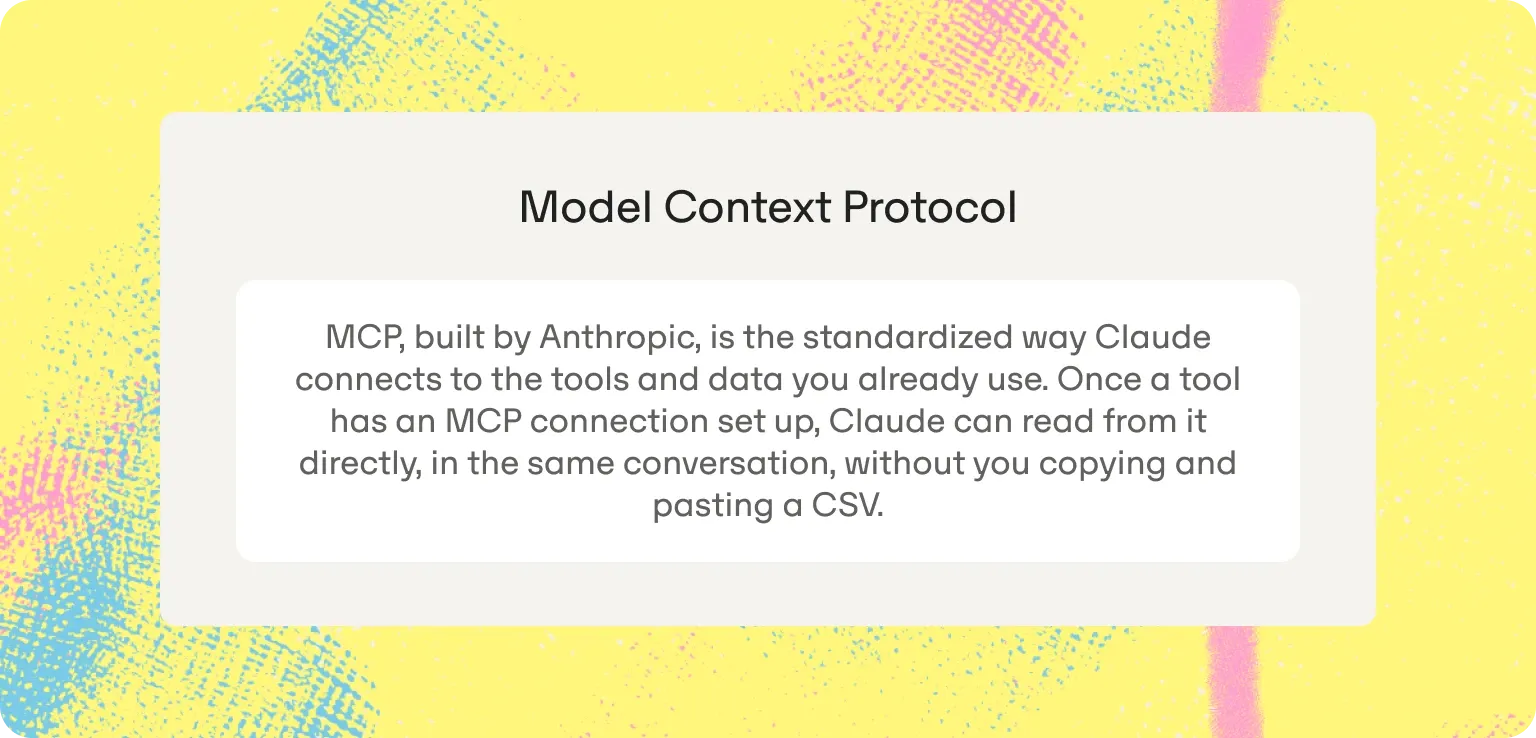
MCP changes that. Model Context Protocol, built by Anthropic, is the standardized way Claude connects to the tools and data you already use. Not a feature inside Claude, not a smarter version of the model, a connection layer sitting between Claude and the outside world. Once a tool has an MCP connection set up, Claude can read from it directly, in the same conversation, without you copying and pasting a CSV.
The clearest way to think about it: MCP is what lets an answer be grounded in your real data instead of assembled from general patterns about your category. Ask Claude which of your landing pages lost traffic last month without MCP, and it'll tell you what usually causes traffic loss. Ask the same question with your GA4 account connected, and it can tell you which pages, by how much, and since when.
That's the entire concept. Claude doesn't get smarter with MCP. It gets access. The reasoning is the same model you already know, the difference is what it's reasoning about, your real numbers instead of a plausible average.
Take a question every marketing lead has asked Claude at some point: "how's our organic traffic trending?" The answer looks different depending on whether Claude can actually see your data or not.
| Without MCP | With MCP connected | |
|---|---|---|
| What Claude answers from | General knowledge about what tends to happen | Your actual Search Console and GA4 data |
| "How's our traffic trending?" | What usually causes traffic loss, and what to check | Which queries and pages moved, by how much, since when |
| What you do next | Pull the export yourself, cross-reference it, then come back with a real question | Ask the follow-up immediately, in the same conversation |
| Time to a real answer | Often an hour of manual work before you can even start deciding | Minutes |
That shift matters most for a team without a dedicated analyst. The work of pulling a GSC export, checking it against GA4, and summarizing what changed doesn't disappear, it happens inside the conversation instead of before it.
None of this makes Claude autonomous, and that distinction matters more than the connection itself. MCP gives Claude access to your data. It doesn't give Claude judgment about what to do with it, and it doesn't run anything on its own. Four things worth being clear on before anyone assumes more than MCP actually delivers:
That last point is the one worth sitting with. MCP turns Claude into a much better analyst. It doesn't turn Claude into someone who runs the account.
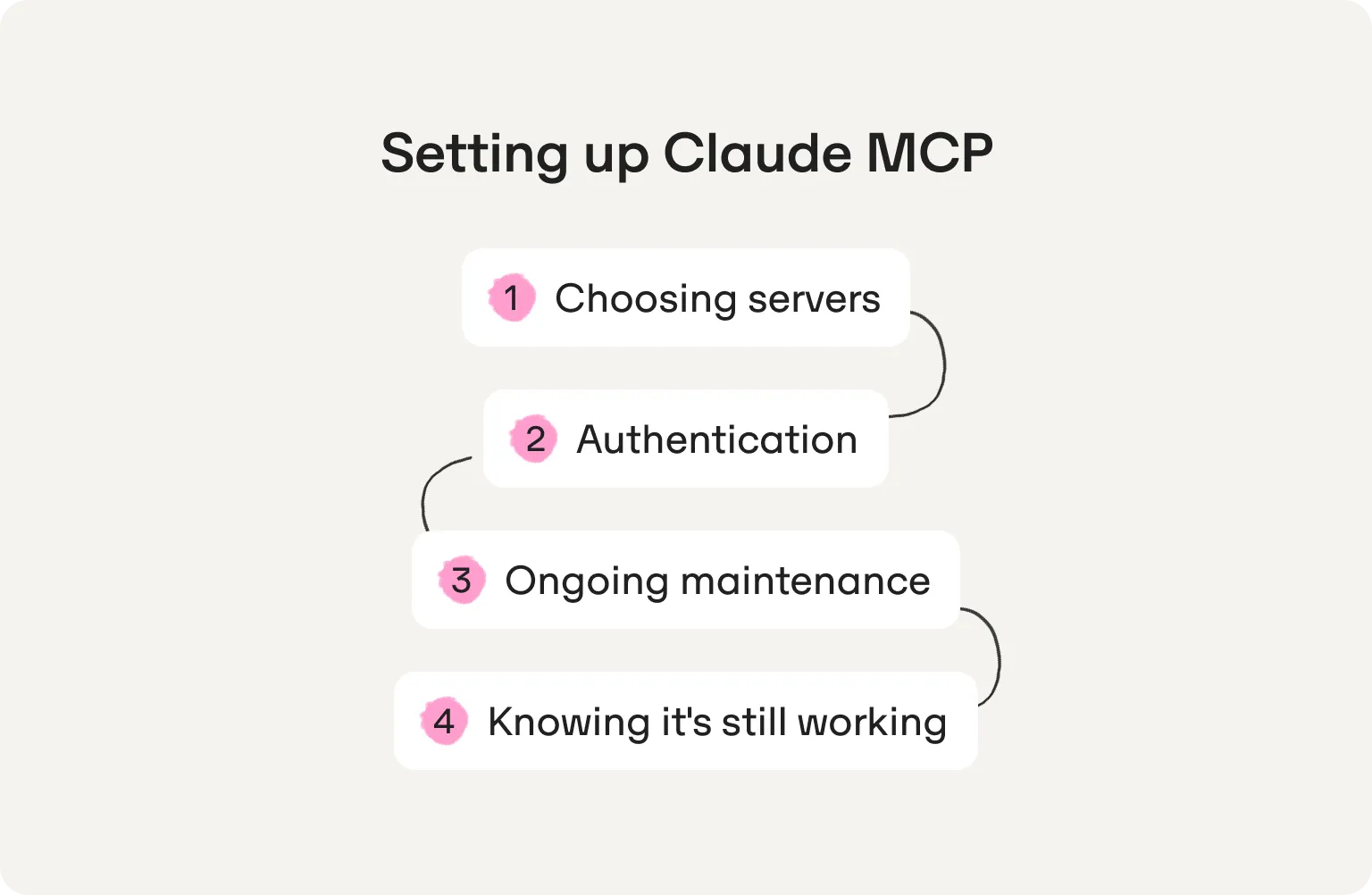
Setup for Claude MCP itself isn't hard in the way writing code is hard, but it isn't free either, and most explanations of MCP skip past what it actually takes for a non-technical team to keep running. For Claude MCP to work for your team, you'll need to consider the following:
None of this is a reason to skip MCP. It's a reason to be honest that "connect Claude to your tools" is an ongoing job, not a one-time checkbox, and that job belongs to someone on a team that may not have anyone to spare for it.
For a team that wants real data inside Claude, driven by a person asking the questions, Omnia's MCP server is built for that workflow specifically.
What it connects you to. Claude reads your Omnia visibility data directly: share of voice, citations, sentiment, across every engine you track. Ask it which prompts you're losing ground on, which competitors are picking up citations you used to hold, or how a page's visibility changed after last month's update, and it answers from your actual tracked data, not a general sense of how AI visibility usually works.
Who this is a good fit for. A team that:
A weekly check-in, a one-off dig into why a competitor jumped, a quick pull before a leadership update, all of that is exactly what this connection is for.
What it doesn't change. Someone still has to ask the question, decide what the answer means, and do something about it. Omnia's MCP makes that person faster. It doesn't replace them.
Enough for: answering a specific question, pulling a number, understanding a trend, on demand, when someone's available to ask. That's exactly the work described above.
Not enough for: a loop instead of a question. Finding a visibility gap is one step. Closing it takes four more that MCP doesn't run:
Someone has to notice the gap, decide it's worth fixing, do the rewrite, get it published, and remember to check back later. On a team of one or two, that chain breaks somewhere in the middle almost every time, not from lack of effort, from lack of hours.
That's the real ceiling, worth naming plainly rather than treating MCP as a stepping stone to something better: Claude with MCP is a research tool. It's a very good one. It was never designed to be an execution tool, and connecting more data to it doesn't change that. The gap between "I can see the problem" and "the problem is fixed" is still a gap only a person, or something built specifically to close it, can cross.
That gap is also where the broader discipline this data feeds into lives. Seeing your citation data is one thing. Acting on it in a way that actually improves your standing across engines is AEO itself, and MCP alone was never going to run that process for you.
Everything in the last section, diagnosing a gap, rewriting the fix, publishing it, checking whether it worked, is the part MCP hands back to you. The Omnia Agent is built to run that loop instead.
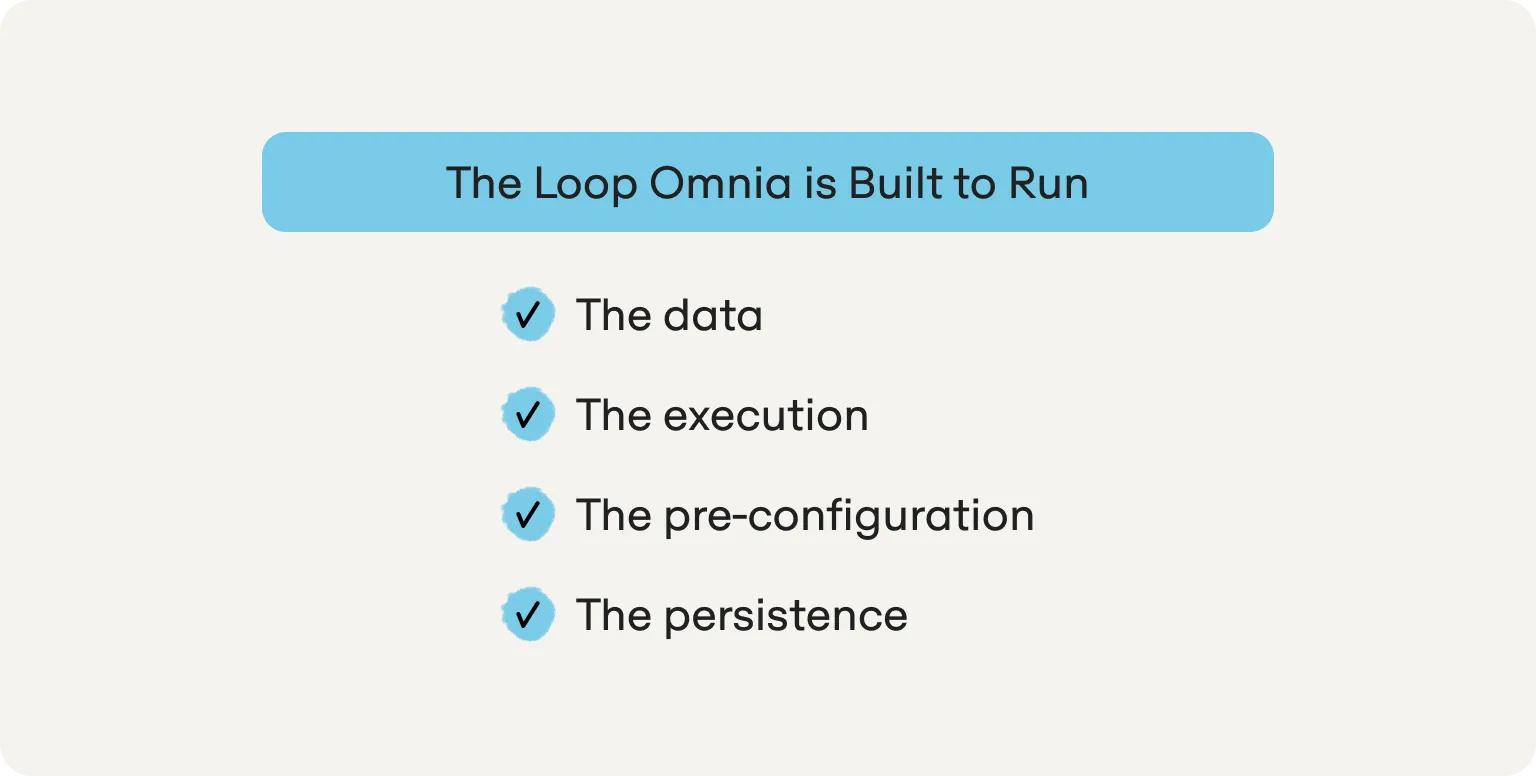
By choosing the Omnia Agent, you get the following:
Both are legitimate answers. Which one fits depends on what's actually true about your team right now, not which one sounds more advanced.
Use Claude plus Omnia's MCP if:
Use the Omnia Agent if:
Most teams don't have to pick a side here. Ask Claude the quick question on a Tuesday afternoon. Let your Omnia Agent run the work nobody has hours left to do by hand.
Start free for 14 days and see what your Omnia Agent can already do with your AI visibility data.
Omnia offers a 14-day free trial on the Growth plan.
No credit card required. See exactly where your brand shows up (or doesn't) across AI engines, then let the platform's recommendations guide your next move.

Model Context Protocol. Built by Anthropic, it's the standardized way Claude connects to outside tools and data, not a feature inside Claude itself.
No. Anthropic created it, but it's an open standard, and other AI assistants have started adopting it too. Claude's implementation is the most mature right now, which is why most marketing-focused MCP servers, including Omnia's, are built with Claude in mind first.
Not necessarily. Official MCP servers, including Omnia's, are built for a non-technical setup: connect an account, authenticate, and Claude can read from it. What still takes real time is choosing which tools to connect and keeping those connections working as the tools on the other end change.
No. It gives Claude access to the data Omnia already tracks. You still need Omnia's platform doing the tracking in the first place, and you're still the one asking the questions and deciding what to do with the answers.
Omnia's MCP puts your tracked data inside a Claude conversation you're driving. Your Omnia Agent works from that same data on its own, diagnosing gaps, drafting fixes, publishing them, and reporting back, with your approval before anything goes live.
Written By
 AndreiHead of GrowthatOmniaAndreiHead of GrowthatOmnia
 JoseGrowthatOmnia
 Daniel EspejoCEO & FounderatOmnia
No credit card required · Free for 14 days · See your AI visibility within 3 minutes