
Citation Analysis
Claude MCP Explained: What You Need to Know

 AndreiHead of GrowthatOmniaAndreiHead of GrowthatOmnia
TL;DR
Hreflang is not a strategy. What actually determines whether multilingual SEO works is which markets get chosen, whether keyword research happens in each language or gets translated from one, whether content gets built for a market instead of converted into it, and whether anyone ever checks if that content shows up when an AI engine answers the same question in that language. This guide covers the strategic decisions, the AI-visibility checkpoint, and how to frame the investment as a business case, then closes with what running all of it market by market actually looks like once an agent, rather than a specialist hire, is doing the work.
Most multilingual SEO strategy content stops at the same place: implement hreflang tags correctly, and the job is done. The tag, technically a link rel alternate hreflang element, is a language indicator that helps search engines serve the correct language version of a page: it routes a French visitor to the French page instead of the English one, based on page language and location. It says nothing about whether that French page was built to actually win in the French market, or whether it's a direct translation nobody researched, wrote for, or linked to the way a market like that requires. Language targeting done correctly is table stakes. It has never been the strategy.
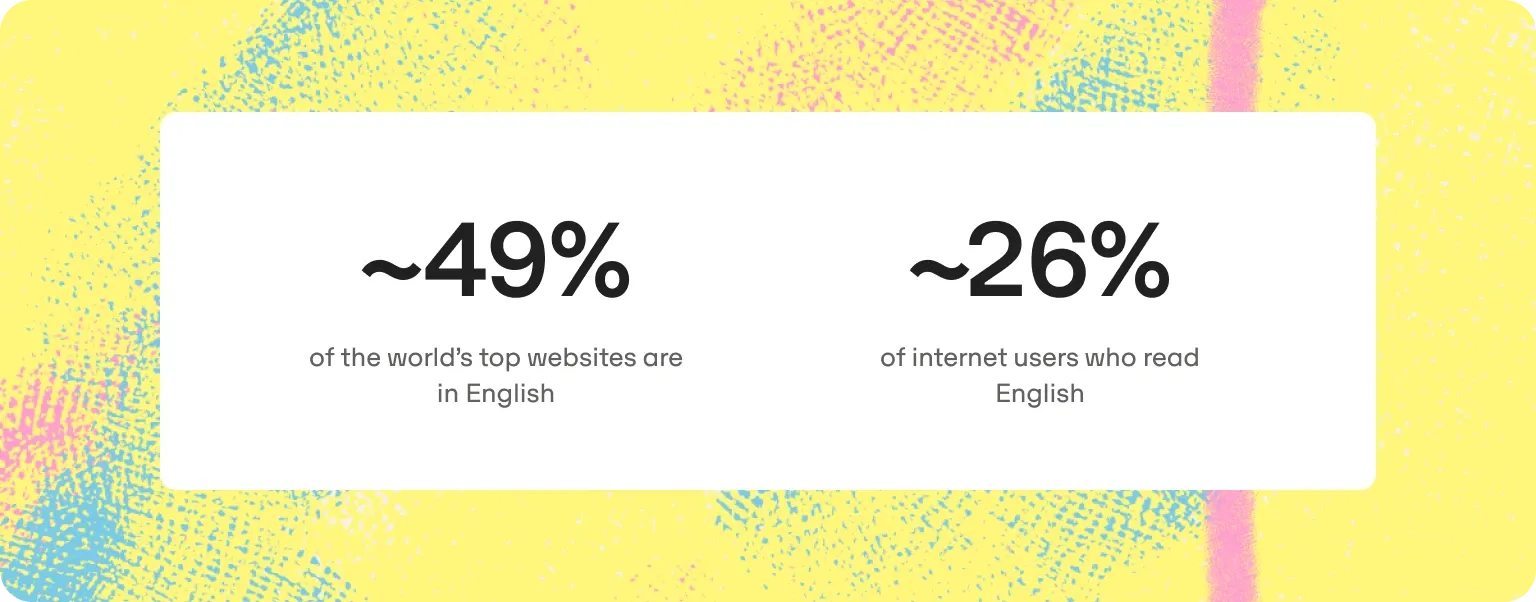
W3Techs data puts English at roughly 49% of the world's top websites as of late 2025. By number of internet users who actually speak English, the same data places it closer to 26%. That gap, half the web's content competing for a quarter of its audience, is a standing opportunity for any brand willing to build for the other three quarters instead of translating for them.
Aleyda Solis, founder of the international SEO consultancy Orainti and one of the field's most cited practitioners, frames the starting question in plain terms: before anything else, can the business actually deliver its content, product, or service in a given market, and is there real demand for it there. Everything downstream, hreflang, keyword research, content architecture, depends on getting that answer right first. Solis has also been direct about sequencing: markets get validated for likely profitability before any technical implementation begins, not after.
That translates into a short checklist most teams skip past on the way to the technical work:
Skipping straight to which country sits closest to headquarters, or which language looks like the smallest lift, answers a different question than the one that actually determines whether the expansion pays off. The same logic holds whether the target audience sits in a single target country or spans various languages at once: a market earns priority once real demand and delivery readiness both check out, not because a seo expert or a local seo expert happened to be available to cover it first.
The single most common mistake in multilingual SEO is translating a home-market keyword list, built around English keywords, instead of learning to conduct keyword research directly in the target language. Search behavior shifts by market in ways a direct translation cannot capture, and the same target keywords rarely hold across different languages, let alone across several foreign languages at once:
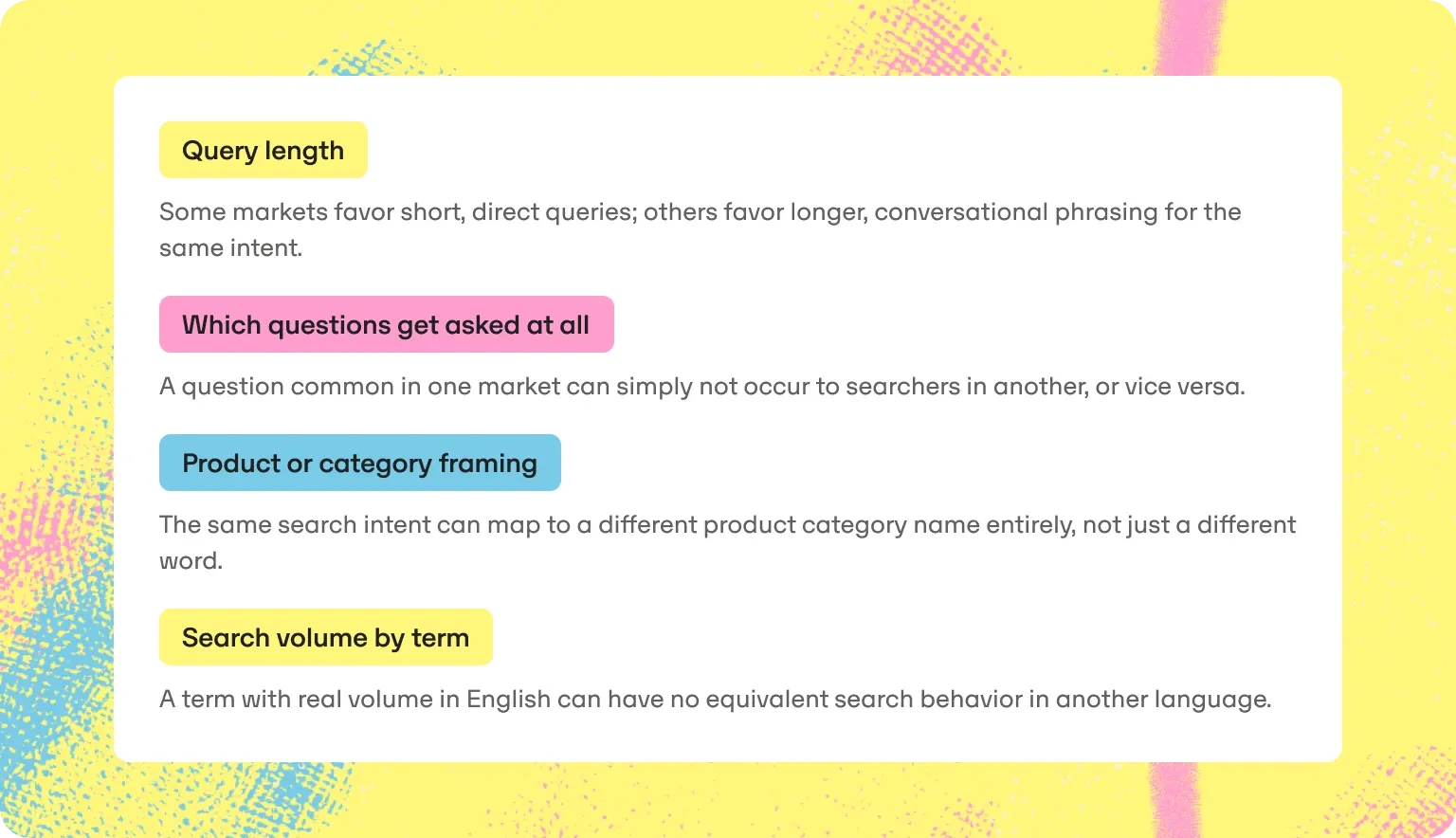
A term that drives strong search results on the English site can return nothing at all on the equivalent Spanish pages, not because the market lacks demand, but because native language speakers rarely search the way a literal translation assumes they will.
That same discipline extends naturally to how people talk to AI engines directly, not just what they type into a search box. The conversational questions someone asks ChatGPT or Perplexity in a given language are a genuinely different research object than a search query, closer to how a person would actually phrase a question out loud than to a list of search terms, and researching that separately from traditional keyword research is what catches the gap a translated list would miss twice over.
The technical SEO structure a team picks for a multilingual website isn't a neutral decision. URL structure for a multi language website, whether that means language-specific URLs under one domain or separate domains entirely, trades speed and cost against how much local commitment it signals, both to search engines and to the people visiting the site.
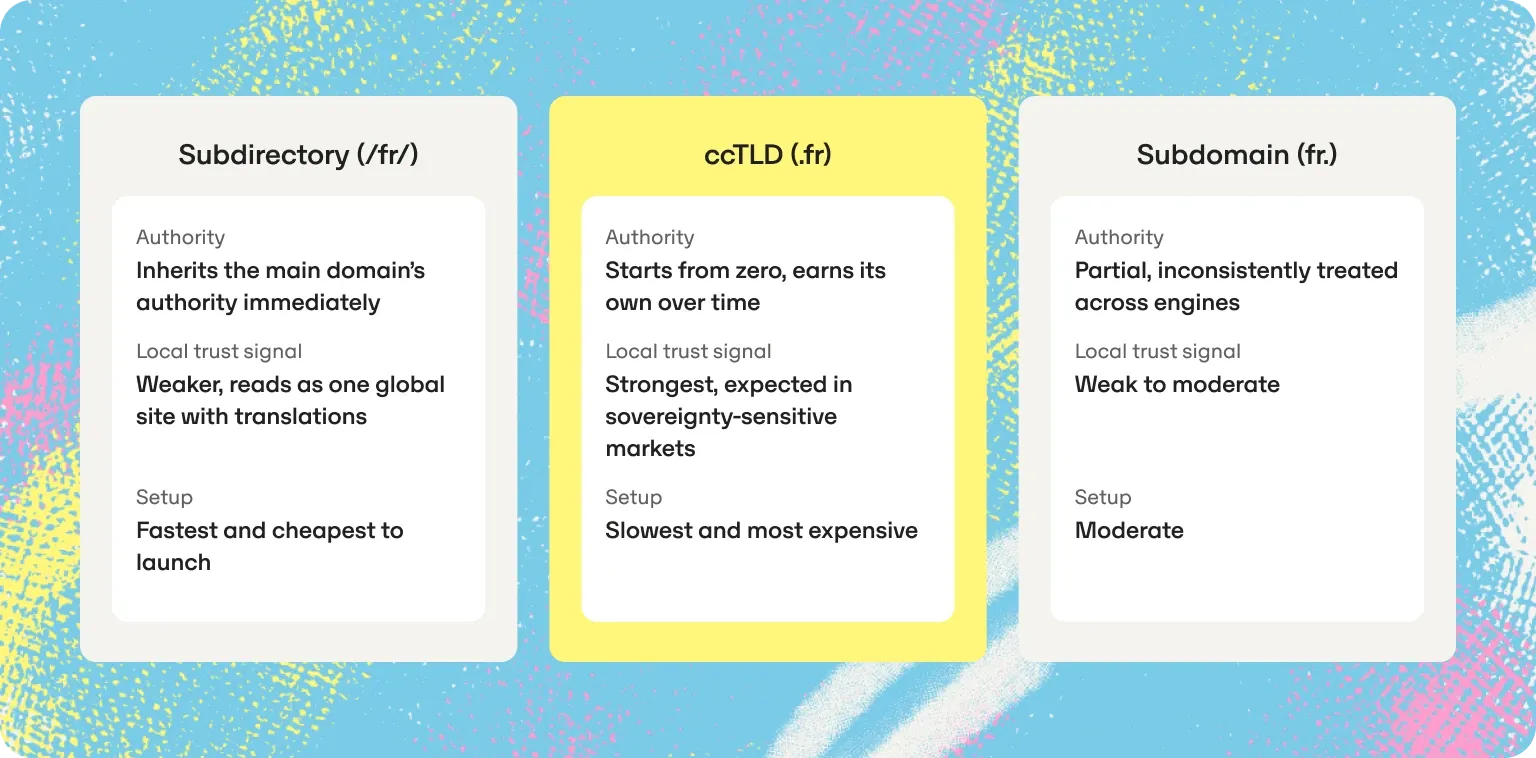
A subdirectory is the right call for a team testing whether a market is worth deeper investment before committing further. A country code top level domain is the right call once a market has already proven itself and local trust is worth the added cost and slower start. Whichever structure gets chosen, it comes with basic technical SEO housekeeping that's easy to skip on a multilingual site: unique meta descriptions and titles per language version rather than copies of the English ones, and correct hreflang and canonical tags so search engines don't read translated web pages as duplicate content competing against each other. None of this fixes a translated page that wasn't researched or written for the market it's launching into. The structure only decides how much authority that page starts with, not whether it deserves to rank once it gets there.
A translated page, whether produced through machine translation, a quick pass with a tool like Google Translate, or careful manual translation, carries none of the backlinks, local authority, or content alignment that earned the original page its place in search results. Local link building efforts, PR, and content partnerships with relevant websites have to happen per market, not once globally and hoped to spread. Literal translations that skip past cultural differences and cultural context read as exactly that, to both readers and search engines: website content translated word for word rarely reflects how someone writing in that local language would actually frame the same topic, and search engines recognize the difference even when every technical box, hreflang included, is checked correctly. Building real SEO authority in a new market takes localized content built for it, not translated content standing in for it.
The same gap extends to AI citations, though the mechanism runs slightly deeper than lost backlinks. A translated page inherits none of the citation history or entity recognition an AI engine associates with the original, which is a distinct problem from ranking in traditional search results.
None of the work above means anything if nobody ever checks whether it worked, and this is the step most multilingual SEO guides skip entirely. Four checks turn that gap into something a team can actually act on:
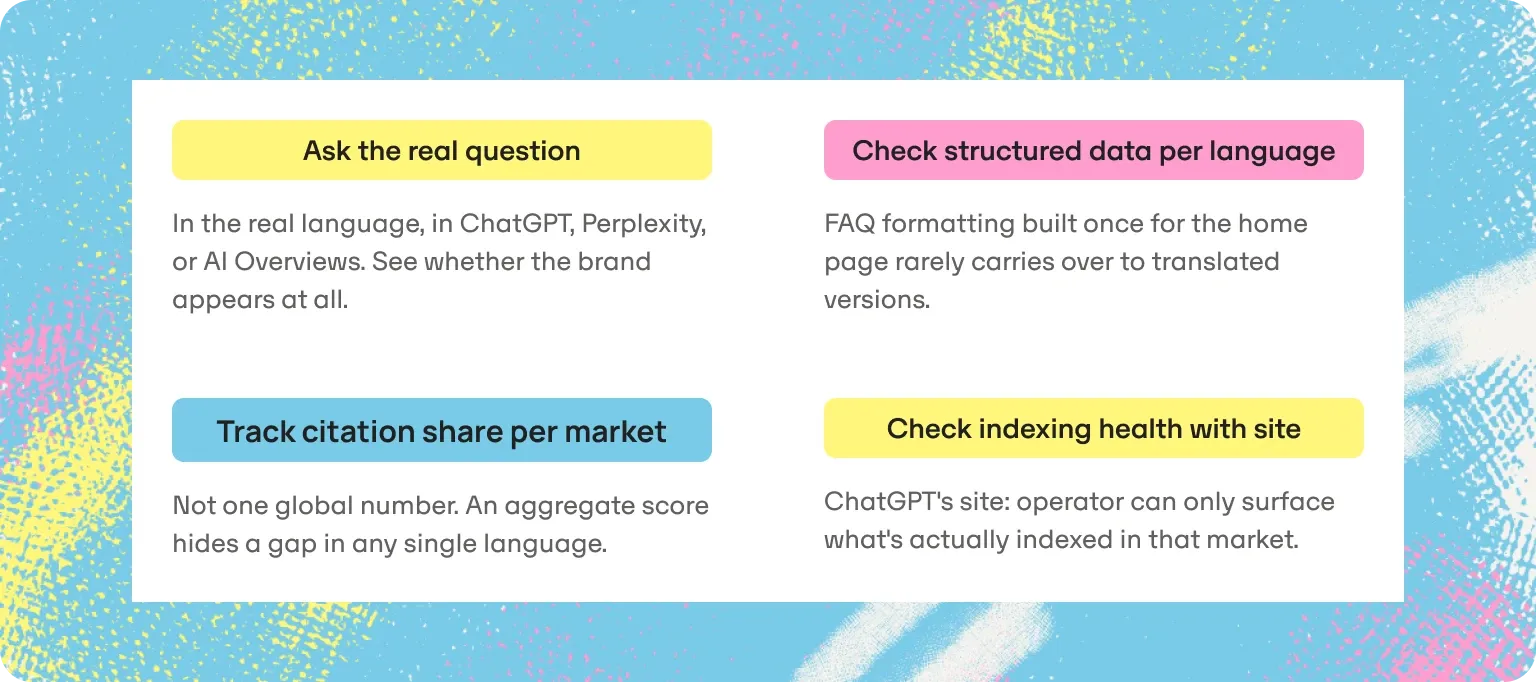
Running these checks does not require a specialist per market or an enterprise monitoring contract, it requires deciding to ask the question at all. For a foundational look at how answer engine optimization works as a discipline, or for a team that wants this covered market by market with the research behind why AI engines behave this way per language, Multilingual SEO for AI Search picks up in depth from here.
Everything above is a set of decisions a practitioner makes when implementing multilingual SEO as part of broader international marketing campaigns. Getting budget to make them is a separate problem, and it's the one that actually stalls most multilingual expansion before market selection ever becomes a live question.
The case is easier to make with real numbers attached than with a general argument about growth. Market selection, covered above, already produces a sizing exercise: existing demand signals and the size of the competitive gap in a candidate market translate directly into an estimate of addressable opportunity, the same input a leadership team needs to weigh a new market against any other use of budget. A market with strong demand and a weak competitive field is a stronger line item than a general statement about international growth potential.
What changes the pitch from a request into a business case is naming what gets measured afterward, before the investment happens, not after someone asks whether it worked.
| Stage | What to track | Why it matters to leadership |
|---|---|---|
| Before launch | Existing demand signal, competitive gap size in the target market | Sets the size of the opportunity being pursued |
| First 90 days | Organic traffic and rankings in-language, not aggregated globally | Confirms the technical foundation, hreflang, content, is actually working |
| 90 days onward | AI citation share in that language, tracked separately from traditional rankings | Confirms the newer channel is capturing the same opportunity, not just the older one |
| Ongoing | Cost per market versus addressable opportunity size | Justifies expansion to market four and five using market one and two as evidence |
The last row is what turns one market's results into a repeatable case for the next one. A leadership team rarely needs to be convinced multilingual expansion matters in the abstract. What earns the next budget cycle is a first market with a number attached to it, and a system already in place to produce the same number for the next one without rebuilding the measurement from scratch each time.
Building that system by hand is exactly where most teams stall, not because the table above is unclear, but because running it, market by market, is real, recurring work: an audit per language, outreach drafted per market, a traffic report pulled and reformatted for each one. This is the actual gap the Omnia Agent, Omnia's own AEO agent, closes. The same skills that audit a site, draft outreach to close a citation gap, and pull an AI-traffic report already run without being capped by country or language, since Omnia's visibility tracking covers unlimited markets from the base plan. Expanding into a second or third market doesn't require a specialist fluent in that market to run the audit or pull the report: your Omnia Agent, which already does this for the home market, runs it again for the next one, on request.
That's what turns effective SEO strategies and scattered multilingual SEO efforts into measurable multilingual SEO success, and what turns the ROI table above from a framework into something a lean team can actually execute without a hire per market. See how the Omnia Agent compares to running the same work manually with Claude and Omnia MCP, or look at what your Omnia Agent does end to end before deciding whether market two needs a person or an agent behind it.
Omnia offers a 14-day free trial on the Growth plan.
No credit card required. See exactly where your brand shows up (or doesn't) across AI engines, then let the platform's recommendations guide your next move.

No. Hreflang correctly routes a visitor to the right language version of a page, but it has no bearing on whether that page was researched, written, and linked to in a way that earns rankings or citations in its market. A technically flawless hreflang setup can still sit on top of a translated page that performs poorly, because the tag solves routing, not relevance.
Subdirectories inherit the main domain's authority immediately and cost less to launch, making them the better choice for testing whether a market is worth deeper investment. Country-code domains start from zero authority but signal stronger local commitment, which tends to pay off once a market has already proven itself and is worth the added cost.
Translating a keyword list misses how search behavior actually differs by market: query length, which questions get asked at all, and even which product category a search implies can all shift in ways a direct translation doesn't capture. The same applies, often more sharply, to the conversational questions people ask AI engines in that language.
Add a market once it's shown that priority makes sense: real demand, a visible competitive gap, delivery readiness, and a way to actually measure whether the investment worked. A market added without a way to check results is a market added on faith, regardless of how many markets came before it.
Ask the actual question, in the market's language, directly in ChatGPT, Perplexity, or Google AI Overviews, and see whether the brand appears. Check that structured data and FAQ formatting exist on each language version, not only the home-market page, and track citation share per market rather than relying on one aggregated global visibility number that can hide a gap in any single language.
Written By
 AndreiHead of GrowthatOmniaAndreiHead of GrowthatOmnia
 JoseGrowthatOmnia
 Daniel EspejoCEO & FounderatOmnia
No credit card required · Free for 14 days · See your AI visibility within 3 minutes