
LLMs
How To Run a GEO Audit (Step by Step) in 2026

 AndreiHead of GrowthatOmnia
 JoseGrowthatOmnia
TL;DR
Brand representation in Claude is determined by what third-party sources say about you, not what your own site publishes. Only 6.7% of Claude citations are owned domains while the remaining 93.3% are editorial and independent web content. If your brand is absent from Claude, you have a citation footprint problem. If it appears but is described inaccurately, you have a source quality problem. The fix for both is the same starting point: identify which domains Claude cites in your category, then build coverage there.
Publishing more content on your own website will not meaningfully improve what Claude says about your brand. According to Omnia's citation database, covering nearly 500,000 Claude citations across more than 36k answers and more than 4k monitored prompts from May 26 to June 8, 2026, only 6.7% of Claude citations point to a brand's own domain. The other 93.3% come from third-party sources, of which 90.1% is editorial and independent web content. What Claude says about your brand is almost entirely a function of what the editorial web says about your brand.
That reframes the improvement problem considerably. Most Claude AI SEO strategy advice defaults to producing more content, optimizing for topical authority on your own site, and adding structured data. None of that is wrong, but for Claude specifically, it addresses the wrong end of the citation chain. The brands gaining ground in Claude's answers are doing so through earned editorial coverage on the sources Claude already trusts in their category and not through content production aimed at their own domain.
This article is about the improvement question specifically. For how to measure where your brand currently stands in Claude, including how to build a prompt set, what metrics to track, and how Claude's citation behavior compares to other engines, see how to track rankings and visibility in Claude AI. This piece picks up where that one ends.
Before optimizing for anything, it helps to be precise about what you are trying to improve. Most teams default to mention frequency as the target metric. Mention frequency is a starting point, not an outcome. A brand mentioned inaccurately in 80% of relevant Claude answers is in a worse position than a brand mentioned accurately in 40% of them.
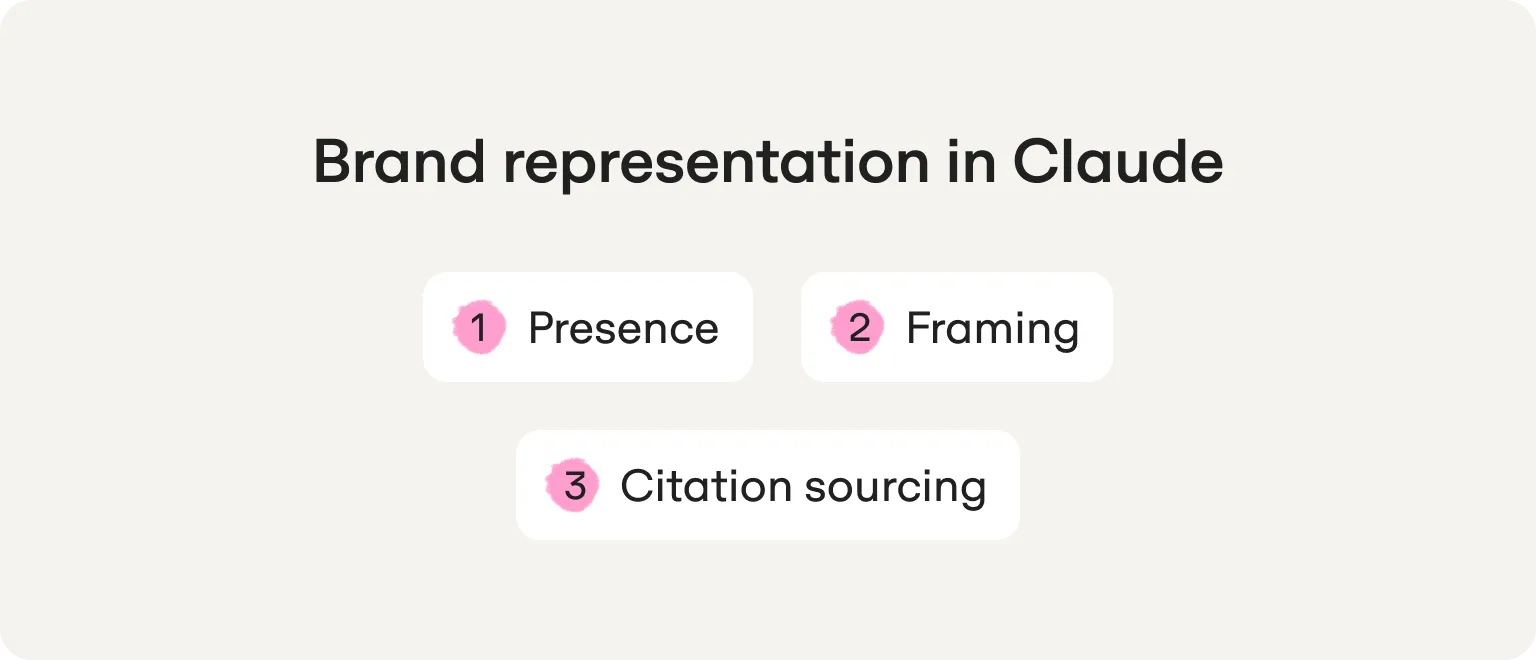
Brand representation in Claude has three components worth separating:
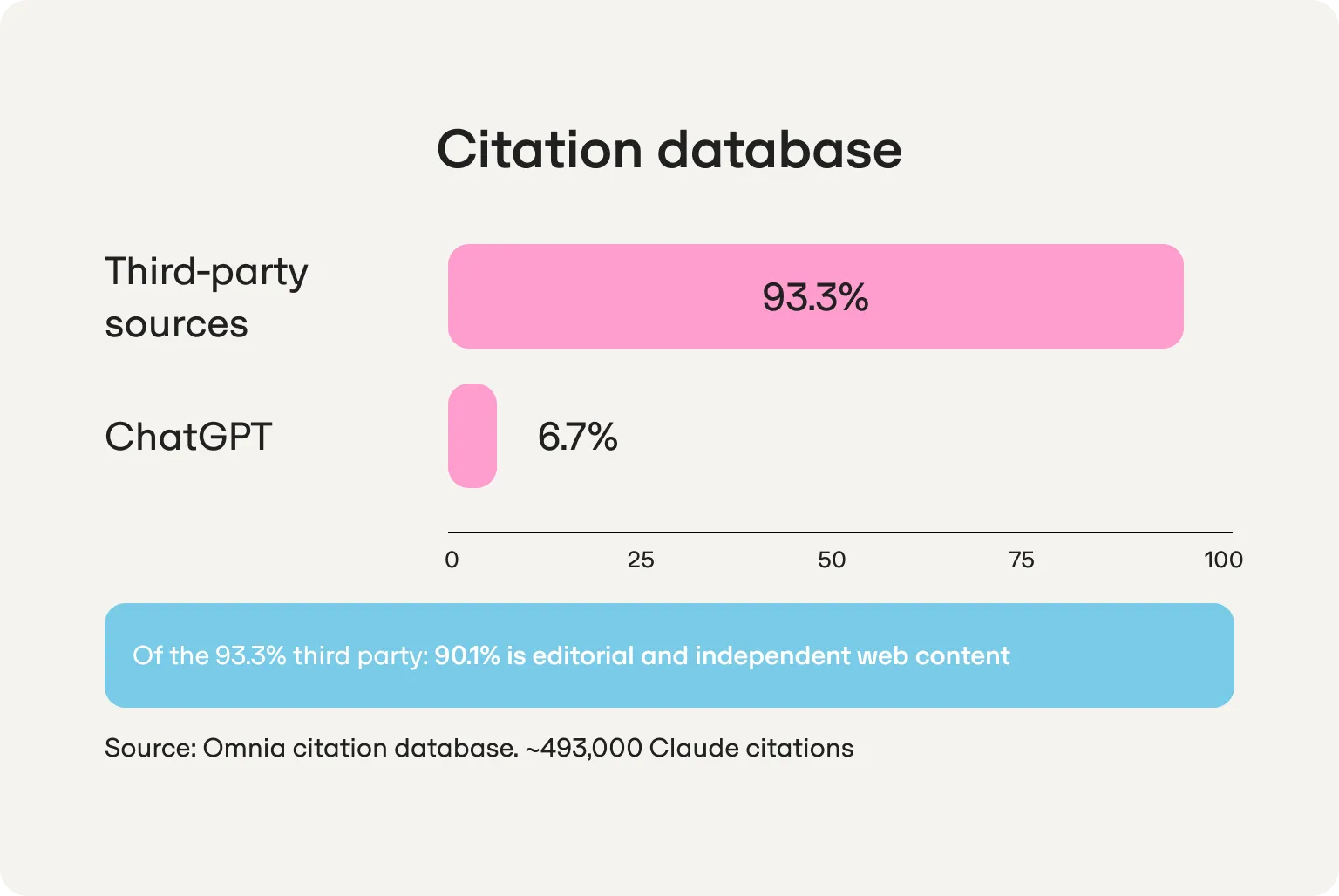
With 93.3% of Claude citations going to third-party sources, what Claude knows about a brand is almost entirely determined by what the editorial web has published about it. Improving brand representation in Claude is therefore primarily a question of influencing what those third-party sources say, and whether those sources are in Claude's active citation pool for relevant prompts.
This leads to a practical diagnostic. Before deciding what to do, determine which problem you actually have:
| Problem | Symptom | Root cause |
|---|---|---|
| Absent brand | Claude rarely or never mentions the brand in relevant prompts | Insufficient citation footprint. Claude has too little reliable third-party content to draw on |
| Misrepresented brand | Claude mentions the brand but the description is inaccurate, incomplete, or outdated | Source quality problem. The sources Claude cites do not represent the brand accurately |
Most new brands have Problem A (absent brand). Most established brands with active content programs have Problem B (misrepresented brand). However, it’s worth noting that some have both. The fix for each is distinct, and conflating them produces a strategy that addresses neither effectively.
If Claude rarely mentions your brand in prompts where it should appear, the issue is not that you need more content. It is that Claude's retrieval layer has too little reliable third-party coverage to draw on when constructing answers about your category. Building a citation footprint means getting your brand into the sources Claude already trusts.
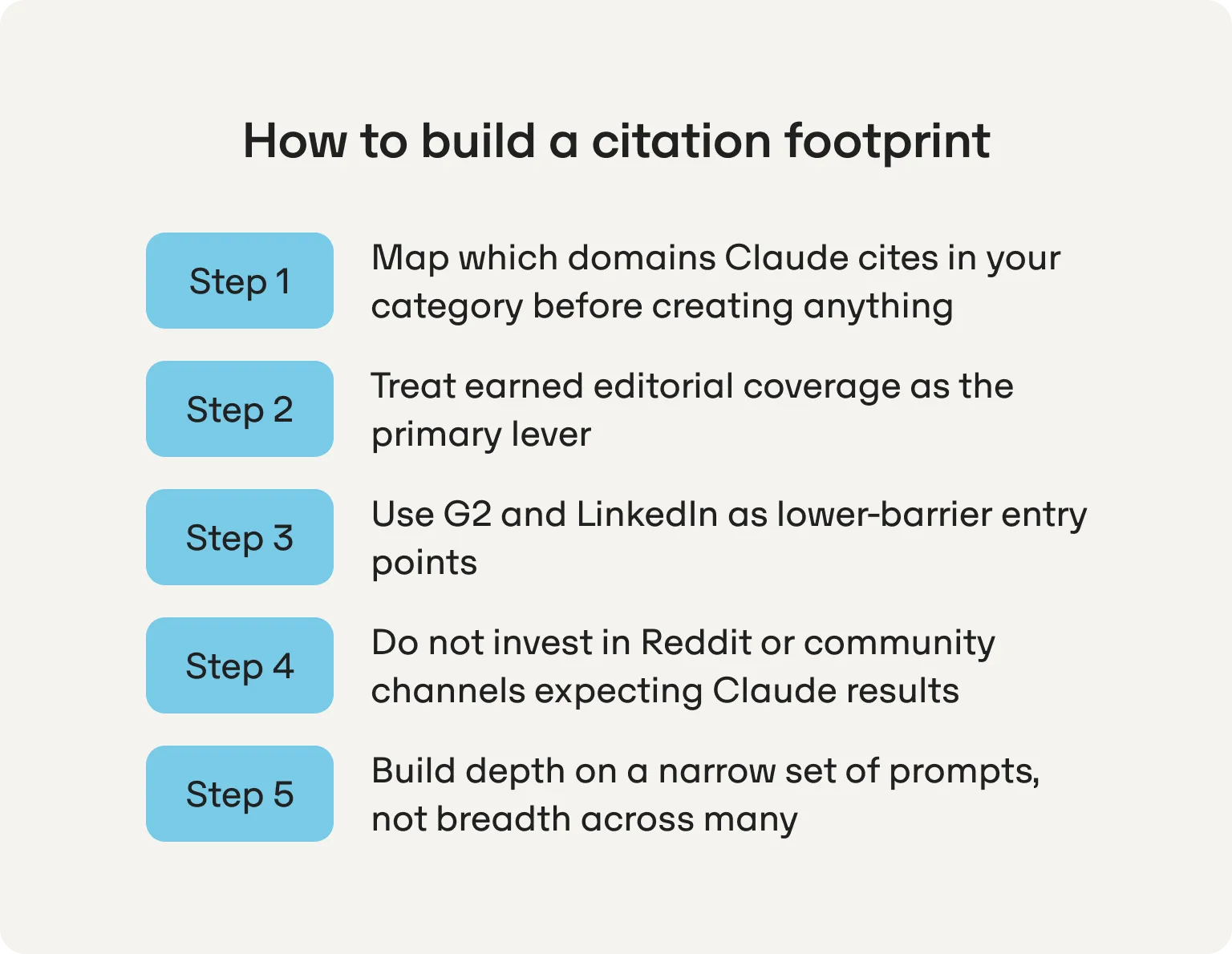
The starting point is not a content calendar. It is a citation map: which domains does Claude consistently pull from when answering the prompts your buyers run? Those domains are your editorial targets. This requires tracking data at the domain level. See AI citation tracking for how to identify and categorize the citation sources Claude uses in your category.
Guest contributions, product inclusions in roundup articles, and expert commentary in trade publications that Claude already cites will move brand citations faster than any volume of content published on your own domain. For a lean marketing team, this means reorienting at least some content effort toward pitching and placement rather than pure production. A single well-placed piece in a domain Claude actively cites is worth more for Claude brand citations than five blog posts on your own site.
Omnia's citation data shows Claude cites G2 at 0.30% of all citations and LinkedIn at 0.76%, which are both slightly higher than ChatGPT (0.12% and 0.44% respectively). For a new brand with no editorial footprint, a strong G2 profile and consistent LinkedIn presence are faster to establish than trade press coverage. They will not close the gap on their own, but they might contribute marginal Claude citation signals while the editorial program builds.
Claude cited Reddit zero times across approximately nearly 500k citations in Omnia's tracking window. ChatGPT cited Reddit more than 100k times in the same period. Forum presence, community-driven UGC, and industry discussion threads are meaningful ChatGPT levers.
For Claude, they produce no citation signal. A new brand should not allocate editorial effort to community channels with the expectation that it will improve brand mentions in Claude.
The full lever comparison by channel:
| Channel | Claude citation impact | ChatGPT citation impact | Priority for new brand |
|---|---|---|---|
| Trade press / independent editorial | High | High | Primary |
| G2 reviews and profile | Marginal | Low | Secondary |
| LinkedIn content | Marginal | Low | Secondary |
| Reddit / forums / UGC | None | High | Skip for Claude |
| Own-site content | Supporting | Supporting | Necessary, not sufficient |
Claude's citation behavior rewards editorial depth and specificity. Consistent, detailed coverage of a narrow topic on sources Claude cites produces more reliable citation signal than scattered mentions across many sources. Pick the five to ten prompts that matter most to your category and build editorial coverage around those intents specifically. For guidance on mapping prompt intent to buyer stage, see prompts vs. search queries.
If Claude mentions your brand but describes it inaccurately, incompletely, or with information that no longer reflects the product, the problem is not what your website says. It is what Claude's active citation sources say. Claude does not invent brand descriptions; however, it constructs them from the sources that its retrieval layer surfaces. Correcting misrepresentation means finding those sources and replacing the inaccurate framing at origin.
Run the prompts where misrepresentation appears through Omnia's tracking and look at the citation domains Claude pulls from for those specific prompts. The domains appearing most consistently are the sources shaping Claude's picture of your brand. Those are the correction targets and not your own site, and not Claude itself. Omnia surfaces this domain map directly from citation data: for each prompt where misrepresentation appears, it identifies which third-party domains Claude is pulling from most consistently, so the team is correcting at source rather than guessing. See source trust signals for AI for how to assess which cited sources carry the most weight in Claude's framing.
If Claude is drawing a three-year-old product description from a trade publication that covered your category launch, updating your own website will not change what Claude says. The fix is to generate newer, more accurate coverage in publications Claude already cites either by updating existing coverage where possible, or by creating new coverage that supersedes the outdated piece. A well-framed guest contribution or product feature in a cited domain will carry more corrective weight than any number of updates to your own pages.
Claude draws on how sources frame a brand, not only the facts they state. A sourced article that positions the brand as a niche tool for a narrow segment will shape Claude's framing even if every individual claim in it is technically correct. The editorial brief for any corrective coverage should specify the positioning, which use cases, which customer types, which differentiators, and not just the factual corrections. Accuracy and framing are separate requirements in the same brief.
Claude's citation pool is more stable than ChatGPT's. Omnia's tracking data shows 84.4% of domains Claude cited in week one were still cited in week two, compared to 61.5% for ChatGPT. Once accurate, well-framed coverage on a cited domain enters Claude's active citation pool, it tends to hold. That durability works against you when the entrenched source is inaccurate, but it works for you once you have placed a correction. A single strong piece of corrective coverage in the right publication can potentially have a more lasting impact on Claude than on ChatGPT, where the citation pool churns faster.
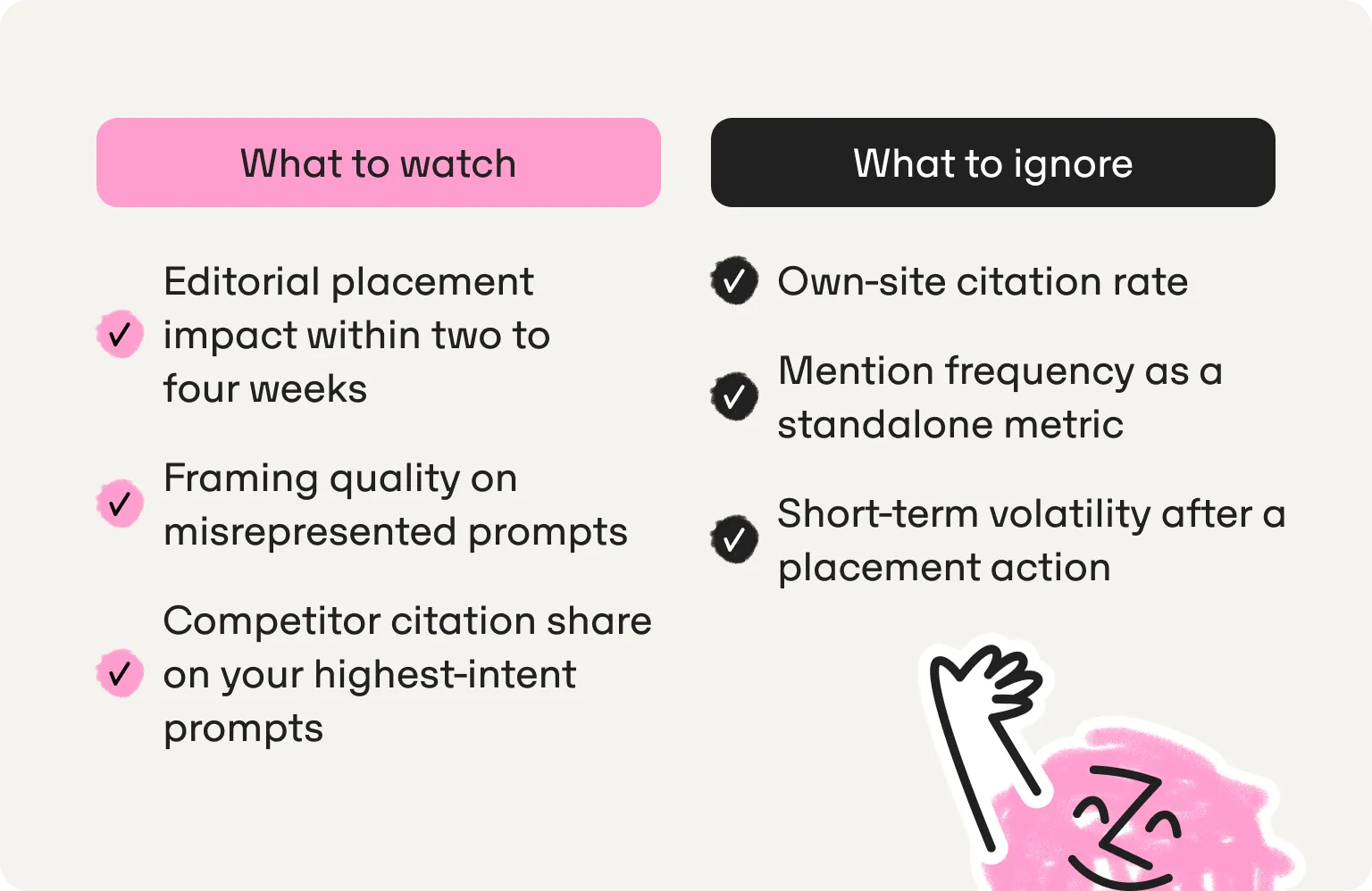
Given Claude's citation stability, framing corrections that land in the active citation pool should produce visible changes within two to four weeks. If framing does not improve after that window, the source targeted was not in Claude's active citation pool for those prompts. Revisit the domain map from Step 1, identify which sources Claude is actually pulling from for the misrepresented prompts, and adjust the editorial targeting accordingly.
These signals apply specifically to improvement tracking. Measurement mechanics are covered in the Claude rank tracking article.
Watch these:
Do not obsess over these:
Both problems (absence and misrepresentation) resolve to the same underlying strategic sequence. The difference is in the editorial brief, not the framework. Here is the consolidated action sequence for a lean team building or correcting brand citations in Claude.
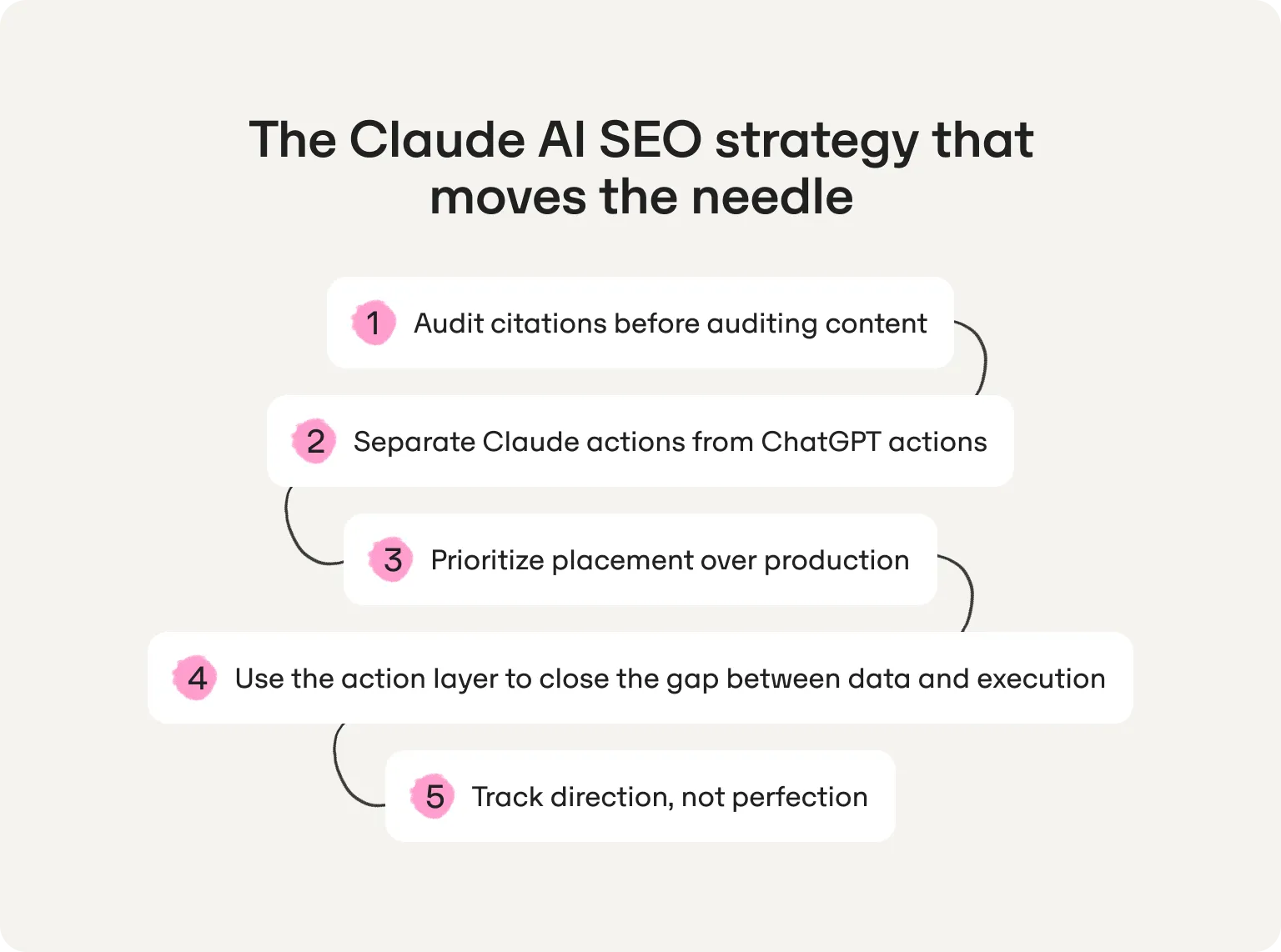
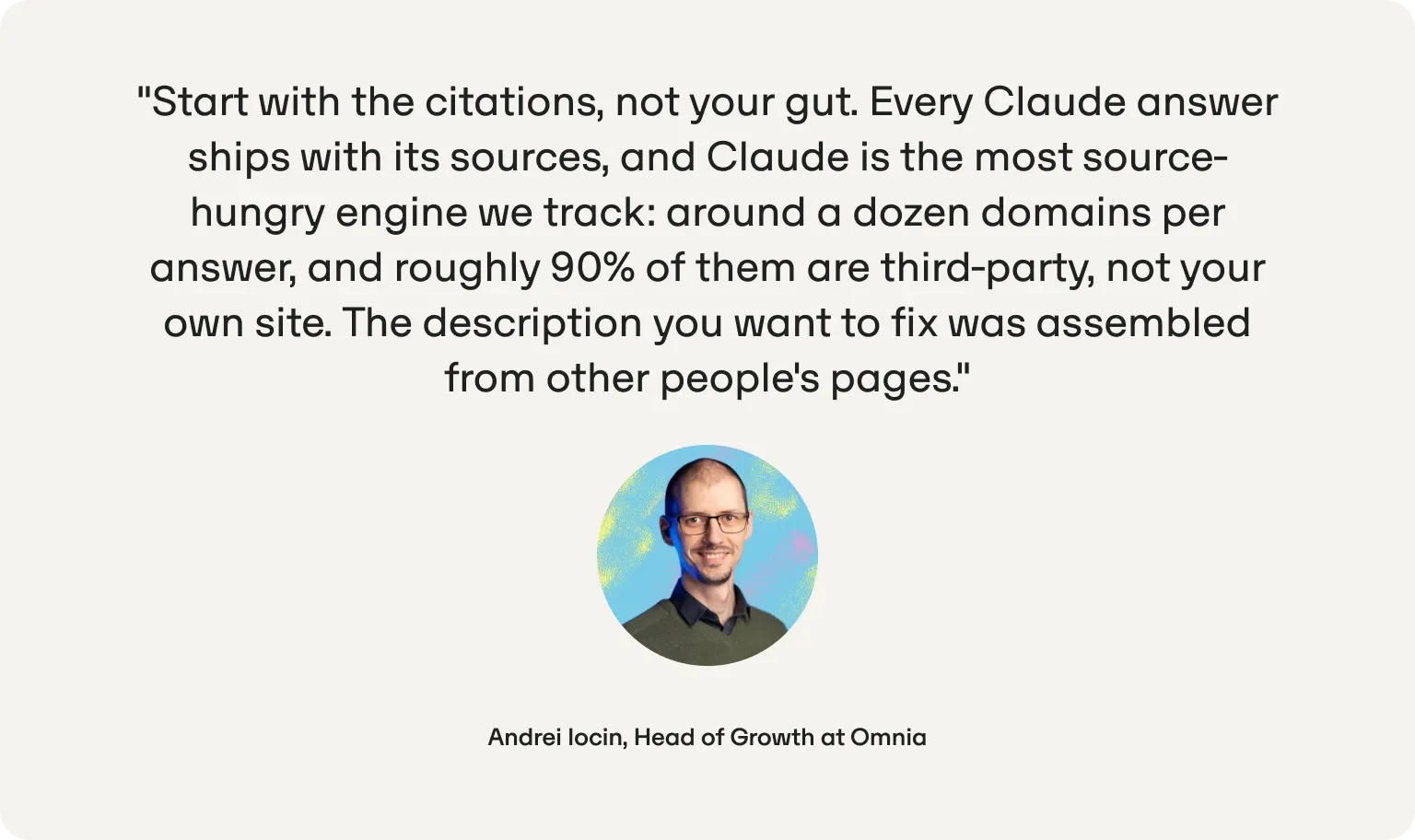
The first question is not "what content do we need to create?" It is "which domains does Claude cite for the prompts where our brand should appear, and what does our coverage on those domains look like?" That question requires citation-level tracking data, not a content gap analysis on your own site. Omnia's tracking surfaces this domain map directly from citation data showing which domains Claude cites consistently for your monitored prompts, which of those sources already mention competitors, and which carry no brand coverage at all. That gap list is the editorial brief, or as Andrei Iocin, Omnia’s Head of Growth, put it: "I go after the highest-reach roundups, comparisons and review profiles I can realistically influence." It tells the team exactly where to place content, rather than where to publish it.
Given the approximately 18% cross-engine citation overlap, actions that move ChatGPT will not reliably move Claude and vice versa. Reddit-based community presence, UGC campaigns, and forum visibility are ChatGPT levers. Editorial placement in trade press and independent web sources moves both, but Claude weights it more heavily. Build two distinct editorial target lists: one for Claude-cited domains, one for ChatGPT-cited domains and track their impact separately. For the ChatGPT-specific playbook, see how to improve brand visibility in ChatGPT.
For a one or two person marketing team, the resource allocation question is real. A guest contribution in a domain Claude cites in your category will do more for brand citations in Claude than five blog posts on your own domain. That does not mean stopping owned content production; however, it underlies ensuring that at least some content effort goes toward pitching and placement, not just publishing. Own-site content supports Claude's sourcing at the 6.7% margin. Editorial placement addresses the rest.
The point where most teams stall is the translation from tracking insight to editorial action. Knowing that Claude cites three publications in your category where your brand has no coverage is a starting point. Knowing which prompt intents those publications are cited for, which competitors appear in them, and what a brief for a corrective or introductory piece should contain is what actually moves the metric. Omnia's action layer generates editorial targeting lists and content briefs directly from citation data. For each gap identified: a cited domain with no brand coverage, a prompt where a competitor consistently outranks the brand, or a publication whose framing is outdated, Omnia produces a brief that specifies the target domain, the prompt intent to address, and the positioning the piece needs to carry. The team receives an action, not an observation.
Claude tracking is still early. Omnia has two weeks of Claude citation data as of this writing. Any team starting a Claude AI SEO strategy now is building a baseline rather than optimizing against a mature dataset. The right success metric at this stage is directional improvement in brand citation frequency and framing quality across the monitored prompt set, week over week. A brand that goes from appearing in 15% of relevant prompts with incomplete framing to appearing in 30% with accurate positioning has made measurable progress regardless of where the absolute number sits.
Your potential customers are already asking Claude which tools to use in your category. Find out what it tells them with a free 14-day trial or book a demo.
Omnia offers a 14-day free trial on the Growth plan.
No credit card required. See exactly where your brand shows up (or doesn't) across AI engines, then let the platform's recommendations guide your next move.

The fastest path is editorial placement on a domain Claude already cites in your category. Guest contributions, product roundup inclusions, and expert commentary in trade publications Claude actively pulls from will move brand citations faster than any amount of content published on your own site. G2 profile optimization and consistent LinkedIn content are lower-barrier entry points that produce marginal signal while the editorial program builds, but neither substitutes for earned coverage on Claude-cited domains.
Partially. Omnia's citation data shows 6.7% of Claude citations point to owned domains. Claude does pull from your site, but it draws the majority of its brand picture from third-party sources: 90.1% of its citation pool is editorial and independent web content. If your website is the only place your brand is described accurately, Claude is working with roughly 6.7% of what it needs. The corrective lever is third-party editorial coverage, not on-site content updates.
Traditional SEO optimizes for Google rankings on static URLs, with signals including backlinks, page authority, and technical structure. Claude brand representation is determined by which third-party sources Claude's retrieval layer surfaces for a given prompt, and what those sources say. There are no positions to rank for, no static URLs to optimize, and no Search Console data to pull. Link building and topical authority remain relevant inputs, but their impact on Claude is mediated through editorial placement on cited sources and not through direct ranking signals the way they work traditionally in Google.
The most effective setup combines citation-level tracking with an action layer that translates source data into editorial briefs. Tracking alone tells you which domains Claude cites in your category. The action layer tells you what to do about the gaps. Omnia tracks Claude citations using API access and real-browser simulation rather than scraping, which matters for Claude specifically, given that its responses vary more than traditional search results and spot-check scraping produces unreliable signals. The action layer then generates editorial targeting lists and content briefs directly from that data, closing the gap between insight and execution without requiring manual translation.
Editorial placements on Claude-cited domains should produce visible movement in brand citation frequency within two to four weeks, given Claude's citation stability. Framing corrections take a similar window to register once corrective coverage lands in Claude's active citation pool. The baseline-building phase, which includes identifying which domains Claude cites in your category, establishing your first editorial placements, and running a consistent prompt set, typically takes four to six weeks before directional trends are readable. Claude tracking data will firm up over time as Omnia's dataset grows beyond its current two-week window, which means teams starting now are building an increasingly reliable signal as the weeks accumulate.
Written By
 JoseGrowthatOmniaAndreiHead of GrowthatOmnia
 JoseGrowthatOmnia
 JoseGrowthatOmnia
 AndreiHead of GrowthatOmnia
 AndreiHead of GrowthatOmnia
No credit card required · Free for 14 days · See your AI visibility within 3 minutes