
Product
Project Suggestions. AKA Proactive Omnia Agent

 Daniel EspejoCEO & FounderatOmniaDaniel EspejoCEO & FounderatOmnia
TL;DR
The prompts users ask AI assistants are constantly evolving and impossible to track manually, making it hard to know where your brand should be showing up. Omnia's Topic Explorer automatically surfaces high-value prompts, scores them by volume and difficulty, and helps you prioritize your AEO strategy with data instead of guesswork.
Digital marketing is experiencing a major shift. For years, the goal was clear: get your website to show up at the top of Google search results. Today, it's a whole different game. Generative AI engines like ChatGPT, Gemini, and Perplexity don't show traditional links anymore, but direct answers to user prompts.
This means that your brand no longer competes only on Google's results page. It competes within AI-generated responses, where only a few brands are mentioned. The key question marketing teams must ask themselves is no longer ‘which keyword should I target?’, but rather: ‘what prompts do users formulate and how do I get my brand to appear in those responses?’
Understanding relevant prompts is vital. They are the new gateway for a potential customer to discover your product, compare options, or make purchasing decisions. But there is a problem: identifying those prompts is not easy.
Unlike traditional keywords, the prompts that trigger responses in AI are neither standardised nor static. Thousands of new variations emerge every day: long, complex, contextual questions influenced by trends, news or even local language.
For instance, a user could ask ChatGPT:
Decision: comparisons and shortlist (‘between X and Y for use Z...’).
Discovery: initial options (‘what do the experts recommend for...?’).
Problem/Troubleshooting: specific barriers (‘for very sensitive skin...’, ‘for travelling with children...’).
Adoption/Implementation: integration requirements, compliance, SLAs.
All these variations represent opportunities for visibility... or risks of invisibility if your brand does not appear in them.
The complexity lies in the fact that these prompts are constantly changing. There is no fixed list of ‘the 10 questions in the sector’. The dynamics are much more volatile and require a system capable of monitoring and prioritising on a daily basis.
This is where Omnia's proposal comes into play.
To understand how to gain visibility on AI engines, you first need to understand how they work. LLMs do not select brands at random: they follow specific patterns that define what appears in their responses. Among these patterns, the following stand out:
From prompt to response (mind map): User prompt → AI engine → Sources consulted (media, forums, videos, wikis) → Co-occurrence of entities → Synthesis → Response (with or without citations) → Brand mentions.
The challenge for marketing teams is double: not only must they understand what the key prompts are, but also what patterns make a brand visible in them. That's where tools like Omnia's Topic Explorer make a difference.
Omnia's Topic Explorer was created to solve precisely this challenge: discovering which prompts matter, how to prioritise them, and how to use them to gain visibility.
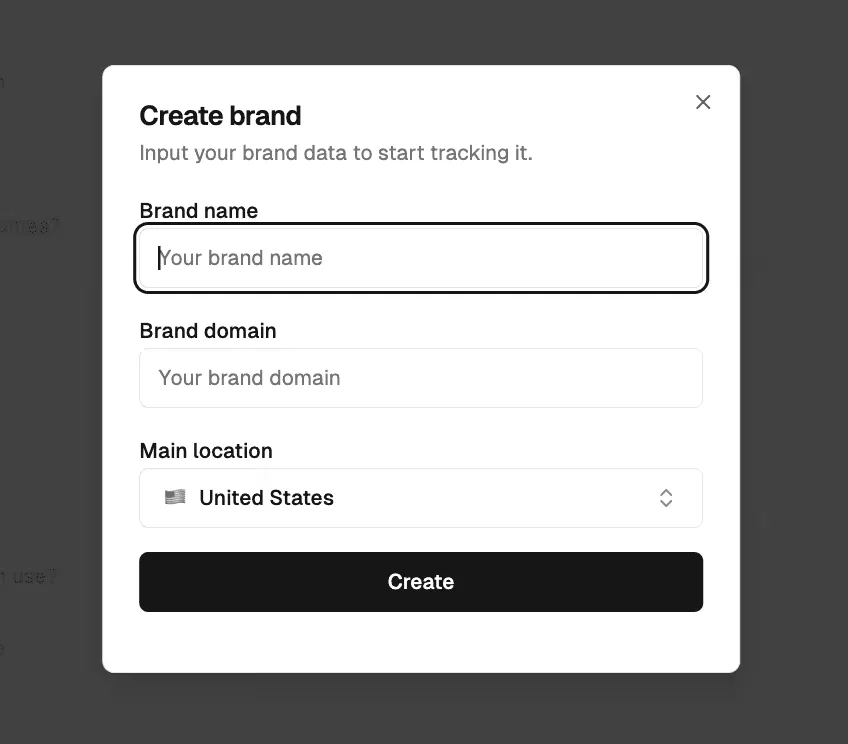
Step by step
Generate an automatic list of prompts for your brand.
Prioritise using a Volume × Difficulty matrix (quick wins vs big bets).
Follow 10–20 strategic prompts (by intent/funnel stage).
Analyse competitors and sources for each prompt.
Activate content, PR, partnerships and presence in aligned forums/KOLs.
Measure SoV in AI and 30/60/90-day trend per prompt.
Most tools on the market are still based on classic keyword research logic. Topic Explorer, on the other hand, focuses on the actual logic of LLMs. Furthermore:
Let's imagine a cosmetics brand that wants to position itself in the field of sustainability. The marketing team suspects that users are asking about ‘vegan cosmetics’ or ‘sustainable makeup,’ but they don't know exactly which questions are gaining the most traction.This is especially true because the questions users ask these engines are not as open-ended and generic as when you ask Google. When a user asks about a product, the prompts are more specific. Example: “I want a natural product to remove spots from my face, I have very sensitive skin”.
With Omnia's Topic Explorer, this brand could:
The result is clear: the brand moves from intuition (‘perhaps they are looking for us because of sustainable make-up’) to certainty (‘we know that users are asking this, with this volume, and that we now appear in those answers’).
Traditional SEO taught us to optimise keywords. The era of generative AI forces us to optimise prompts. The difference is huge: it is no longer about competing for positions on a Google page, but about entering the conversation of LLMs, at the moment when users ask their questions.
The challenge is enormous: thousands of prompts, constantly changing, with new and unclear visibility patterns. But it is also a great opportunity: brands that know how to detect them, prioritise them and position themselves in them will have a competitive advantage that is difficult to match.
Omnia's Topic Explorer turns that complexity into a simple, accessible, and actionable process. It allows you to:
Visibility in AI is not a matter of luck. It's a matter of data, decisions and focus.
Omnia offers a 14-day free trial on the Growth plan.
No credit card required. See exactly where your brand shows up (or doesn't) across AI engines, then let the platform's recommendations guide your next move.
Written By
 Daniel EspejoCEO & FounderatOmniaDaniel EspejoCEO & FounderatOmnia
 Miguel FernándezCTO & FounderatOmnia
 Miguel FernándezCTO & FounderatOmnia
 AndreiHead of GrowthatOmnia
 ButiBuilderatOmnia
No credit card required · Free for 14 days · See your AI visibility within 3 minutes